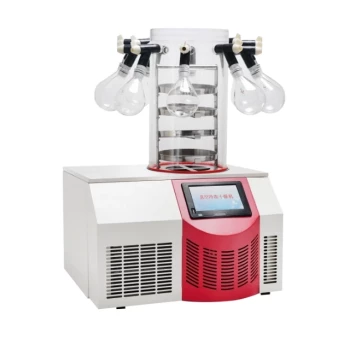
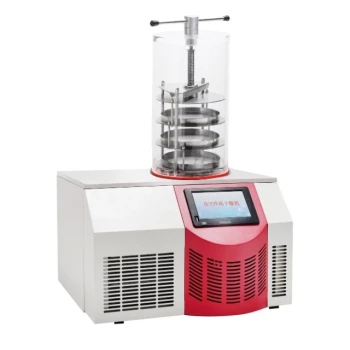
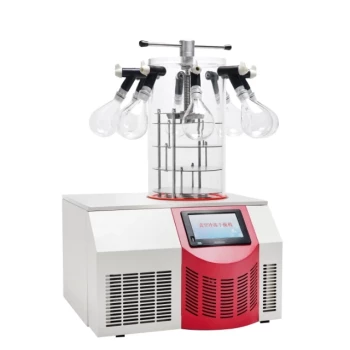
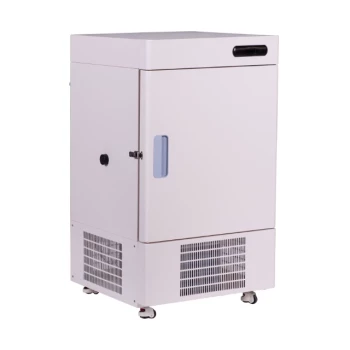
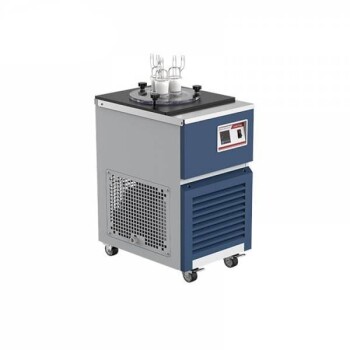
The use of freeze drying or cyclic freezing-thawing equipment fundamentally reshapes the internal architecture of Au-(PNiPAAm/PVA) gel nanocomposites, creating a distinct honeycomb-like microstructure. By controlling the growth and subsequent removal or melting of ice crystals, these processes force the polymer chains to organize into a highly porous network containing both micro- and macro-pores.
Core Insight: The structural transformation driven by these thermal cycles is not merely aesthetic; it is functional engineering. The resulting porous architecture serves as the critical enabler for the material's rapid response to photothermal stimuli and provides the essential physical scaffolding to stabilize the embedded gold nanoparticles.
The Mechanism of Structural Transformation
The Exclusion Effect
The process relies on the physical phenomenon known as the exclusion effect. As the hydrogel system freezes, pure ice crystals begin to grow, physically pushing the polymer chains (such as PVA) and water into the interstitial spaces between the crystals.
Physical Cross-Linking
This concentration of polymer chains facilitates physical cross-linking, particularly within the PVA components. This allows the gel to form a stable framework without requiring chemical cross-linking agents, which preserves the purity of the material.
Formation of the Honeycomb Lattice
Once the ice crystals are removed (via sublimation in a freeze dryer) or melted, they leave behind voids. This results in a uniform, honeycomb-like structure characterized by a network of interconnected micro- and macro-pores.
Functional Impacts on Performance
Enhanced Swelling Kinetics
The porosity created by this equipment significantly increases the gel's swelling capacity. The open structure allows water to move more freely in and out of the matrix, resulting in much faster contraction and swelling responses.
Optimized Photothermal Response
Because the material can move fluid more rapidly, its reaction to photothermal stimuli is accelerated. This makes the nanocomposite highly effective as a photo-actuator, converting light energy into mechanical motion with greater speed.
Stabilization of Nanoparticles
The honeycomb framework provides robust physical support for the gold (Au) nanoparticles. The structural integrity formed by the freeze-thaw process ensures these particles remain spatially arranged within the active layer, which is vital for consistent performance.
Critical Considerations and Trade-offs
Process Dependence
The uniformity of the honeycomb structure is entirely dependent on the precision of the freezing and melting cycles. Inconsistent temperature control during the equipment operation can lead to irregular pore sizes, which may compromise the mechanical strength of the composite.
Mechanical Integrity vs. Porosity
While high porosity enhances speed and swelling, it relies on the physical cross-linking of the polymer chains for strength. Unlike chemical cross-linking, the mechanical robustness of this physical network is directly tied to the success of the ice crystal exclusion process.
Making the Right Choice for Your Goal
If you are engineering Au-(PNiPAAm/PVA) nanocomposites, consider how the structural changes induced by this equipment align with your performance targets:
- If your primary focus is Rapid Actuation: Prioritize freeze-drying protocols that maximize macro-porosity, as this directly accelerates the thermal response time to light stimuli.
- If your primary focus is Material Purity: Utilize cyclic freezing to achieve gelation through physical cross-linking, allowing you to avoid the introduction of chemical cross-linking agents.
- If your primary focus is Particle Stability: Ensure your thermal cycles produce a uniform honeycomb lattice to provide the most consistent spatial support for the gold nanoparticles.
The freeze-thaw process is the key to converting a simple polymer mixture into a responsive, high-performance actuator.
Summary Table:
| Feature | Impact of Freeze-Thaw/Freeze-Drying Process | Functional Benefit |
|---|---|---|
| Microstructure | Creates a uniform, interconnected honeycomb-like lattice | Provides physical scaffolding for Au nanoparticles |
| Porosity | Generates micro- and macro-pores via ice crystal exclusion | Increases swelling kinetics and water transport speed |
| Cross-Linking | Promotes physical cross-linking of polymer chains (PVA) | Ensures material purity by avoiding chemical agents |
| Thermal Response | Enables rapid contraction/swelling under light stimuli | Accelerates photothermal actuation for device efficiency |
Elevate your material science research with KINTEK’s precision laboratory solutions. From advanced freeze dryers and cooling solutions (ULT freezers, cold traps) to specialized crushing and milling systems, we provide the tools necessary to engineer high-performance nanocomposites. Whether you are developing responsive hydrogels or optimizing particle stability, KINTEK’s comprehensive range of laboratory equipment and consumables—including PTFE products, ceramics, and crucibles—ensures consistent, repeatable results for your most demanding applications. Contact us today to find the perfect equipment for your lab!
References
- Marija Janković, Marija Šljivić‐Ivanović. An influence of the final volume of samples during the electrolysis of water, on counts for tritium activity determination. DOI: 10.21175/rad.abstr.book.2023.34.14
This article is also based on technical information from Kintek Solution Knowledge Base .
Related Products
- High Performance Laboratory Freeze Dryer
- High Performance Laboratory Freeze Dryer for Research and Development
- Benchtop Laboratory Freeze Dryer for Lab Use
- Benchtop Laboratory Vacuum Freeze Dryer
- 108L Vertical Ultra Low Temperature ULT Freezer
People Also Ask
- What role does a laboratory freeze dryer play in the synthesis of graphene-based electrocatalysts? Preserve 3D Structures
- What are the technical advantages of using a laboratory freeze dryer for porous carbon precursors? Preserve 3D Networks
- What types of liquid samples can be processed using a laboratory freeze dryer? Preserve Your Sensitive Materials
- How do laboratory freeze dryers support scientific research? Preserve Sample Integrity for Reproducible Results
- Why is a laboratory freeze dryer preferred over traditional heating? Preserve Biochar Structure & Maximize Porosity