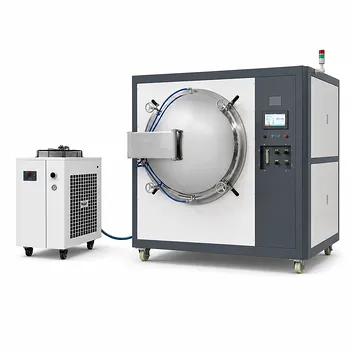
The vacuum environment acts as a fundamental barrier against chemical degradation. For SiCf/Ti-43Al-9V composites, this environment is not merely a feature of the furnace; it is a prerequisite for material viability. It works by drastically reducing oxygen partial pressure, thereby preventing the catastrophic oxidation of the highly reactive titanium matrix and silicon carbide fibers at processing temperatures between 800 °C and 1200 °C.
Core Takeaway The vacuum environment serves a dual purpose: chemically, it prevents the formation of brittle oxide inclusions by shielding reactive elements; physically, it facilitates the removal of adsorbed gases to minimize porosity. This ensures the structural integrity of the fiber-matrix interface, which is the defining factor in the composite's mechanical performance.
Preventing Chemical Degradation
The primary function of the vacuum in processing Ti-43Al-9V is managing the extreme reactivity of titanium and its alloying elements.
Mitigating Titanium Reactivity
Titanium-based alloys are chemically aggressive at elevated temperatures. Without a vacuum, the matrix would rapidly react with atmospheric oxygen. This reaction creates brittle oxide layers that severely compromise the material's ductility and strength.
Protecting Silicon Carbide Fibers
The reinforcement material, SiC fibers, is also susceptible to degradation at the processing range of 800 °C to 1200 °C. The vacuum environment reduces the oxygen partial pressure below the threshold required for oxidation. This preservation of the fiber surface is essential for maintaining the load-bearing capability of the composite.
Eliminating Brittle Inclusions
Oxidation does not just damage the surface; it introduces impurities into the bulk material. Oxide inclusions act as stress concentrators and crack initiation sites within the composite. By maintaining a high-purity environment, the vacuum ensures these defects are not introduced during the sintering phase.
Enhancing Microstructural Integrity
Beyond preventing oxidation, the vacuum plays a critical physical role in densification and bonding.
Removal of Adsorbed Gases
Powder particles and fiber surfaces naturally adsorb moisture and gases from the atmosphere prior to processing. As the furnace heats up, the vacuum actively extracts these volatiles from the gaps between particles. If these gases were not removed, they would be trapped inside the material as it densifies.
Minimizing Porosity
Trapped gases are a primary cause of internal pore defects in sintered composites. By degassing the material effectively, the vacuum allows for higher final density. A dense, void-free microstructure is critical for achieving the theoretical mechanical properties of the alloy.
Optimizing Interface Bonding
The mechanical performance of a composite relies heavily on the bond between the matrix (Ti) and the reinforcement (SiC). The vacuum purifies this interface by removing contaminants that would otherwise block atomic diffusion. A clean, oxide-free interface promotes strong adhesion and efficient load transfer between the matrix and the fibers.
Understanding the Trade-offs
While the vacuum is essential, it introduces specific processing constraints that must be managed.
Lack of Convective Cooling
In a vacuum, there is no air to transfer heat via convection. Cooling relies almost entirely on radiation, which is inherently slower. While this requires longer cycle times, it can be beneficial; slow cooling allows for controlled phase transformations (such as alpha to alpha-2/gamma) and the release of residual thermal stresses.
Vaporization of Alloying Elements
High vacuum at high temperatures can lead to the volatilization of certain elements. Aluminum, a key component of Ti-43Al-9V, has a relatively high vapor pressure. Operators must balance the vacuum level to prevent the evaporation of aluminum from the surface, which could alter the alloy's surface chemistry.
Making the Right Choice for Your Goal
The vacuum parameters should be tuned based on the specific mechanical property you aim to prioritize.
- If your primary focus is Fracture Toughness: Prioritize high vacuum levels to eliminate oxide inclusions, as these are the primary drivers of brittle failure.
- If your primary focus is Ultimate Tensile Strength: Ensure the vacuum cycle includes a sufficient "degassing" hold time at lower temperatures to maximize density and interfacial bonding.
- If your primary focus is Phase Stability: Utilize the natural slow-cooling characteristic of the vacuum furnace to promote the formation of the alpha-2/gamma lamellar structure.
The vacuum is not just a passive lack of air; it is an active tool for ensuring the chemical purity and structural density required for high-performance composites.
Summary Table:
| Protection Mechanism | Primary Benefit | Processing Impact |
|---|---|---|
| Oxigen Partial Pressure Reduction | Prevents matrix oxidation & fiber degradation | Eliminates brittle oxide inclusions |
| Volatile Outgassing | Removes moisture and adsorbed gases | Minimizes internal porosity & voids |
| Surface Purification | Enhances atomic diffusion at interface | Optimizes load transfer & bonding strength |
| Radiation-Based Cooling | Controlled thermal phase transformation | Reduces residual thermal stresses |
Elevate Your Material Research with KINTEK
Precision in vacuum processing is the difference between a failed sample and a high-performance composite. KINTEK specializes in advanced laboratory equipment, providing high-performance hot pressing furnaces, vacuum furnaces, and CVD/PECVD systems designed to meet the rigorous demands of aerospace and metallurgy research.
Whether you are processing reactive titanium alloys or advanced SiC composites, our expertise in high-temperature furnaces, hydraulic presses, and crushing/milling systems ensures your lab achieves superior microstructural integrity and chemical purity.
Ready to optimize your high-temperature processing? Contact our technical experts today to find the perfect equipment solution for your laboratory.
Related Products
- Vacuum Hot Press Furnace Heated Vacuum Press Machine Tube Furnace
- 600T Vacuum Induction Hot Press Furnace for Heat Treat and Sintering
- Vacuum Hot Press Furnace Machine Heated Vacuum Press
- Vacuum Hot Press Furnace Machine for Lamination and Heating
- Vacuum Heat Treat and Pressure Sintering Furnace for High Temperature Applications
People Also Ask
- What advantages does a vacuum hot press furnace provide for LSLBO ceramic electrolytes? Achieve 94% Relative Density
- What role does a Vacuum Hot Press (VHP) furnace play in the densification of austenitic stainless steel 316 composites?
- What are the advantages of using a vacuum hot pressing furnace? Superior Densification for 2024Al/Gr/SiC Composites
- What are the advantages of a vacuum hot press furnace for LTPO solid electrolytes? Boost Density and Conductivity
- What core processing conditions does a vacuum hot press furnace provide? Achieve High-Density Cu-SiC/Diamond Composites