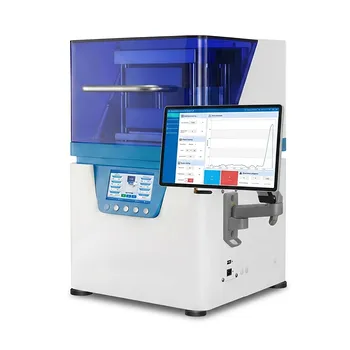
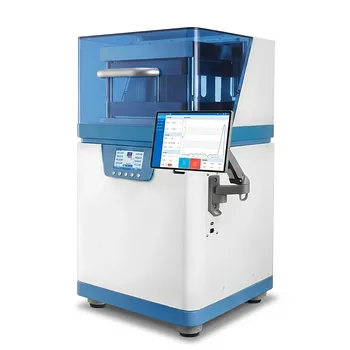
A laboratory hydraulic press is a critical tool for minimizing interfacial resistance in photocatalyst electrodes.
By applying high-precision vertical pressure, the press compacts photocatalyst powders, conductive additives, and binders into dense pellets or onto conductive substrates. This mechanical process ensures intimate electrical contact between the catalyst particles and the current collector, which is essential for capturing accurate photocurrent responses and Mott-Schottky data during electrochemical characterization.
The hydraulic press converts loose catalyst powder into a structurally stable, electrically conductive electrode by eliminating internal voids and maximizing contact area. This mechanical transformation ensures that electrochemical data reflects the intrinsic properties of the material rather than artifacts caused by poor connectivity.
The Role of Compaction in Charge Transport
Reducing Interparticle Resistance
Photocatalyst powders are naturally loose and full of internal voids that act as barriers to electron flow. The hydraulic press applies stable, high pressure to compress these powders into dense films or pellets, significantly reducing the contact resistance between individual particles.
Enhancing Substrate Adhesion
For a photocatalyst to function in a three-electrode cell, it must be securely bonded to a current collector like FTO glass, nickel foam, or copper foil. The press forces the catalyst layer into the micro-structures of the substrate, ensuring excellent Ohmic contact and mechanical stability during testing.
Eliminating Internal Voids
The presence of air pockets within an electrode can lead to non-uniform current distribution and localized heating. Using a press to achieve high-pressure physical molding eliminates these voids, creating a uniform density that allows for reproducible experimental results.
Achieving Data Accuracy in Characterization
Optimizing Photocurrent Responses
In photoelectrochemical testing, the workstation must capture minute changes in current when the catalyst is exposed to light. By minimizing interfacial resistance, the hydraulic press ensures that the charge carriers generated by light are efficiently collected and measured.
Securing Reliable Mott-Schottky Data
Accurate determination of band potential data requires a stable electrical interface. A pressed electrode provides the structural integrity needed to maintain consistent capacitance measurements across varying potentials in a three-electrode electrolytic cell.
Improving Stability During High-Current Testing
Electrochemical reactions like the Oxygen Evolution Reaction (OER) or Hydrogen Evolution Reaction (HER) can be physically taxing on the electrode. The mechanical adhesion provided by the press prevents the catalyst layer from delaminating or "sloughing off" during high-current-density operations.
Understanding the Trade-offs and Pitfalls
Pressure Sensitivity of Substrates
While high pressure improves conductivity, it can also damage sensitive substrates. For example, excessive pressure on FTO or ITO glass can cause the conductive coating to crack or the glass itself to shatter, while over-compressing metal foams may collapse their porous structure and reduce active surface area.
Impact on Porosity and Mass Transport
There is a delicate balance between electrical contact and mass transport. Over-compacting a catalyst layer can close off the pores necessary for electrolyte infiltration and gas escape, potentially hindering the reaction kinetics despite improved conductivity.
Deformation of Catalyst Morphology
Extreme pressures can occasionally alter the morphology or crystal structure of the photocatalyst. Researchers must calibrate the pressure—often around 6 MPa—to ensure they are improving contact without inducing structural defects that could skew the material's intrinsic performance.
Strategic Implementation for Electrode Preparation
How to Apply This to Your Project
To achieve the best results in your electrochemical testing, tailor your pressing strategy to your specific materials and goals.
- If your primary focus is maximize electrical conductivity: Use higher pressures (within the limits of your substrate) and include conductive additives like carbon black to ensure a low-resistance pathway.
- If your primary focus is testing gas evolution (OER/HER): Use a moderate pressure on a nickel foam or steel mesh to ensure the catalyst stays attached while maintaining enough porosity for gas bubbles to escape.
- If your primary focus is material characterization (XRD/Resistivity): Use a stainless steel mold to create high-density pellets that provide a uniform surface for X-ray diffraction or bulk resistivity measurements.
By precisely controlling mechanical pressure, you transform a simple powder into a high-performance electrode capable of yielding definitive scientific data.
Summary Table:
| Key Function | Benefit to Electrode Preparation | Impact on Electrochemical Data |
|---|---|---|
| Powder Compaction | Reduces interparticle contact resistance | More accurate photocurrent and Mott-Schottky responses |
| Substrate Adhesion | Ensures Ohmic contact with FTO, foil, or foam | Prevents delamination during high-current testing (OER/HER) |
| Void Elimination | Creates uniform density and removes air pockets | Ensures reproducible results and uniform current distribution |
| Mechanical Molding | Produces structurally stable pellets or films | Enhances structural integrity for long-term characterization |
Elevate Your Electrode Precision with KINTEK
Maximize the accuracy of your electrochemical research with KINTEK’s high-precision laboratory hydraulic presses and specialized pellet dies. Whether you are preparing thin-film electrodes on FTO glass or compacting powders for bulk resistivity, our equipment ensures the mechanical stability and electrical conductivity required for definitive scientific data.
Beyond compaction, KINTEK provides a comprehensive ecosystem for advanced material science, including:
- Electrochemical Tools: High-performance electrolytic cells, electrodes, and battery research consumables.
- Thermal Processing: Muffle, tube, and vacuum furnaces for catalyst calcination.
- Reaction Systems: High-temperature high-pressure reactors and autoclaves.
- Sample Prep: Crushing, milling systems, and precision sieving equipment.
Ready to optimize your lab's workflow? Contact our technical experts today to find the perfect solution for your research needs.
References
- Madasamy Thangamuthu, Junwang Tang. Tungsten Oxide-Based Z-Scheme for Visible Light-Driven Hydrogen Production from Water Splitting. DOI: 10.1021/acscatal.3c01312
This article is also based on technical information from Kintek Solution Knowledge Base .
Related Products
- Laboratory Hydraulic Press Split Electric Lab Pellet Press
- Laboratory Hydraulic Press Lab Pellet Press Machine for Glove Box
- Laboratory Hydraulic Press Lab Pellet Press for Button Battery
- Fully Automatic Heated Hydraulic Lab Press for Materials Sintering and Sample Preparation
- Automatic Laboratory Hydraulic Pellet Press Machine for Lab Use
People Also Ask
- What are the roles of a laboratory hydraulic press and stainless steel molds in the preparation of graphite samples?
- What is the role of a laboratory hydraulic press in electrode prep? Maximize Energy Density & Sealing Precision
- How does a laboratory hydraulic press ensure the quality of alumina-forming alloy green bodies? Optimize CSP Research
- How is a laboratory hydraulic press used to evaluate the mechanical performance of nano-modified concrete? Expert Guide
- Why is a laboratory hydraulic press used for ASSB assembly? Achieving 392 MPa for Optimal Solid-State Battery Density