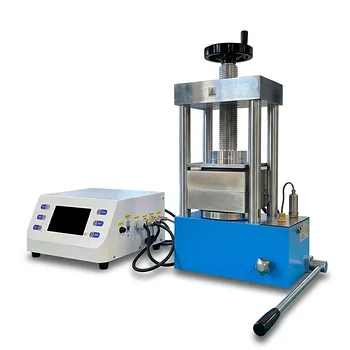
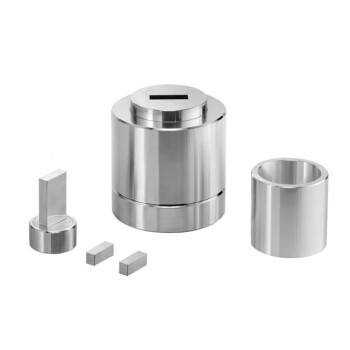
The laboratory hydraulic press is the critical tool for transforming loose titanium dioxide (TiO2) powder into a high-performance, standardized electrode. It compresses a mixture of TiO2 powder, conductive agents, and binders into a dense, flat pellet or a coated substrate. This process ensures tight contact between particles, which is essential for reducing contact resistance and providing the mechanical strength necessary for accurate electrochemical evaluation.
The primary function of a laboratory hydraulic press in TiO2 electrode preparation is to apply precise, uniform pressure to create a "green body" with maximized particle-to-particle contact. This structural consolidation minimizes electrical resistance and establishes the physical foundation required for consistent, reproducible experimental results.
Enhancing Electrical and Mechanical Integrity
Reducing Interfacial and Contact Resistance
The hydraulic press applies significant axial pressure to ensure tight mechanical contact between TiO2 particles and conductive additives like carbon black. This compaction reduces the gaps between individual grains, which significantly lowers the interfacial resistance within the electrode. By creating a continuous conductive network, the press ensures that the observed electrochemical behavior reflects the intrinsic properties of the TiO2 rather than artifacts of poor connectivity.
Securing the Active Material to Current Collectors
In many electrode designs, the TiO2 mixture is pressed onto a conductive substrate such as steel mesh, copper foil, or metal foam. The hydraulic press provides the force necessary to physically bond the active material to these irregular surfaces. This robust adhesion prevents the material from delaminating during high-current cycles and ensures a uniform current distribution across the entire electrode surface.
Standardizing Sample Geometry
Consistency is vital in laboratory research to ensure that data from different samples can be compared accurately. The use of precision molds in a hydraulic press allows researchers to produce pellets with exact diameters and thicknesses. This standardization is critical for calculating property metrics that depend on volume or surface area, such as bulk resistivity or specific capacity.
Preparing the Material for Thermal Transformation
Forming the "Green Body"
Before TiO2 electrodes can be sintered or calcined, they must exist as a green body—a compacted powder sample with enough mechanical strength to be handled. The hydraulic press packs the nanopowders so tightly that they achieve a specific green density. This initial strength is what allows the electrode to maintain its shape as it enters high-temperature furnaces.
Optimizing the Sintering Reaction Path
By compressing the powders, the press shortens the physical distance between particles, which facilitates faster solid-state reactions. This proximity is essential during the subsequent calcination process, as it improves the efficiency of doping reactions and grain fusion. A well-pressed pellet ensures that diffusion occurs uniformly throughout the material, leading to a more homogenous final electrode.
Understanding the Trade-offs
The Risk of Over-Compaction
While high pressure improves conductivity, excessive force can lead to material deformation or the crushing of sensitive conductive structures. Over-compacting can also reduce the porosity of the electrode to a point where electrolyte penetration is hindered. This trade-off requires researchers to find the "sweet spot" where mechanical integrity is high but ionic transport remains efficient.
Pressure Gradients and Non-Uniformity
If the pressure is not applied perfectly vertically or if the mold is poorly lubricated, pressure gradients can develop within the pellet. This results in a density mismatch, where the edges of the TiO2 electrode may be denser than the core. Such inconsistencies can lead to uneven reaction rates and potential cracking during the high-temperature sintering phase.
How to Apply This to Your Project
Making the Right Choice for Your Goal
- If your primary focus is evaluating intrinsic material conductivity: Use high pressure (e.g., 1500 kg/cm²) with a precision mold to create high-density pellets that minimize grain boundary resistance.
- If your primary focus is long-term electrochemical cycling: Prioritize the compression of the TiO2 layer onto a metal mesh current collector to ensure mechanical stability and prevent delamination.
- If your primary focus is subsequent thermal processing or sintering: Focus on achieving a specific green density that allows for optimal grain growth without causing structural cracks during heating.
By mastering the application of pressure, you ensure that your TiO2 reference electrodes provide the structural stability and electrical clarity required for advanced materials research.
Summary Table:
| Key Process | Benefit to TiO2 Electrode | Impact on Research |
|---|---|---|
| Powder Compaction | Reduces interfacial & contact resistance | Improves intrinsic conductivity measurements |
| Substrate Bonding | Secures active material to current collectors | Prevents delamination during cycling |
| Geometric Mold | Standardizes pellet diameter & thickness | Ensures reproducible & comparable data |
| Green Body Prep | Provides mechanical strength for handling | Allows for safe transfer to sintering furnaces |
| Density Control | Optimizes particle proximity | Facilitates uniform solid-state reactions |
Elevate Your Materials Research with KINTEK Precision
Achieving the perfect TiO2 reference electrode requires more than just high-quality powder—it demands the precision and reliability of KINTEK’s laboratory hydraulic presses. Whether you are preparing dense pellets with our pellet presses or exploring advanced bonding with hot and isostatic systems, our equipment is designed to provide the uniform pressure necessary for superior electrochemical performance.
Beyond compaction, KINTEK supports your entire workflow with a comprehensive range of high-temperature furnaces (muffle, tube, and vacuum) for sintering, crushing and milling systems for powder refinement, and essential ceramic crucibles.
Why choose KINTEK?
- Unmatched Precision: Ensure consistent green density and geometric standardization.
- Versatile Solutions: From battery research tools to high-pressure reactors, we equip your entire lab.
- Expert Support: Our team helps you find the "sweet spot" for pressure to avoid over-compaction.
Ready to enhance your lab's efficiency and data accuracy? Contact our specialists today to find the perfect equipment for your project!
References
- Tomasz Kędzierski, Ewa Mijowska. Towards Promotion of Graphene/Titania‐Based Electrode via Ultrafast and Self‐Expansion Reduction for Li‐ion Battery. DOI: 10.1002/celc.202201068
This article is also based on technical information from Kintek Solution Knowledge Base .
Related Products
- Manual Lab Heat Press
- Hydraulic Diaphragm Lab Filter Press for Laboratory Filtration
- Laboratory Hydraulic Press Split Electric Lab Pellet Press
- Laboratory Manual Hydraulic Pellet Press for Lab Use
- Automatic Laboratory Hydraulic Pellet Press Machine for Lab Use
People Also Ask
- Why use laboratory manual hydraulic presses for semiconductor pellets? Optimize Annealing & Crystalline Quality
- How is a laboratory manual hydraulic press used in solid-state battery testing? Optimize Electrode Performance
- What is manual hydraulic press? A Guide to Simple, High-Force Compression
- What role does a laboratory manual hydraulic press play in the preparation of salt pellets? Ensure Research Precision
- What is a manual press? Amplify Your Force for Precision Assembly and Stamping