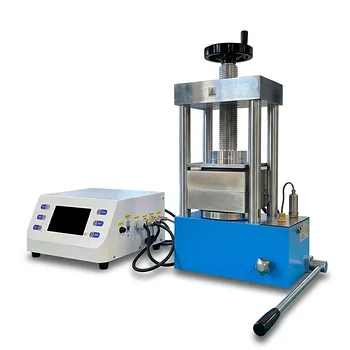
In the context of mechanical stability research, a laboratory precision hydraulic press serves two critical functions: consolidating nanocrystalline powders into dense bulk specimens and applying standardized loads for strength verification. It ensures that the test subjects possess uniform internal density, free from micropores that would otherwise compromise the integrity of fatigue or tensile testing data.
By eliminating the interference of porosity, the press ensures that researchers are testing the intrinsic physics of the nanomaterial—such as grain boundary migration—rather than structural defects introduced during specimen preparation.
Achieving Specimen Integrity
To accurately study the mechanical stability of nanocrystalline materials, the test specimen itself must be flawless. The hydraulic press is the primary tool used to create these high-fidelity samples.
Consolidating Nanocrystalline Powders
Nanocrystalline materials often begin as powders. To test them, they must be formed into bulk specimens suitable for fatigue or tensile testing. The hydraulic press applies immense, controlled force to bond these loose particles into a solid mass.
Minimizing Micropores
A major challenge in powder metallurgy is porosity. If a specimen contains micropores, they act as stress concentrators that lead to premature failure. The press utilizes precise pressure-holding capabilities to maximize internal density, effectively minimizing these voids.
Ensuring Uniformity
Inconsistent density leads to inconsistent data. The equipment’s ability to deliver stable, uniform pressure ensures that the material properties are consistent throughout the entire volume of the specimen.
Unlocking Accurate Mechanical Data
Once a high-quality specimen is created, the focus shifts to understanding how the nanomaterial behaves under stress.
Revealing Deformation Mechanisms
With porosity removed as a variable, researchers can isolate the material's behavior. This clarity allows for the accurate observation of complex phenomena, such as grain boundary migration and specific deformation mechanisms under cyclic loading.
verifying Nanomaterial Modifications
Beyond pure powders, the press is used to verify the performance of nanocomposites, such as concrete modified with nano-alumina, nano-iron oxide, or nano-silica. It applies standardized loads to quantitatively verify if these specific dosages have successfully improved the ultimate compressive strength and internal structural reinforcement.
Understanding the Trade-offs
While the laboratory precision hydraulic press is essential, relying on it requires awareness of potential pitfalls that can skew research results.
The Risk of Density Gradients
Even with a precision press, improper die design or friction can lead to density gradients within the sample. If the pressure is not distributed perfectly evenly, the "bulk" specimen may be denser at the edges than the center, creating invalid test data.
Calibration Sensitivity
The accuracy of the "ultimate compressive strength" reading is entirely dependent on the machine's calibration. A press that drifts even slightly can produce data that falsely validates—or invalidates—the success of a nanomaterial modification.
Making the Right Choice for Your Goal
The specific application of the hydraulic press depends on whether you are synthesizing new materials or testing existing composites.
- If your primary focus is fundamental physics: Use the press to prioritize high-pressure consolidation to eliminate micropores, ensuring you can observe grain boundary migration without interference.
- If your primary focus is composite engineering: Use the press to apply standardized, consistent loads to verify the compressive strength gains from additives like nano-silica or nano-alumina.
The laboratory precision hydraulic press transforms raw nanomaterials into verifiable scientific data by ensuring the physical integrity of the sample before testing begins.
Summary Table:
| Application Phase | Primary Function | Research Benefit |
|---|---|---|
| Specimen Preparation | Consolidating powders into bulk specimens | Eliminates micropores and structural defects |
| Material Integrity | Maximizing internal density | Minimizes stress concentrators for accurate fatigue data |
| Performance Testing | Applying standardized compressive loads | Quantifies strength gains from nano-modifications |
| Mechanism Analysis | Isolating material deformation | Enables observation of grain boundary migration |
Elevate Your Materials Research with KINTEK Precision
Achieving accurate data in nanocrystalline research starts with specimen integrity. KINTEK specializes in advanced laboratory solutions, offering high-performance hydraulic presses (pellet, hot, isostatic) engineered to eliminate density gradients and provide the precise pressure control required for cutting-edge mechanical stability studies.
From crushing and milling systems to high-temperature furnaces and vacuum reactors, our comprehensive portfolio supports every stage of your nanomaterial synthesis and testing. Don't let equipment calibration drift or specimen porosity compromise your findings. Partner with KINTEK for reliable, industry-leading laboratory equipment and consumables.
Contact KINTEK today to find the perfect press for your lab!
References
- Saryu Fensin, Jian Luo. Deformation and Transitions at Interfaces and Grain Boundaries. DOI: 10.1007/s11837-019-03390-2
This article is also based on technical information from Kintek Solution Knowledge Base .
Related Products
- Laboratory Hydraulic Press Lab Pellet Press Machine for Glove Box
- Laboratory Hydraulic Press Split Electric Lab Pellet Press
- Automatic Laboratory Hydraulic Pellet Press Machine for Lab Use
- Automatic Laboratory Hydraulic Press for XRF & KBR Pellet Press
- Laboratory Hydraulic Pellet Press for XRF KBR FTIR Lab Applications
People Also Ask
- What is the function of a laboratory hydraulic press in W-Cu composites? Control Porosity and Material Ratio
- What is the role of a laboratory hydraulic press in the initial stages of Li6PS5Cl preparation? Key to Green Pellets
- What role does a laboratory hydraulic press play in triboelectric testing? Achieve Precision Alloy Sample Prep
- How can a laboratory hydraulic press be applied to chitosan for wastewater treatment? Optimize Pores & Strength
- How do a precision laboratory hydraulic press and specialized molds contribute to the fabrication of spherical ceramic samples? Achieving High-Density Material Precision