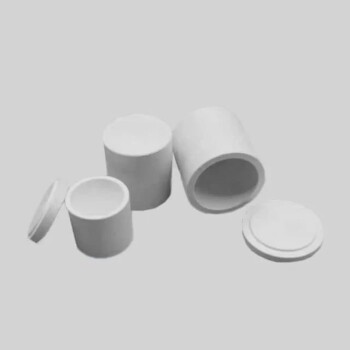
Knowledge lab crucible How is an alumina crucible with a ceramic filter used for the extraction of CeRh2As2 single crystals? Optimize Yields
Author avatar

Tech Team · Kintek Solution

Updated 1 month ago

How is an alumina crucible with a ceramic filter used for the extraction of CeRh2As2 single crystals? Optimize Yields


The extraction of $CeRh_2As_2$ single crystals relies on a centrifugal filtration method. This process utilizes an alumina crucible integrated with a ceramic filter to physically isolate solid crystals from a molten Bismuth flux. By reheating the growth environment and applying high-speed rotation, the liquid metal is purged through the filter, leaving clean crystals for recovery.

The alumina crucible and ceramic filter assembly function as a high-temperature micro-strainer within a centrifuge, enabling the clean recovery of $CeRh_2As_2$ crystals. This method leverages phase differences at specific temperatures to ensure high-purity yields without the need for aggressive chemical etching.

The Mechanics of Centrifugal Flux Separation

The Role of the Alumina-Ceramic Assembly

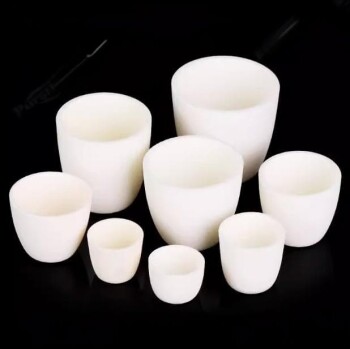
The alumina crucible serves as the primary vessel, providing the thermal and chemical stability required for high-temperature synthesis. Within this setup, the ceramic filter acts as a permeable barrier that allows liquid to pass while retaining solid matter.

Thermal Parameters for Decanting

Before separation can occur, the growth mixture must be reheated to a specific threshold. For $CeRh_2As_2$ grown in Bismuth, the temperature is raised to approximately 450°C to ensure the flux is entirely molten.

Centrifugal Force as the Driving Mechanism

Once the flux is liquid, the entire assembly is placed into a centrifuge. The resulting high centrifugal force pulls the dense liquid Bismuth through the pores of the ceramic filter and into a dedicated collection chamber.

Understanding the Trade-offs

Mechanical and Thermal Stress

Rapid heating or high-speed rotation at elevated temperatures can cause thermal shock to the alumina components. Brittle ceramic filters may also crack under extreme G-forces if not properly seated within the crucible.

Filter Pore Size Optimization

Selecting the correct pore size is a critical balancing act. If pores are too large, smaller $CeRh_2As_2$ crystals will be lost to the collection chamber; if too small, the viscous flux may not drain completely.

Crystal Fragility

While $CeRh_2As_2$ crystals are solid during this process, they are subject to mechanical stress during the spin cycle. If the crystals are particularly thin or delicate, the force of the flux moving past them can cause breakage or surface damage.

How to Apply This to Your Growth Process

To achieve the best results when extracting $CeRh_2As_2$ single crystals, consider your specific experimental priorities:

  • If your primary focus is crystal purity: Maintain the centrifuge temperature strictly above 450°C to prevent any Bismuth from solidifying on the crystal facets during the spin.
  • If your primary focus is maximum yield: Use a ceramic filter with a pore size significantly smaller than your target crystal dimensions to ensure even the smallest nucleation points are retained.
  • If your primary focus is crystal integrity: Gradually ramp the centrifuge speed to the required RPM to minimize the impact of sudden mechanical stress on the crystal lattice.

Utilizing a centrifugal filtration system provides a highly efficient, non-chemical route to harvesting high-quality $CeRh_2As_2$ single crystals.

Summary Table:

Component/Step Function/Role Key Consideration
Alumina Crucible Primary reaction vessel Must offer high thermal & chemical stability
Ceramic Filter Micro-strainer/barrier Pore size must be smaller than target crystals
Decanting Temp ~450°C (for Bismuth flux) Must remain above the flux melting point
Centrifugation Mechanical separation force Higher RPM improves drainage but risks crystal breakage

Elevate Your Crystal Synthesis with KINTEK

Achieving high-purity CeRh2As2 single crystals requires precision equipment that withstands extreme thermal and mechanical stress. KINTEK specializes in advanced laboratory solutions, providing the high-performance tools necessary for complex material synthesis.

Our extensive portfolio features premium high-temperature furnaces (muffle, tube, vacuum, and atmosphere), along with the essential ceramics, crucibles, and PTFE products required for flux growth and centrifugal separation. We also offer robust crushing and milling systems, hydraulic presses, and high-temperature high-pressure reactors to support every stage of your research.

Don't let equipment limitations compromise your crystal integrity. Partner with KINTEK for reliable, high-quality lab consumables and systems tailored to your specific experimental needs.

Ready to optimize your lab's efficiency? Contact our experts today to find the perfect solution for your research!

References

  1. Grzegorz Chajewski, D. Kaczorowski. Horizontal flux growth as an efficient preparation method of CeRh<sub>2</sub>As<sub>2</sub> single crystals. DOI: 10.1039/d3mh01351k

This article is also based on technical information from Kintek Solution Knowledge Base .

Related Products

People Also Ask

Related Products

Alumina Al2O3 Ceramic Crucible Semicircle Boat with Lid for Engineering Advanced Fine Ceramics

Alumina Al2O3 Ceramic Crucible Semicircle Boat with Lid for Engineering Advanced Fine Ceramics

Crucibles are containers widely used for melting and processing various materials, and semicircular boat-shaped crucibles are suitable for special smelting and processing requirements. Their types and uses vary by material and shape.

Arc-Shaped Alumina Ceramic Crucible High Temperature Resistant for Engineering Advanced Fine Ceramics

Arc-Shaped Alumina Ceramic Crucible High Temperature Resistant for Engineering Advanced Fine Ceramics

In the journey of scientific exploration and industrial production, every detail is crucial. Our arc-shaped alumina ceramic crucibles, with their excellent high temperature resistance and stable chemical properties, have become a powerful assistant in laboratories and industrial fields. They are made of high-purity alumina materials and manufactured through precision processes to ensure excellent performance in extreme environments.

Engineering Advanced Fine Ceramics Alumina Al2O3 Crucible With Lid Cylindrical Laboratory Crucible

Engineering Advanced Fine Ceramics Alumina Al2O3 Crucible With Lid Cylindrical Laboratory Crucible

Cylindrical Crucibles Cylindrical crucibles are one of the most common crucible shapes, suitable for melting and processing a wide variety of materials, and are easy to handle and clean.

Engineering Advanced Fine Alumina Al2O3 Ceramic Crucible for Laboratory Muffle Furnace

Engineering Advanced Fine Alumina Al2O3 Ceramic Crucible for Laboratory Muffle Furnace

Alumina ceramic crucibles are used in some materials and metal melting tools, and flat-bottomed crucibles are suitable for melting and processing larger batches of materials with better stability and uniformity.

Engineering Advanced Fine Ceramics Alumina Crucibles (Al2O3) for Thermal Analysis TGA DTA

Engineering Advanced Fine Ceramics Alumina Crucibles (Al2O3) for Thermal Analysis TGA DTA

TGA/DTA thermal analysis vessels are made of aluminum oxide (corundum or aluminum oxide). It can withstand high temperature and is suitable for analyzing materials that require high temperature testing.

Ceramic Evaporation Boat Set Alumina Crucible for Laboratory Use

Ceramic Evaporation Boat Set Alumina Crucible for Laboratory Use

It can be used for vapor deposition of various metals and alloys. Most metals can be evaporated completely without loss. Evaporation baskets are reusable.1

High Quality Alumina Ceramic Screw for Engineering Advanced Fine Ceramics with High Temperature Resistance and Insulation

High Quality Alumina Ceramic Screw for Engineering Advanced Fine Ceramics with High Temperature Resistance and Insulation

Alumina ceramic screws are fastening components made of 99.5% alumina, ideal for extreme applications requiring excellent thermal resistance, electrical insulation and chemical resistance.

Advanced Engineering Fine Ceramics Alumina Ceramic Saggar for Fine Corundum

Advanced Engineering Fine Ceramics Alumina Ceramic Saggar for Fine Corundum

Alumina sagger products have the characteristics of high temperature resistance, good thermal shock stability, small expansion coefficient, anti-stripping, and good anti-powdering performance.

Custom-Made Alumina Zirconia Special-Shaped Ceramic Plates for Engineering Advanced Fine Ceramics Processing

Custom-Made Alumina Zirconia Special-Shaped Ceramic Plates for Engineering Advanced Fine Ceramics Processing

Alumina ceramics have good electrical conductivity, mechanical strength and high temperature resistance, while zirconia ceramics are known for their high strength and high toughness and are widely used.

High Temperature Wear-Resistant Alumina Al2O3 Plate for Engineering Advanced Fine Ceramics

High Temperature Wear-Resistant Alumina Al2O3 Plate for Engineering Advanced Fine Ceramics

High temperature wear-resistant insulating alumina plate has excellent insulation performance and high temperature resistance.

Aluminized Ceramic Evaporation Boat for Thin Film Deposition

Aluminized Ceramic Evaporation Boat for Thin Film Deposition

Vessel for depositing thin films; has an aluminum-coated ceramic body for improved thermal efficiency and chemical resistance. making it suitable for various applications.

High Temperature Alumina (Al2O3) Furnace Tube for Engineering Advanced Fine Ceramics

High Temperature Alumina (Al2O3) Furnace Tube for Engineering Advanced Fine Ceramics

High temperature alumina furnace tube combines the advantages of high hardness of alumina, good chemical inertness and steel, and has excellent wear resistance, thermal shock resistance and mechanical shock resistance.

Engineering Advanced Fine Ceramics Aluminium Oxide Al2O3 Ceramic Washer for Wear-Resistant Applications

Engineering Advanced Fine Ceramics Aluminium Oxide Al2O3 Ceramic Washer for Wear-Resistant Applications

Alumina wear-resistant ceramic washer are used for heat dissipation, which can replace aluminum heat sinks, with high temperature resistance and high thermal conductivity.

Boron Nitride (BN) Crucible for Phosphorous Powder Sintered

Boron Nitride (BN) Crucible for Phosphorous Powder Sintered

Phosphorus powder sintered boron nitride (BN) crucible has a smooth surface, dense, pollution-free and long service life.

High Temperature Aluminum Oxide (Al2O3) Protective Tube for Engineering Advanced Fine Ceramics

High Temperature Aluminum Oxide (Al2O3) Protective Tube for Engineering Advanced Fine Ceramics

Alumina oxide protective tube, also known as high temperature resistant corundum tube or thermocouple protection tube, is a ceramic tube mainly made of alumina (aluminum oxide).

High Purity Alumina Granulated Powder for Engineering Advanced Fine Ceramics

High Purity Alumina Granulated Powder for Engineering Advanced Fine Ceramics

Ordinary alumina granulated powder is alumina particles prepared by traditional processes, with a wide range of applications and good market adaptability. This material is known for its high purity, excellent thermal stability and chemical stability, and is suitable for a variety of high-temperature and conventional applications.

Engineering Advanced Fine Ceramics Aluminum Oxide Al2O3 Heat Sink for Insulation

Engineering Advanced Fine Ceramics Aluminum Oxide Al2O3 Heat Sink for Insulation

The hole structure of the ceramic heat sink increases the heat dissipation area in contact with the air, which greatly enhances the heat dissipation effect, and the heat dissipation effect is better than that of super copper and aluminum.

High Purity Pure Graphite Crucible for Evaporation

High Purity Pure Graphite Crucible for Evaporation

Vessels for high temperature applications, where materials are kept at extremely high temperatures to evaporate, allowing thin films to be deposited on substrates.

High Purity Pure Graphite Crucible for Electron Beam Evaporation

High Purity Pure Graphite Crucible for Electron Beam Evaporation

A technology mainly used in the field of power electronics. It is a graphite film made of carbon source material by material deposition using electron beam technology.

Evaporation Crucible for Organic Matter

Evaporation Crucible for Organic Matter

An evaporation crucible for organic matter, referred to as an evaporation crucible, is a container for evaporating organic solvents in a laboratory environment.


Leave Your Message