Knowledge How long does it take to grow a CVD diamond? A 2-4 Week Journey to a Flawless Gem
Author avatar

Tech Team · Kintek Solution

Updated 5 days ago

How long does it take to grow a CVD diamond? A 2-4 Week Journey to a Flawless Gem


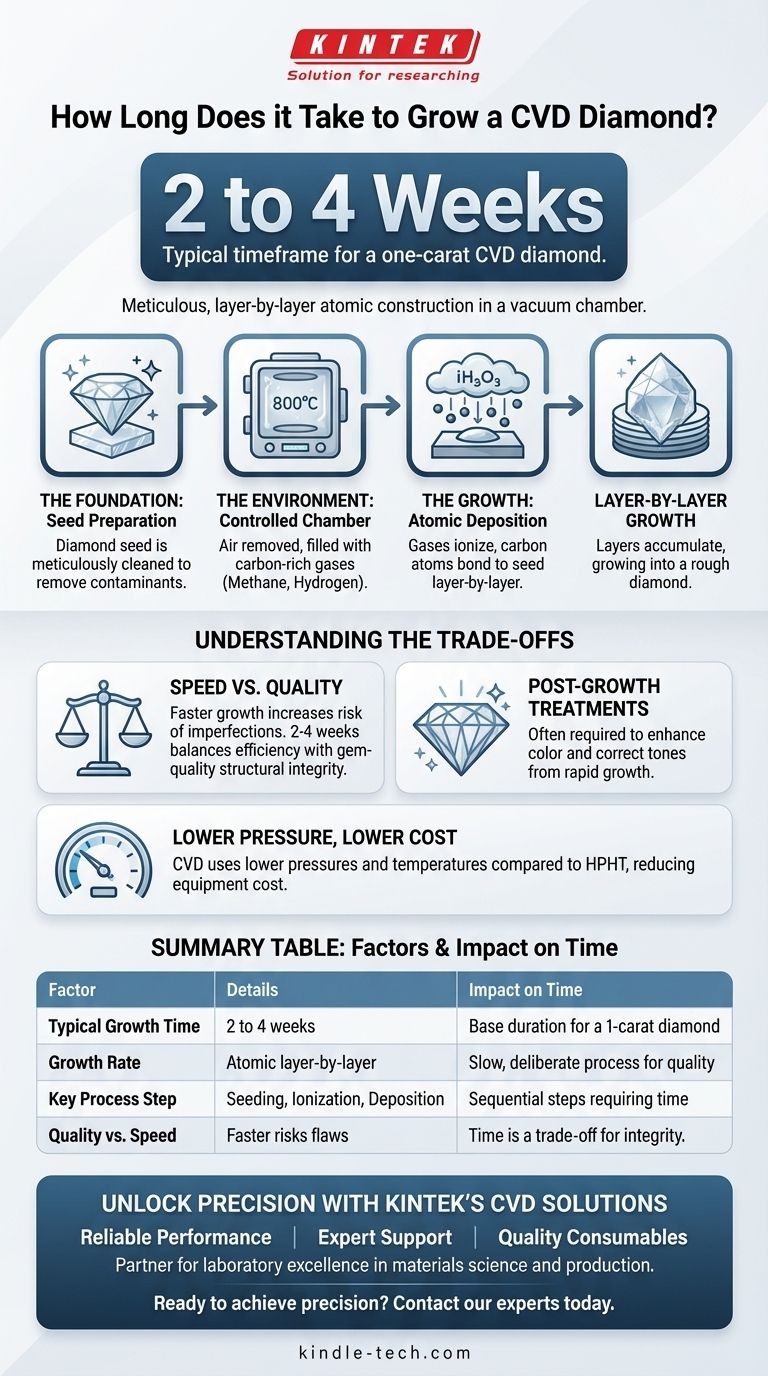
In short, growing a one-carat CVD diamond typically takes between two and four weeks. This timeframe allows for the meticulous, layer-by-layer atomic construction required to form a high-quality gemstone inside a specialized vacuum chamber.

The time required to grow a CVD diamond is a direct reflection of its controlled, atom-by-atom growth process. While significantly faster than nature, this two-to-four-week period represents the deliberate pace needed to ensure structural integrity and quality in the final crystal.
How long does it take to grow a CVD diamond? A 2-4 Week Journey to a Flawless Gem

The CVD Growth Process: An Atomic Blueprint

To understand why it takes several weeks to grow a CVD diamond, you must first understand the method. It is less like baking and more like 3D printing on an atomic scale.

The Foundation: Preparing the Seed

The process begins with a diamond seed. This is a very thin, flat slice of a previously created diamond.

This seed is meticulously cleaned to remove any microscopic dust or contaminants, as any impurity can disrupt the crystal growth and create flaws.

The Environment: A Controlled Chamber

The seed is placed inside a vacuum chamber. All air is removed to create a pure, controlled environment.

The chamber is then heated to an extremely high temperature, typically around 800°C, and filled with a precise mixture of carbon-rich gases, such as methane and hydrogen.

The Growth: Atomic Deposition

The intense heat and pressure cause the gases to ionize, breaking the molecules apart and releasing pure carbon atoms.

These carbon atoms "rain down" onto the cooler diamond seed, bonding to its crystal lattice one by one. Over weeks, these layers accumulate, growing the original seed into a larger, rough diamond.

Understanding the Trade-offs

The CVD method's timeframe and process come with distinct advantages and necessary compromises. It is not simply a matter of speed.

Post-Growth Treatments are Common

While the process is highly controlled, many CVD diamonds require post-growth treatment to enhance their color. This extra step is often needed to correct tones that can develop during the rapid growth cycle.

A Balance of Speed and Quality

Producers could theoretically speed up the process, but this would dramatically increase the risk of inclusions and imperfections in the crystal structure.

The two-to-four-week timeframe is the industry's equilibrium point, balancing an efficient production schedule with the need to create a high-quality, gem-worthy diamond.

Lower Pressure, Lower Cost

Compared to the alternative HPHT (High Pressure/High Temperature) method, CVD uses significantly lower pressures and temperatures. This reduces the upfront equipment cost and complexity, making the technology more accessible.

What This Means for You

Understanding the growth time provides critical context for evaluating CVD diamonds, whether for purchase or for technological appreciation.

  • If your primary focus is on the technology: Recognize that CVD is a feat of additive manufacturing, where time is a function of atomic precision, not just a simple chemical reaction.
  • If your primary focus is on purchasing a diamond: The growth time confirms its lab-created origin and influences its final cost, but be aware that post-growth treatments are a normal part of achieving top-tier color.

Ultimately, knowing the process behind the product empowers you to assess its quality and value with true clarity.

Summary Table:

Factor Details Impact on Time
Typical Growth Time 2 to 4 weeks Base duration for a 1-carat diamond
Growth Rate Atomic layer-by-layer deposition Slow, deliberate process for quality
Key Process Step Seeding, gas ionization, carbon deposition Sequential steps that require time
Quality vs. Speed Faster growth risks inclusions and flaws Time is a trade-off for structural integrity

Unlock Precision with KINTEK's CVD Solutions

Understanding the precise nature of CVD diamond growth is key to achieving superior results in your research or production. At KINTEK, we specialize in providing the high-quality lab equipment and consumables that power this advanced technology.

Why choose KINTEK for your CVD needs?

  • Reliable Performance: Our equipment ensures the stable, controlled environments necessary for consistent, high-quality diamond growth.
  • Expert Support: Leverage our deep expertise in laboratory processes to optimize your CVD operations.
  • Quality Consumables: From diamond seeds to specialized gases, we supply the pure materials required for flawless crystal formation.

Whether you are advancing materials science or developing next-generation applications, KINTEK is your trusted partner in laboratory excellence.

Ready to achieve precision in your lab? Contact our experts today to discuss how our solutions can meet your specific CVD requirements.

Visual Guide
How long does it take to grow a CVD diamond? A 2-4 Week Journey to a Flawless Gem Visual Guide

Related Products

People Also Ask

Related Products

Customer Made Versatile CVD Tube Furnace Chemical Vapor Deposition Chamber System Equipment

Customer Made Versatile CVD Tube Furnace Chemical Vapor Deposition Chamber System Equipment

Get your exclusive CVD furnace with KT-CTF16 Customer Made Versatile Furnace. Customizable sliding, rotating, and tilting functions for precise reactions. Order now!

Split Chamber CVD Tube Furnace with Vacuum Station Chemical Vapor Deposition System Equipment Machine

Split Chamber CVD Tube Furnace with Vacuum Station Chemical Vapor Deposition System Equipment Machine

Efficient split chamber CVD furnace with vacuum station for intuitive sample checking and quick cooling. Up to 1200℃ max temperature with accurate MFC mass flowmeter control.

1200℃ Split Tube Furnace with Quartz Tube Laboratory Tubular Furnace

1200℃ Split Tube Furnace with Quartz Tube Laboratory Tubular Furnace

KT-TF12 split tube furnace: high-purity insulation, embedded heating wire coils, and max. 1200C. Widely used for new materials and chemical vapour deposition.

Rotary Tube Furnace Split Multi Heating Zone Rotating Tube Furnace

Rotary Tube Furnace Split Multi Heating Zone Rotating Tube Furnace

Multi zone rotary furnace for high-precision temperature control with 2-8 independent heating zones. Ideal for lithium ion battery electrode materials and high-temperature reactions. Can work under vacuum and controlled atmosphere.

1700℃ Laboratory Quartz Tube Furnace with Alumina Tube Tubular Furnace

1700℃ Laboratory Quartz Tube Furnace with Alumina Tube Tubular Furnace

Looking for a high-temperature tube furnace? Check out our 1700℃ Tube Furnace with Alumina Tube. Perfect for research and industrial applications up to 1700C.

1400℃ Laboratory Quartz Tube Furnace with Alumina Tube Tubular Furnace

1400℃ Laboratory Quartz Tube Furnace with Alumina Tube Tubular Furnace

Looking for a tube furnace for high-temperature applications? Our 1400℃ Tube Furnace with Alumina Tube is perfect for research and industrial use.

Vertical Laboratory Quartz Tube Furnace Tubular Furnace

Vertical Laboratory Quartz Tube Furnace Tubular Furnace

Elevate your experiments with our Vertical Tube Furnace. Versatile design allows for operation under various environments and heat treatment applications. Order now for precise results!

Laboratory Muffle Oven Furnace Bottom Lifting Muffle Furnace

Laboratory Muffle Oven Furnace Bottom Lifting Muffle Furnace

Efficiently produce batches with excellent temperature uniformity using our Bottom Lifting Furnace. Features two electric lifting stages and advanced temperature control up to 1600℃.

High Temperature Muffle Oven Furnace for Laboratory Debinding and Pre Sintering

High Temperature Muffle Oven Furnace for Laboratory Debinding and Pre Sintering

KT-MD High temperature debinding and pre-sintering furnace for ceramic materials with various molding processes. Ideal for electronic components such as MLCC and NFC.

Vacuum Sealed Continuous Working Rotary Tube Furnace Rotating Tube Furnace

Vacuum Sealed Continuous Working Rotary Tube Furnace Rotating Tube Furnace

Experience efficient material processing with our vacuum-sealed rotary tube furnace. Perfect for experiments or industrial production, equipped with optional features for controlled feeding and optimized results. Order now.

Laboratory Quartz Tube Furnace Tubular RTP Heating Furnace

Laboratory Quartz Tube Furnace Tubular RTP Heating Furnace

Get lightning-fast heating with our RTP Rapid Heating Tube Furnace. Designed for precise, high-speed heating and cooling with convenient sliding rail and TFT touch screen controller. Order now for ideal thermal processing!

High Pressure Laboratory Vacuum Tube Furnace Quartz Tubular Furnace

High Pressure Laboratory Vacuum Tube Furnace Quartz Tubular Furnace

KT-PTF High Pressure Tube Furnace: Compact split tube furnace with strong positive pressure resistance. Working temp up to 1100°C and pressure up to 15Mpa. Also works under controller atmosphere or high vacuum.

1700℃ Muffle Oven Furnace for Laboratory

1700℃ Muffle Oven Furnace for Laboratory

Get superior heat control with our 1700℃ Muffle Furnace. Equipped with intelligent temperature microprocessor, TFT touch screen controller & advanced insulation materials for precise heating up to 1700C. Order now!

1800℃ Muffle Oven Furnace for Laboratory

1800℃ Muffle Oven Furnace for Laboratory

KT-18 muffle furnace with Japan Al2O3 polycrystalline fibe and Silicon Molybdenum heating element, up to 1900℃, PID temperature control and 7" smart touch screen. Compact design, low heat loss, and high energy efficiency. Safety interlock system and versatile functions.

Laboratory Vacuum Tilt Rotary Tube Furnace Rotating Tube Furnace

Laboratory Vacuum Tilt Rotary Tube Furnace Rotating Tube Furnace

Discover the versatility of Laboratory Rotary Furnace: Ideal for calcination, drying, sintering, and high-temperature reactions. Adjustable rotating and tilting functions for optimal heating. Suitable for vacuum and controlled atmosphere environments. Learn more now!

1400℃ Muffle Oven Furnace for Laboratory

1400℃ Muffle Oven Furnace for Laboratory

Get precise high-temperature control up to 1500℃ with KT-14M Muffle furnace. Equipped with a smart touch screen controller and advanced insulation materials.

Vacuum Heat Treat and Sintering Furnace with 9MPa Air Pressure

Vacuum Heat Treat and Sintering Furnace with 9MPa Air Pressure

The air pressure sintering furnace is a high-tech equipment commonly used for the sintering of advanced ceramic materials. It combines vacuum sintering and pressure sintering techniques to achieve high-density and high-strength ceramics.

Vacuum Heat Treat Sintering Brazing Furnace

Vacuum Heat Treat Sintering Brazing Furnace

A vacuum brazing furnace is a type of industrial furnace used for brazing, a metalworking process that joins two pieces of metal using a filler metal that melts at a lower temperature than the base metals. Vacuum brazing furnaces are typically used for high-quality applications where a strong, clean joint is required.

Vertical High Temperature Graphite Vacuum Graphitization Furnace

Vertical High Temperature Graphite Vacuum Graphitization Furnace

Vertical high temperature graphitization furnace for carbonization and graphitization of carbon materials up to 3100℃.Suitable for shaped graphitization of carbon fiber filaments and other materials sintered in a carbon environment.Applications in metallurgy, electronics, and aerospace for producing high-quality graphite products like electrodes and crucibles.

600T Vacuum Induction Hot Press Furnace for Heat Treat and Sintering

600T Vacuum Induction Hot Press Furnace for Heat Treat and Sintering

Discover the 600T Vacuum Induction Hot Press Furnace, designed for high-temperature sintering experiments in vacuum or protected atmospheres. Its precise temperature and pressure control, adjustable working pressure, and advanced safety features make it ideal for nonmetal materials, carbon composites, ceramics, and metal powders.


Leave Your Message