
In short, there is no single standard thickness for the lining of an induction furnace. The required thickness is a critical engineering decision that varies significantly based on the furnace's size, the type of metal being melted, and the specific refractory material used. It is designed to balance safety, efficiency, and operational cost.
The thickness of an induction furnace lining is not a fixed dimension but a calculated trade-off. It is engineered to provide maximum safety and refractory life while minimizing heat loss and its impact on the furnace's electrical efficiency and capacity.
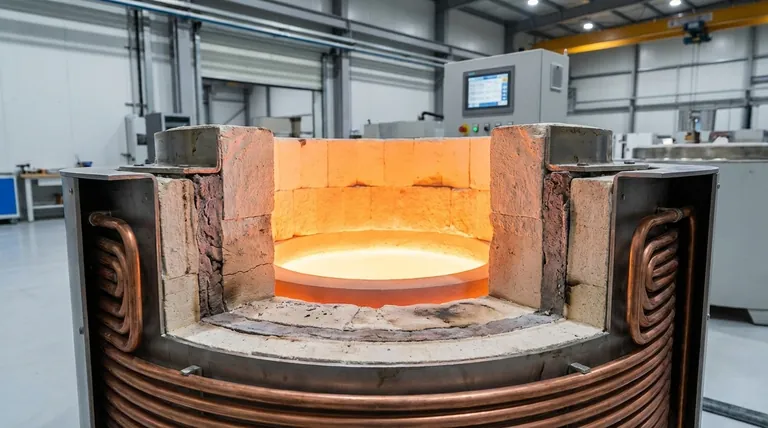
The Core Function of the Furnace Lining
The lining, or refractory, is arguably the most critical component for the safe and efficient operation of an induction furnace. Its primary job is to act as the crucible that contains the intensely hot molten metal.
Containing the Molten Metal
The most obvious function of the lining is to form a non-reactive vessel that can withstand extreme temperatures without failing. A breach in the lining, known as a metal breakout, is a catastrophic and extremely dangerous event.
Protecting the Induction Coil
The lining creates a thermal and electrical barrier between the molten metal bath and the water-cooled copper induction coil. Direct contact between the metal and the coil would cause an immediate and destructive short circuit.
Ensuring Structural Integrity
The refractory lining must be strong enough to withstand the physical force and constant motion of the circulating molten metal, which is electromagnetically stirred during the heating process.
Key Factors That Determine Lining Thickness
Engineers determine the optimal lining thickness by analyzing several interdependent factors. A change in one variable requires re-evaluating the others.
Furnace Capacity and Size
Larger furnaces, which hold many tons of molten metal, exert significantly more physical pressure on the lining. They naturally require a thicker and more robust refractory wall to ensure structural integrity compared to smaller laboratory furnaces.
Operating Temperature and Metal Type
The type of metal dictates the required operating temperature and its chemical corrosiveness. Melting high-temperature alloys like steel or stainless steel demands a more resilient, and often thicker, lining than melting lower-temperature metals like aluminum or zinc.
Refractory Material Properties
Modern refractories are specialized ceramic materials (e.g., silica, alumina, magnesia-based). A high-performance refractory with superior thermal insulation and erosion resistance may allow for a slightly thinner design compared to a lower-grade, less expensive material.
Electrical Efficiency (Coil Coupling)
The induction furnace works by creating a magnetic field in the coil that induces current in the metal charge. The distance between the coil and the metal—a gap occupied by the lining—affects the efficiency of this energy transfer. A thicker lining increases this distance, which can slightly decrease the electrical coupling efficiency.
Understanding the Trade-offs
Choosing a lining thickness is a balancing act between competing priorities. Understanding these trade-offs is key to making the right decision for a specific application.
Safety vs. Electrical Efficiency
A thicker lining provides a greater safety margin against erosion and potential metal breakout. However, as the lining thickness increases, the distance between the coil and the metal charge grows, which can lead to a marginal decrease in electrical efficiency and a slower melt rate.
Lining Lifespan vs. Furnace Capacity
For a given furnace shell size, a thicker refractory lining directly reduces the internal volume available for the metal charge. This means a trade-off exists between the longevity and robustness of a thick lining and the maximum batch size of a thinner one.
Upfront Cost vs. Total Cost of Ownership
High-performance refractory materials that enable thinner, more efficient linings are typically more expensive upfront. Likewise, a thicker lining of any material costs more. This initial investment must be weighed against the total cost of ownership, including lining lifespan, energy consumption, and the operational cost of downtime during relining procedures.
Making the Right Choice for Your Goal
Your optimal lining strategy depends entirely on your primary operational objective.
- If your primary focus is maximizing throughput: Prioritize a design that balances good furnace capacity with a reasonable refractory lifespan to minimize the frequency of downtime for relining.
- If your primary focus is melting aggressive, high-temperature alloys: Prioritize safety and longevity by selecting a high-grade, robust refractory, even if it means a slightly thicker wall and reduced furnace volume.
- If your primary focus is minimizing long-term operational costs: Conduct a thorough analysis of refractory cost versus expected lifespan and energy efficiency to find the lowest total cost of ownership, not just the lowest initial price.
Ultimately, determining the correct furnace lining thickness is a precise engineering calculation, not a general specification.
Summary Table:
| Factor | Impact on Lining Thickness |
|---|---|
| Furnace Capacity | Larger furnaces require thicker linings for structural integrity. |
| Metal Type & Temperature | High-temperature, corrosive alloys (e.g., steel) demand thicker, more robust linings. |
| Refractory Material | High-performance materials can allow for thinner designs while maintaining safety. |
| Electrical Efficiency | Thicker linings increase coil-to-metal distance, potentially reducing efficiency. |
Optimize your melting process with the right furnace lining strategy.
The correct lining thickness is critical for the safety, efficiency, and cost-effectiveness of your operations. KINTEK specializes in providing laboratory equipment and consumables, including expert solutions for induction furnace maintenance and refractory selection. Our team can help you analyze your specific needs—whether you're melting aggressive alloys or prioritizing throughput—to ensure maximum performance and value.
Contact us today to discuss how we can support your laboratory's melting applications and enhance your operational success.
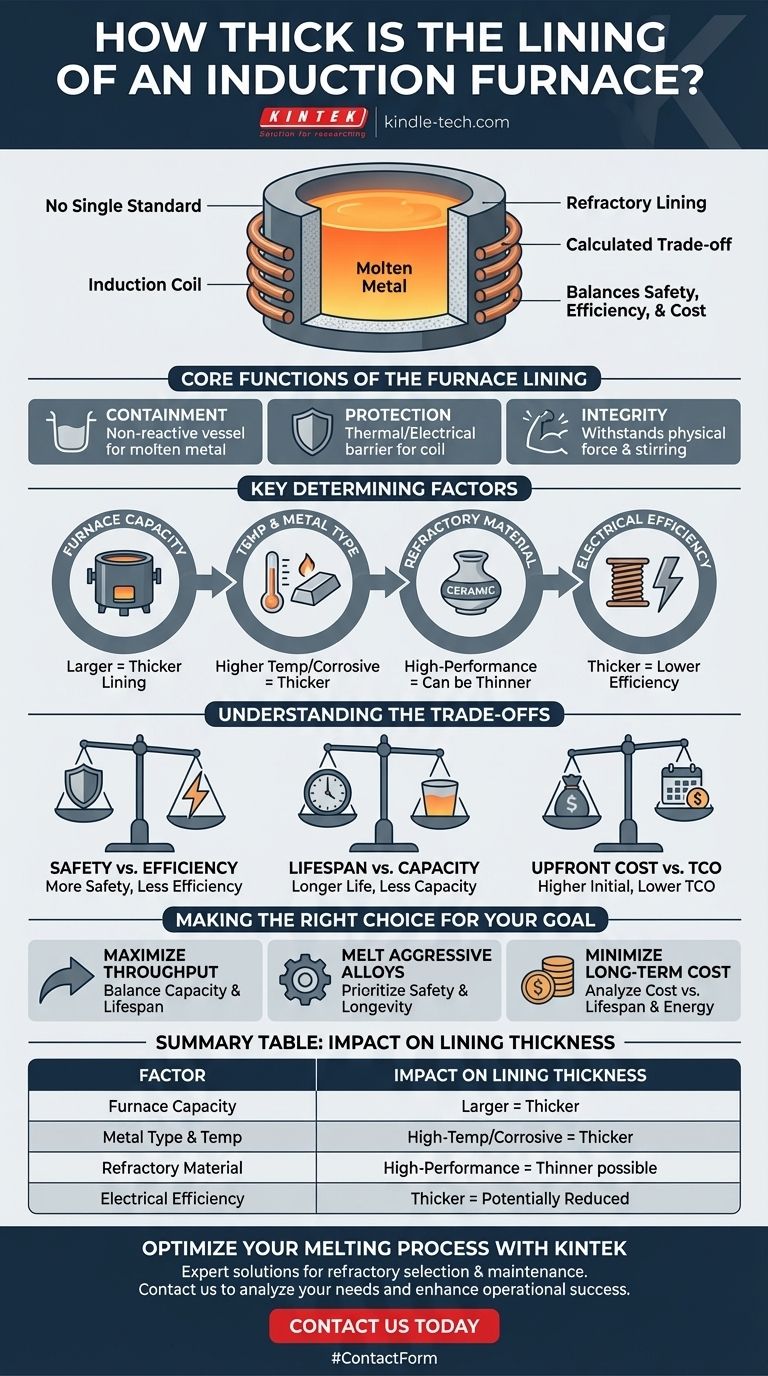
Visual Guide
Related Products
- 600T Vacuum Induction Hot Press Furnace for Heat Treat and Sintering
- Lab-Scale Vacuum Induction Melting Furnace
- Non Consumable Vacuum Arc Induction Melting Furnace
- Vacuum Arc Induction Melting Furnace
- Controlled Nitrogen Inert Hydrogen Atmosphere Furnace
People Also Ask
- What are the advantages of a vacuum hot press furnace for W-50%Cu? Achieve 99.6% Density at Lower Temperatures
- Why is a high-precision temperature control system in a vacuum hot press furnace critical? Perfect Cu-Ti3SiC2 Synthesis
- Why is precise pressure control from a vacuum hot press furnace necessary for IZO ceramic targets? Ensure High Density
- What role does mechanical pressure play during the vacuum diffusion bonding of tungsten and copper? Keys to Solid Bonding
- What advantages does a vacuum hot press furnace provide for LSLBO ceramic electrolytes? Achieve 94% Relative Density



















