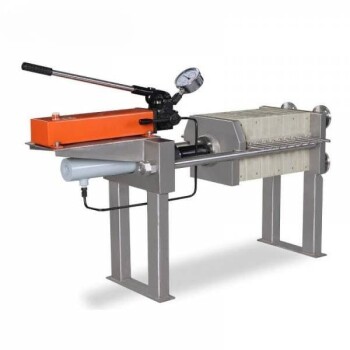
The laboratory hydraulic press acts as the critical consolidation mechanism in the powder metallurgy of copper-nickel alloys, transforming loose powder mixtures into a solid, cohesive unit known as a "green body." By applying high-intensity isostatic or axial pressure, the equipment forces metal particles into tight contact, establishing the initial geometric form and structural integrity required for subsequent processing.
The press does more than simply shape the material; its precise pressure-holding capability is essential for expelling trapped air and maximizing green density. This mechanical compaction is the decisive factor in minimizing porosity during sintering, directly enabling the creation of the high-density poly-crystalline structures necessary for accurate material analysis.
The Mechanics of Green Body Formation
Compaction and Geometry
The primary function of the press is to compress mixed metal powders into a specific geometry.
By applying high pressure to the mold, the press forces the copper and nickel particles to mechanically interlock.
This transforms a loose, fluid-like powder mixture into a solid pellet capable of holding its shape.
Expulsion of Trapped Air
Air trapped between powder particles is a significant barrier to achieving high density.
The laboratory press utilizes a precise pressure-holding functionality.
Maintained pressure gives the air time to escape from the interstitial spaces between particles, significantly increasing the density of the compact.
Establishing Green Strength
The resulting "green body" must be strong enough to be handled without crumbling.
The press provides the necessary force to achieve this green strength.
Without this initial cohesion, the sample cannot survive the transfer to a furnace or cryogenic chamber.
The Impact on Final Material Quality
Minimizing Porosity During Sintering
The density achieved during the pressing stage dictates the quality of the final alloy.
A high green density reduces the amount of work the sintering process must do to close voids.
This minimizes residual porosity in the final poly-crystalline structure, ensuring the material properties are accurate for analysis.
Eliminating Internal Defects
Uniformity during pressing is vital for the structural integrity of the alloy.
High-precision pressure control ensures that the density is consistent throughout the pellet.
This helps eliminate internal density gradients, which are microscopic variances that can lead to structural failure.
Preventing Thermal Deformation
The green body will eventually undergo intense temperature variations, such as sintering or deep cryogenic treatment.
If the particles are not in tight contact, these thermal stresses will cause the material to crack or deform.
The hydraulic press ensures the particle contact is sufficient to withstand these harsh downstream processes.
Understanding the Trade-offs
The Risk of Density Gradients
While the goal is uniformity, improper pressure application can create density gradients.
If the pressure is not applied evenly, the edges of the pellet may become denser than the center.
This lack of homogeneity often leads to warping or cracking once the material is heated.
Balancing Pressure and Integrity
There is a limit to how much pressure yields beneficial results.
Insufficient pressure leaves too much air, resulting in a weak, porous alloy.
However, excessive pressure can sometimes damage precision molds or cause lamination defects within the green body itself.
Optimizing Your Compaction Strategy
To achieve a poly-crystalline copper-nickel alloy suitable for high-level analysis, align your pressing strategy with your specific objectives:
- If your primary focus is microstructural density: Prioritize the pressure-holding phase to maximize air expulsion and minimize porosity before sintering.
- If your primary focus is preventing fracture: Ensure high-precision pressure control to eliminate density gradients, reducing the risk of cracks during thermal expansion.
The integrity of your final alloy is established the moment the press applies its force, making precise compaction the foundation of successful powder metallurgy.
Summary Table:
| Process Stage | Function of Hydraulic Press | Impact on Final Alloy |
|---|---|---|
| Compaction | Mechanical interlocking of Cu-Ni particles | Establishes geometric form and green strength |
| Pressure Holding | Expulsion of trapped air from interstices | Maximizes green density and minimizes sintering porosity |
| Uniform Loading | Elimination of internal density gradients | Prevents warping, cracking, and thermal deformation |
| Precision Control | Balancing pressure against mold limits | Ensures structural integrity without lamination defects |
Elevate Your Material Research with KINTEK Precision
Achieving the perfect poly-crystalline structure starts with superior compaction. KINTEK specializes in advanced laboratory equipment designed for the most demanding powder metallurgy applications. Whether you are developing copper-nickel alloys or advanced ceramics, our high-performance hydraulic presses (pellet, hot, isostatic) and crushing systems provide the precision needed to eliminate defects and maximize density.
From high-temperature furnaces for sintering to PTFE consumables and crucibles for sample preparation, KINTEK offers a comprehensive ecosystem for your lab. Let our expertise in high-pressure technology and thermal processing accelerate your next breakthrough.
Ready to optimize your green body formation?
Contact KINTEK Today to Find the Right Solution for Your Lab
References
- Stefan J. Eder, Carsten Gachot. Effect of Temperature on the Deformation Behavior of Copper Nickel Alloys under Sliding. DOI: 10.3390/ma14010060
This article is also based on technical information from Kintek Solution Knowledge Base .
Related Products
- Laboratory Hydraulic Press Lab Pellet Press Machine for Glove Box
- Laboratory Hydraulic Press Split Electric Lab Pellet Press
- Laboratory Hydraulic Press Lab Pellet Press for Button Battery
- Automatic Laboratory Hydraulic Press for XRF & KBR Pellet Press
- Automatic Laboratory Hydraulic Pellet Press Machine for Lab Use
People Also Ask
- What is the function of a laboratory hydraulic press in W-Cu composites? Control Porosity and Material Ratio
- What is the role of a laboratory hydraulic press in the initial stages of Li6PS5Cl preparation? Key to Green Pellets
- What role does a laboratory hydraulic press play in triboelectric testing? Achieve Precision Alloy Sample Prep
- How can a laboratory hydraulic press be applied to chitosan for wastewater treatment? Optimize Pores & Strength
- How do a precision laboratory hydraulic press and specialized molds contribute to the fabrication of spherical ceramic samples? Achieving High-Density Material Precision