Choosing between centrifugation and filtration is not about which method is superior, but which is the correct tool for your specific separation task. Centrifugation separates components based on differences in their density by spinning them at high speed, while filtration uses a physical barrier to separate them based on differences in size. The best choice depends entirely on the nature of your sample and your ultimate goal.
The decision hinges on a fundamental difference: centrifugation separates based on density, while filtration separates based on size. Understanding your sample's properties and whether you need the liquid or the solid is the key to making the right choice.
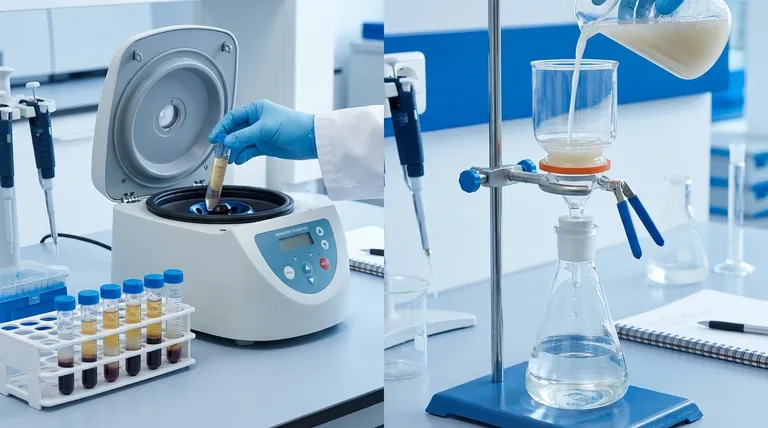
The Fundamental Principle: Density vs. Size
To select the right method, you must first understand how each one works at a physical level. Their mechanisms are fundamentally different, making them suitable for entirely different challenges.
How Centrifugation Works: Leveraging Density
Centrifugation uses high-speed rotation to generate a powerful centrifugal force. This force causes denser components in a liquid mixture to sediment, or move away from the axis of rotation, faster than less dense components.
The result is a separation into a dense, compacted solid at the bottom of the tube, called a pellet, and a clarified liquid on top, known as the supernatant.
This method is highly effective for separating components with significant density differences, such as separating cells from culture media or precipitating DNA from a solution.
How Filtration Works: A Physical Size Barrier
Filtration is a mechanical process that uses a porous membrane as a physical sieve. The liquid is forced through the filter, either by gravity, pressure, or vacuum.
Particles larger than the filter's pore size are retained on the surface, becoming the retentate. The liquid that passes through is called the filtrate.
This method provides an absolute cutoff based on size. It is the gold standard for tasks like sterilizing a solution, where you must remove all bacteria (which are larger than a 0.22 µm pore).
Key Factors for Your Decision
Your choice will be guided by four primary factors: the nature of your particles, the part of the sample you want to keep, the scale of your work, and the sensitivity of your material.
Particle Characteristics: Size, Density, and Concentration
The properties of the solids in your mixture are the most critical factor.
Centrifugation excels when particles are dense and relatively large. It easily handles high concentrations of solids without clogging, making it ideal for bulk harvesting.
Filtration is the choice when particles have a low density or are very close in density to the liquid. It's also necessary when you need to separate based on a precise size cutoff, regardless of density.
Desired Product: Is it the Solid or the Liquid?
Your goal dictates which component needs to be recovered cleanly.
If your product is the solid pellet (e.g., harvesting yeast cells), centrifugation is often more straightforward. You simply pour off the supernatant and are left with a compact mass.
If your product is a perfectly clear filtrate (e.g., clarifying a buffer or sterilizing media), filtration is the only way to guarantee the removal of all particles above a certain size.
Scale of Operation: From Lab Bench to Industrial Plant
The volume you need to process matters.
For small lab-scale volumes (e.g., microliters to a few liters), both methods are readily available.
For large, industrial-scale processes, the economics change. Continuous-flow centrifuges can process thousands of liters per hour and are effective for high-solid streams. Large-scale filtration systems also exist but can become complex and costly, especially if filter replacement is frequent.
Sample Integrity: Shear Stress and Cell Viability
Some biological materials are sensitive to physical forces.
High-speed centrifugation can generate significant hydrostatic pressure and shear forces that can damage or lyse delicate cells.
Likewise, some filtration methods, particularly tangential flow filtration (TFF), expose materials to high shear stress as they are pumped across the filter surface. A simple dead-end filtration, however, is very gentle.
Understanding the Trade-offs and Limitations
Neither method is perfect. Being aware of their inherent weaknesses is crucial for avoiding failed experiments and process bottlenecks.
The Challenge of Centrifugation: Incomplete Separation
The effectiveness of centrifugation is relative, not absolute. A very fine or low-density particle may not pellet completely, leaving your supernatant hazy. You are always at the mercy of density differences and the time/speed of your run.
The Problem with Filtration: Membrane Clogging (Fouling)
The primary enemy of filtration is clogging. As particles accumulate on the membrane, the flow rate decreases dramatically, eventually stopping the process. This is especially problematic with high-concentration or gelatinous samples, leading to process delays and the cost of replacing filters.
Cost and Equipment Considerations
A basic lab centrifuge is a standard piece of equipment, but high-speed or ultracentrifuges are significant investments. Likewise, simple filter funnels are inexpensive, but advanced cross-flow filtration systems for large volumes represent a major capital expense.
Making the Right Choice for Your Goal
Use this framework to guide your decision based on your primary objective.
- If your primary focus is harvesting cells or a heavy precipitate: Centrifugation is typically faster and better at handling high solid content, providing a compact pellet for easy collection.
- If your primary focus is achieving a perfectly clear, particle-free liquid: Filtration is the definitive choice, as its absolute pore size guarantees the removal of all particles larger than the cutoff.
- If you need to sterilize a heat-sensitive solution: Sterile filtration through a 0.22 µm membrane is the industry standard and the only reliable method.
- If you are separating particles with a density very close to your liquid: Filtration is often the only viable option, as centrifugation would require impractical speeds or durations.
- If you are processing a high-volume, high-solids slurry: Centrifugation is usually more efficient and cost-effective, as it avoids the constant problem of filter clogging.
By methodically evaluating your sample and your goals against the core principles of each technique, you can confidently select the right tool for the job.
Summary Table:
| Method | Separates Based On | Best For | Key Limitation |
|---|---|---|---|
| Centrifugation | Density differences | Harvesting dense solids (cells, precipitates) | Incomplete separation for low-density particles |
| Filtration | Particle size | Sterilizing, clarifying liquids, low-density particles | Membrane clogging (fouling) |
Still unsure which separation method is right for your specific application?
KINTEK specializes in lab equipment and consumables, serving laboratory needs. Our experts can help you select the ideal centrifuge or filtration system to maximize your yield, ensure sample integrity, and improve your lab's efficiency.
Contact our team today for a personalized consultation!
Visual Guide

Related Products
- Automatic Laboratory Heat Press Machine
- Laboratory Disc Rotary Mixer for Efficient Sample Mixing and Homogenization
- Small Vacuum Heat Treat and Tungsten Wire Sintering Furnace
- Laboratory Quartz Tube Furnace Tubular RTP Heating Furnace
- Metallographic Specimen Mounting Machine for Laboratory Materials and Analysis
People Also Ask
- What is the temperature range for compression molding? Optimize Your Process for Perfect Parts
- How do you ensure the safe operation of equipment and machinery? A Proactive Guide to Risk Management
- What is the difference between manual and automatic heat press? Choose the Right Press for Your Precision Needs
- What are heated hydraulic presses used for? Molding Composites, Vulcanizing Rubber, and More
- How is conventional heating different from induction heating? Direct vs. Indirect Heat Explained