Knowledge engineering ceramics Is ceramic strong and durable? Unlocking Its Unique Strengths and Limitations
Author avatar

Tech Team · Kintek Solution

Updated 2 months ago

Is ceramic strong and durable? Unlocking Its Unique Strengths and Limitations


In the world of materials, the strength of ceramic is a paradox. Yes, advanced ceramics are incredibly strong and durable, but in a very specific way. They possess immense hardness and resistance to heat, wear, and corrosion due to their powerful atomic bonds, making them last for decades under the right conditions.

The core takeaway is that ceramic's durability comes from its exceptional hardness and resistance to compression, not from its ability to withstand impacts. While it is one of the most wear-resistant materials available, it is also inherently brittle and can shatter from a sharp blow.
Is ceramic strong and durable? Unlocking Its Unique Strengths and Limitations

What "Strong" Means for Ceramic

The term "strong" can be misleading. For ceramic materials, strength is defined by a unique set of properties that make them superior in certain environments but vulnerable in others.

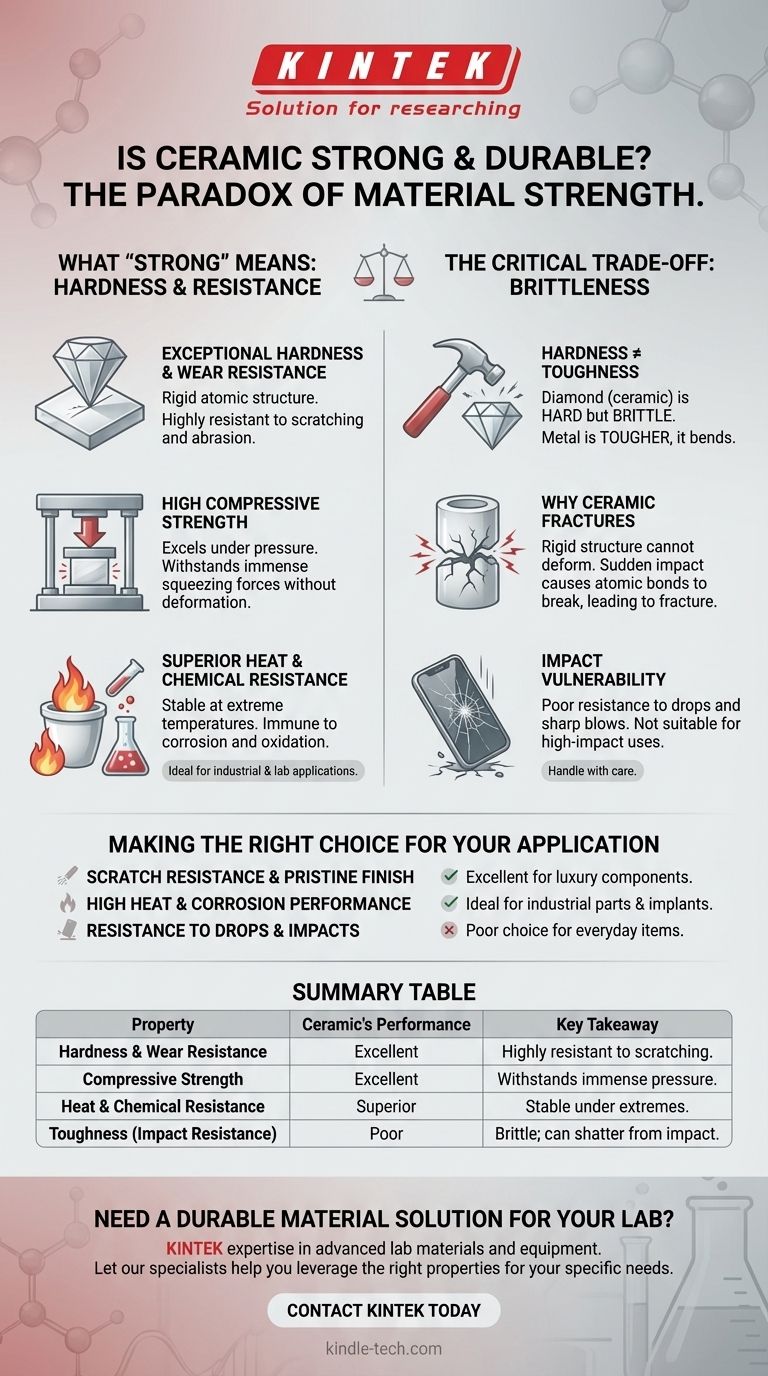
Exceptional Hardness and Wear Resistance

The primary strength of ceramic is its incredible hardness. The strong ionic and covalent bonds that hold ceramic atoms together create a highly rigid structure that is extremely difficult to scratch or wear down.

This makes it one of the most durable materials for applications where surface abrasion is the main concern.

High Compressive Strength

Ceramics excel under compression. They are exceptionally strong when being squeezed or pushed, able to withstand immense pressure without deforming.

This property is why ceramics are used in applications like armor plating and industrial bearings.

Superior Heat and Chemical Resistance

Durability isn't just about physical force. Ceramics are highly resistant to extreme temperatures and are virtually immune to corrosion and oxidation.

They do not rust or degrade when exposed to harsh chemicals, contributing to their exceptional long-term stability and lifespan.

Understanding the Critical Trade-Off: Brittleness

The very properties that make ceramic so hard also create its primary weakness. Its strength is not universal, and understanding its limitations is crucial.

The Difference Between Hardness and Toughness

It's vital to distinguish between hardness (resistance to scratching) and toughness (resistance to fracture). A diamond is extremely hard and can scratch steel, but a steel hammer can easily shatter the diamond.

Ceramic is like the diamond: exceptionally hard, but not tough. Metals, by contrast, are often tougher and will dent or bend rather than shatter under impact.

Why Ceramic Can Fracture

The rigid atomic structure of ceramic does not allow for deformation. When a ceramic object is subjected to a sharp, sudden impact, the energy has nowhere to go.

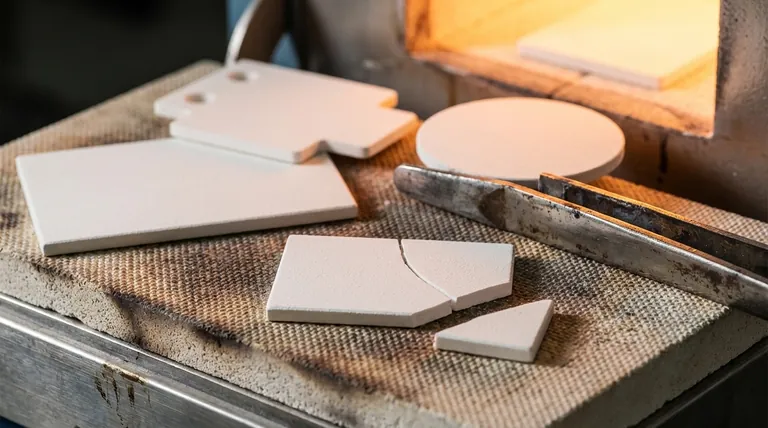
Instead of bending, the atomic bonds break, causing the material to fracture or shatter. This property is known as brittleness.

Making the Right Choice for Your Application

Whether ceramic is "strong" and "durable" enough depends entirely on its intended use.

  • If your primary focus is scratch resistance and a pristine finish: Ceramic is an excellent choice for items like watch cases or luxury components where avoiding wear is paramount.
  • If your primary focus is performance under high heat or corrosion: Ceramic is an ideal material for industrial parts, engine components, or medical implants due to its stability.
  • If your primary focus is resistance to drops and impacts: Ceramic is a poor choice for applications like phone cases or everyday cookware where sudden shocks are likely.

Understanding this balance between extreme hardness and inherent brittleness is the key to leveraging ceramic's remarkable properties correctly.

Summary Table:

Property Ceramic's Performance Key Takeaway
Hardness & Wear Resistance Excellent Highly resistant to scratching and abrasion.
Compressive Strength Excellent Withstands immense pressure without deforming.
Heat & Chemical Resistance Superior Stable under extreme temperatures and harsh chemicals.
Toughness (Impact Resistance) Poor Brittle; can shatter from a sharp blow or impact.

Need a durable material solution for your lab?

At KINTEK, we understand that material selection is critical to your success. Whether your application demands extreme heat resistance, unparalleled hardness, or chemical inertness, our expertise in advanced lab materials and equipment can help you make the right choice.

We provide high-quality materials and consumables tailored to the unique challenges of laboratory environments. Let our specialists help you leverage the right properties for your specific needs.

Contact KINTEK today to discuss your project and discover how our solutions can enhance your lab's performance and durability.

Visual Guide
Is ceramic strong and durable? Unlocking Its Unique Strengths and Limitations Visual Guide

Related Products

People Also Ask

Related Products

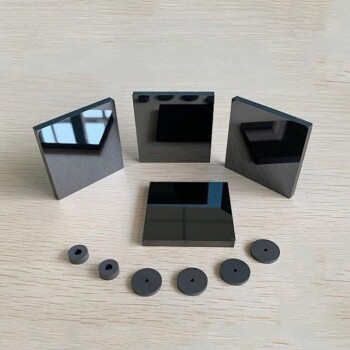
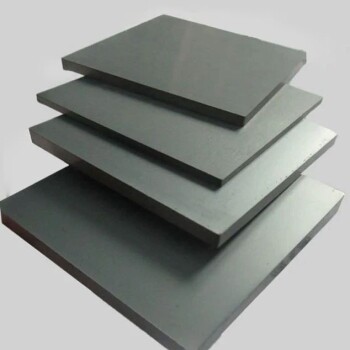
Silicon Carbide (SIC) Ceramic Sheet Wear-Resistant Engineering Advanced Fine Ceramics

Silicon Carbide (SIC) Ceramic Sheet Wear-Resistant Engineering Advanced Fine Ceramics

Silicon carbide (sic) ceramic sheet is composed of high-purity silicon carbide and ultra-fine powder, which is formed by vibration molding and high-temperature sintering.

Boron Nitride (BN) Ceramic Plate

Boron Nitride (BN) Ceramic Plate

Boron nitride (BN) ceramic plates do not use aluminum water to wet, and can provide comprehensive protection for the surface of materials that directly contact molten aluminum, magnesium, zinc alloys and their slag.

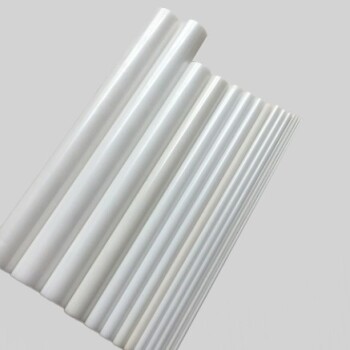
Boron Nitride (BN) Ceramic Tube

Boron Nitride (BN) Ceramic Tube

Boron nitride (BN) is known for its high thermal stability, excellent electrical insulating properties and lubricating properties.

High Quality Alumina Ceramic Screw for Engineering Advanced Fine Ceramics with High Temperature Resistance and Insulation

High Quality Alumina Ceramic Screw for Engineering Advanced Fine Ceramics with High Temperature Resistance and Insulation

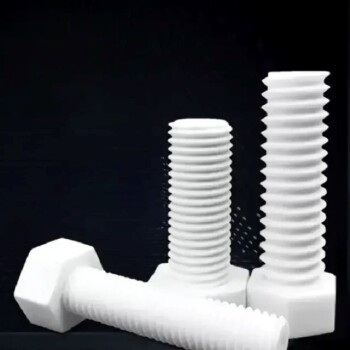
Alumina ceramic screws are fastening components made of 99.5% alumina, ideal for extreme applications requiring excellent thermal resistance, electrical insulation and chemical resistance.

Silicon Carbide (SIC) Ceramic Plate for Engineering Advanced Fine Ceramics

Silicon Carbide (SIC) Ceramic Plate for Engineering Advanced Fine Ceramics

Silicon nitride (sic) ceramic is an inorganic material ceramic that does not shrink during sintering. It is a high-strength, low-density, high-temperature-resistant covalent bond compound.

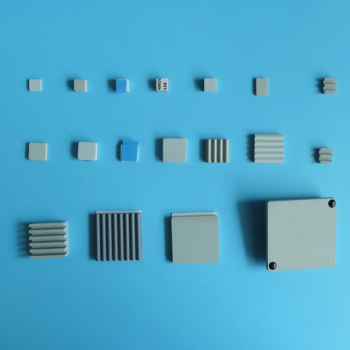
Silicon Carbide (SIC) Ceramic Sheet Flat Corrugated Heat Sink for Engineering Advanced Fine Ceramics

Silicon Carbide (SIC) Ceramic Sheet Flat Corrugated Heat Sink for Engineering Advanced Fine Ceramics

Silicon carbide (sic) ceramic heat sink not only does not generate electromagnetic waves, but also can isolate electromagnetic waves and absorb part of electromagnetic waves.

Ceramic Evaporation Boat Set Alumina Crucible for Laboratory Use

Ceramic Evaporation Boat Set Alumina Crucible for Laboratory Use

It can be used for vapor deposition of various metals and alloys. Most metals can be evaporated completely without loss. Evaporation baskets are reusable.1

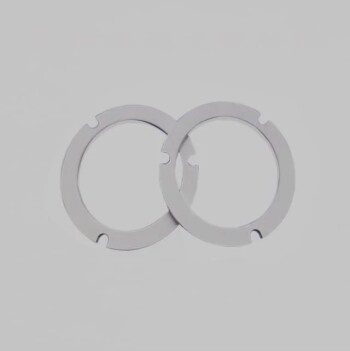
Hexagonal Boron Nitride HBN Ceramic Ring

Hexagonal Boron Nitride HBN Ceramic Ring

Boron nitride ceramic (BN) rings are commonly used in high temperature applications such as furnace fixtures, heat exchangers and semiconductor processing.

Engineering Advanced Fine Ceramics Aluminium Oxide Al2O3 Ceramic Washer for Wear-Resistant Applications

Engineering Advanced Fine Ceramics Aluminium Oxide Al2O3 Ceramic Washer for Wear-Resistant Applications

Alumina wear-resistant ceramic washer are used for heat dissipation, which can replace aluminum heat sinks, with high temperature resistance and high thermal conductivity.

Alumina Al2O3 Ceramic Crucible Semicircle Boat with Lid for Engineering Advanced Fine Ceramics

Alumina Al2O3 Ceramic Crucible Semicircle Boat with Lid for Engineering Advanced Fine Ceramics

Crucibles are containers widely used for melting and processing various materials, and semicircular boat-shaped crucibles are suitable for special smelting and processing requirements. Their types and uses vary by material and shape.

Precision Machined Yttrium Stabilized Zirconia Ceramic Rod for Engineering Advanced Fine Ceramics

Precision Machined Yttrium Stabilized Zirconia Ceramic Rod for Engineering Advanced Fine Ceramics

Zirconia ceramic rods are prepared by isostatic pressing, and a uniform, dense and smooth ceramic layer and transition layer are formed at high temperature and high speed.

Custom-Made Alumina Zirconia Special-Shaped Ceramic Plates for Engineering Advanced Fine Ceramics Processing

Custom-Made Alumina Zirconia Special-Shaped Ceramic Plates for Engineering Advanced Fine Ceramics Processing

Alumina ceramics have good electrical conductivity, mechanical strength and high temperature resistance, while zirconia ceramics are known for their high strength and high toughness and are widely used.

Aluminized Ceramic Evaporation Boat for Thin Film Deposition

Aluminized Ceramic Evaporation Boat for Thin Film Deposition

Vessel for depositing thin films; has an aluminum-coated ceramic body for improved thermal efficiency and chemical resistance. making it suitable for various applications.

Engineering Advanced Fine Alumina Al2O3 Ceramic Crucible for Laboratory Muffle Furnace

Engineering Advanced Fine Alumina Al2O3 Ceramic Crucible for Laboratory Muffle Furnace

Alumina ceramic crucibles are used in some materials and metal melting tools, and flat-bottomed crucibles are suitable for melting and processing larger batches of materials with better stability and uniformity.

Advanced Engineering Fine Ceramics Alumina Ceramic Saggar for Fine Corundum

Advanced Engineering Fine Ceramics Alumina Ceramic Saggar for Fine Corundum

Alumina sagger products have the characteristics of high temperature resistance, good thermal shock stability, small expansion coefficient, anti-stripping, and good anti-powdering performance.

Engineering Advanced Fine Ceramics Aluminum Oxide Al2O3 Heat Sink for Insulation

Engineering Advanced Fine Ceramics Aluminum Oxide Al2O3 Heat Sink for Insulation

The hole structure of the ceramic heat sink increases the heat dissipation area in contact with the air, which greatly enhances the heat dissipation effect, and the heat dissipation effect is better than that of super copper and aluminum.

Engineering Advanced Fine Ceramics Alumina Al2O3 Crucible With Lid Cylindrical Laboratory Crucible

Engineering Advanced Fine Ceramics Alumina Al2O3 Crucible With Lid Cylindrical Laboratory Crucible

Cylindrical Crucibles Cylindrical crucibles are one of the most common crucible shapes, suitable for melting and processing a wide variety of materials, and are easy to handle and clean.

Boron Nitride (BN) Crucible for Phosphorous Powder Sintered

Boron Nitride (BN) Crucible for Phosphorous Powder Sintered

Phosphorus powder sintered boron nitride (BN) crucible has a smooth surface, dense, pollution-free and long service life.

Dental Porcelain Zirconia Sintering Ceramic Vacuum Press Furnace

Dental Porcelain Zirconia Sintering Ceramic Vacuum Press Furnace

Get precise dental results with Dental Vacuum Press Furnace. Automatic temperature calibration, low noise tray, and touch screen operation. Order now!

Dental Porcelain Zirconia Sintering Ceramic Furnace Chairside with Transformer

Dental Porcelain Zirconia Sintering Ceramic Furnace Chairside with Transformer

Experience top-notch sintering with Chairside Sintering Furnace with Transformer. Easy to operate, noise-free pallet, and automatic temperature calibration. Order now!


Leave Your Message