Knowledge Is powder metallurgy the same as sintering? The Critical Step That Bonds Metal Powder into Strong Parts
Author avatar

Tech Team · Kintek Solution

Updated 1 week ago

Is powder metallurgy the same as sintering? The Critical Step That Bonds Metal Powder into Strong Parts


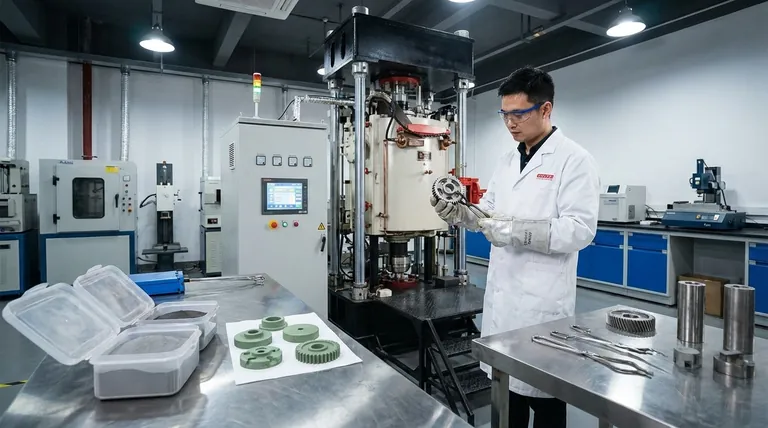
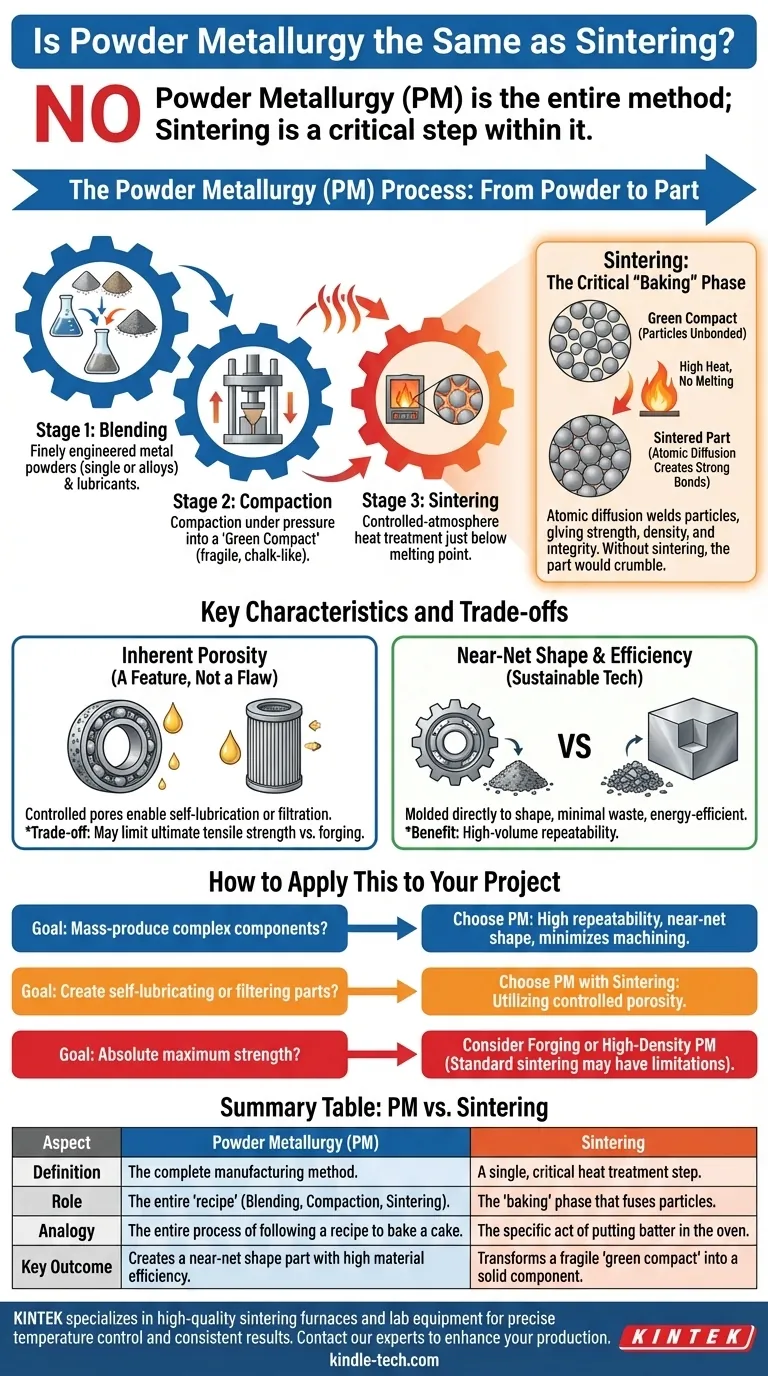
In short, no. Powder metallurgy is the name for the entire manufacturing method, while sintering is a single, critical heat treatment step within that method. To put it simply, powder metallurgy is the complete recipe for creating a metal part from powder, and sintering is the specific act of "baking" it to give it strength.

Sintering is not a process separate from powder metallurgy; it is the essential thermal stage that transforms a compacted powder into a solid, functional component. You cannot have modern powder metallurgy without sintering.
Is powder metallurgy the same as sintering? The Critical Step That Bonds Metal Powder into Strong Parts

The Powder Metallurgy Process: From Powder to Part

To understand the relationship, it helps to see the entire powder metallurgy (PM) workflow. It is a precise, multi-stage process used to create "near-net shape" parts, which require little to no finish machining.

Stage 1: Blending

The process begins not with a solid block of metal, but with finely engineered metal powders. These powders can be a single metal or a blend of different alloys and lubricants designed to achieve specific final properties.

Stage 2: Compaction

Next, the blended powder is poured into a high-precision die. A powerful press then compacts the powder under immense pressure into the desired shape. The resulting piece is called a "green compact." It holds its shape but is fragile, similar in consistency to a piece of chalk.

Stage 3: Sintering

This is the decisive step. The green compact is moved into a controlled-atmosphere furnace and heated to a temperature just below the melting point of the primary metal. The heat causes the individual powder particles to bond and fuse together on an atomic level, a process called diffusion.

Why Sintering Is the Critical Bonding Phase

Sintering is where a fragile powder form gains the strength and integrity of a solid metal part. Without it, the green compact would simply crumble.

The Science of Fusing Without Melting

Sintering does not melt the metal. Instead, the high temperature provides the energy for atoms to move across the surfaces of the powder particles. This atomic diffusion creates strong metallurgical bonds, effectively welding the particles together and dramatically reducing the voids between them.

The Result: Strength and Integrity

This bonding process is what gives the final component its density, hardness, and mechanical strength. It transforms the part from a delicate green compact into a robust, work-ready component suitable for demanding applications like automotive gears, valve seats, and cutting tools.

Understanding the Key Characteristics and Trade-offs

Powder metallurgy, with sintering at its core, offers a unique set of advantages and considerations compared to other manufacturing methods like casting or forging.

Inherent Porosity: A Feature, Not a Flaw

The sintering process leaves behind microscopic pores. This controlled porosity is a major advantage for certain applications. It allows parts like bearings to be impregnated with oil for self-lubrication or used to create highly effective metal filters.

However, this same porosity means a standard PM part may not achieve the same ultimate tensile strength or impact resistance as a fully dense, forged component.

Near-Net Shape and Material Efficiency

Because parts are molded directly into complex shapes, PM is a "green" or sustainable technology. It produces very little waste material compared to subtractive methods like machining, which start with a large block and cut material away. This also reduces energy consumption, as the metal is never fully melted.

High-Volume Repeatability

Once the initial tooling (the die) is created, the PM process can produce millions of highly consistent parts with excellent dimensional accuracy. This makes it extremely cost-effective for large production runs common in the automotive industry.

How to Apply This to Your Project

Understanding the distinction between the overall PM process and the sintering step helps you choose the right manufacturing solution for your goal.

  • If your primary focus is mass-producing complex components: Powder metallurgy is an exceptional choice for its high repeatability and ability to create near-net shapes, which minimizes costly secondary machining.
  • If your primary focus is creating self-lubricating or filtering parts: The inherent and controllable porosity achieved through the sintering stage makes PM the ideal and often only viable technology.
  • If your primary focus is absolute maximum strength and fatigue resistance: You may need to consider forging or specialized high-density PM techniques, as the residual porosity in standard sintered parts can be a limiting factor.

By recognizing that sintering is the metallurgical heart of the powder metallurgy process, you can better leverage its distinct capabilities to solve your engineering challenges.

Summary Table:

Aspect Powder Metallurgy (PM) Sintering
Definition The complete manufacturing method for creating parts from metal powder. A single, critical heat treatment step within the PM process.
Role The entire "recipe," including blending, compaction, and sintering. The "baking" phase that fuses powder particles to give the part strength.
Analogy The entire process of following a recipe to bake a cake. The specific act of putting the batter in the oven to bake.
Key Outcome Creates a near-net shape part with high material efficiency. Transforms a fragile "green compact" into a solid metal component.

Need a robust, cost-effective solution for your metal components?

Understanding the nuances of powder metallurgy and sintering is key to selecting the right manufacturing process for your application. Whether you're mass-producing complex parts, creating self-lubricating bearings, or exploring material-efficient solutions, the right equipment is crucial.

KINTEK specializes in high-quality sintering furnaces and lab equipment that provide the precise temperature control and consistent results your projects demand. Our expertise helps you leverage the full benefits of powder metallurgy, from material efficiency to high-volume repeatability.

Let's discuss how our solutions can enhance your production: Contact our experts today to find the perfect equipment for your laboratory or manufacturing needs.

Visual Guide
Is powder metallurgy the same as sintering? The Critical Step That Bonds Metal Powder into Strong Parts Visual Guide

Related Products

People Also Ask

Related Products

Vacuum Heat Treat and Pressure Sintering Furnace for High Temperature Applications

Vacuum Heat Treat and Pressure Sintering Furnace for High Temperature Applications

Vacuum pressure sintering furnaces are designed for high temperature hot pressing applications in metal and ceramic sintering. Its advanced features ensure precise temperature control, reliable pressure maintenance, and a robust design for seamless operation.

600T Vacuum Induction Hot Press Furnace for Heat Treat and Sintering

600T Vacuum Induction Hot Press Furnace for Heat Treat and Sintering

Discover the 600T Vacuum Induction Hot Press Furnace, designed for high-temperature sintering experiments in vacuum or protected atmospheres. Its precise temperature and pressure control, adjustable working pressure, and advanced safety features make it ideal for nonmetal materials, carbon composites, ceramics, and metal powders.

Horizontal High Temperature Graphite Vacuum Graphitization Furnace

Horizontal High Temperature Graphite Vacuum Graphitization Furnace

Horizontal Graphitization Furnace: This type of furnace is designed with the heating elements placed horizontally, allowing for uniform heating of the sample. It's well-suited for graphitizing large or bulky samples that require precise temperature control and uniformity.

Graphite Vacuum Furnace Negative Material Graphitization Furnace

Graphite Vacuum Furnace Negative Material Graphitization Furnace

Graphitization furnace for battery production has uniform temperature and low energy consumption. Graphitization furnace for negative electrode materials: an efficient graphitization solution for battery production and advanced functions to enhance battery performance.

1700℃ Controlled Atmosphere Furnace Nitrogen Inert Atmosphere Furnace

1700℃ Controlled Atmosphere Furnace Nitrogen Inert Atmosphere Furnace

KT-17A Controlled atmosphere furnace: 1700℃ heating, vacuum sealing technology, PID temperature control, and versatile TFT smart touch screen controller for laboratory and industrial use.

Ultra-High Temperature Graphite Vacuum Graphitization Furnace

Ultra-High Temperature Graphite Vacuum Graphitization Furnace

The ultra-high temperature graphitization furnace utilizes medium frequency induction heating in a vacuum or inert gas environment. The induction coil generates an alternating magnetic field, inducing eddy currents in the graphite crucible, which heats up and radiates heat to the workpiece, bringing it to the desired temperature. This furnace is primarily used for graphitization and sintering of carbon materials, carbon fiber materials, and other composite materials.

Spark Plasma Sintering Furnace SPS Furnace

Spark Plasma Sintering Furnace SPS Furnace

Discover the benefits of Spark Plasma Sintering Furnaces for rapid, low-temperature material preparation. Uniform heating, low cost & eco-friendly.

Graphite Vacuum Furnace Bottom Discharge Graphitization Furnace for Carbon Materials

Graphite Vacuum Furnace Bottom Discharge Graphitization Furnace for Carbon Materials

Bottom-out graphitization furnace for carbon materials, ultra-high temperature furnace up to 3100°C, suitable for graphitization and sintering of carbon rods and carbon blocks. Vertical design, bottom discharging, convenient feeding and discharging, high temperature uniformity, low energy consumption, good stability, hydraulic lifting system, convenient loading and unloading.

Large Vertical Graphite Vacuum Graphitization Furnace

Large Vertical Graphite Vacuum Graphitization Furnace

A large vertical high-temperature graphitization furnace is a type of industrial furnace used for the graphitization of carbon materials, such as carbon fiber and carbon black. It is a high-temperature furnace that can reach temperatures of up to 3100°C.

1200℃ Muffle Furnace Oven for Laboratory

1200℃ Muffle Furnace Oven for Laboratory

Upgrade your lab with our 1200℃ Muffle Furnace. Achieve fast, precise heating with Japan alumina fibers and Molybdenum coils. Features TFT touch screen controller for easy programming and data analysis. Order now!

Vertical High Temperature Graphite Vacuum Graphitization Furnace

Vertical High Temperature Graphite Vacuum Graphitization Furnace

Vertical high temperature graphitization furnace for carbonization and graphitization of carbon materials up to 3100℃.Suitable for shaped graphitization of carbon fiber filaments and other materials sintered in a carbon environment.Applications in metallurgy, electronics, and aerospace for producing high-quality graphite products like electrodes and crucibles.

Graphite Vacuum Continuous Graphitization Furnace

Graphite Vacuum Continuous Graphitization Furnace

High-temperature graphitization furnace is a professional equipment for graphitization treatment of carbon materials. It is a key equipment for the production of high-quality graphite products. It has high temperature, high efficiency and uniform heating. It is suitable for various high-temperature treatments and graphitization treatments. It is widely used in metallurgy, electronics, aerospace, etc. industry.

1200℃ Split Tube Furnace with Quartz Tube Laboratory Tubular Furnace

1200℃ Split Tube Furnace with Quartz Tube Laboratory Tubular Furnace

KT-TF12 split tube furnace: high-purity insulation, embedded heating wire coils, and max. 1200C. Widely used for new materials and chemical vapour deposition.

Vacuum Hot Press Furnace Machine for Lamination and Heating

Vacuum Hot Press Furnace Machine for Lamination and Heating

Experience clean and precise lamination with Vacuum Lamination Press. Perfect for wafer bonding, thin-film transformations, and LCP lamination. Order now!

Custom PTFE Teflon Parts Manufacturer for Culture Dish and Evaporation Dish

Custom PTFE Teflon Parts Manufacturer for Culture Dish and Evaporation Dish

The PTFE culture dish evaporating dish is a versatile laboratory tool known for its chemical resistance and high-temperature stability. PTFE, a fluoropolymer, offers exceptional non-stick properties and durability, making it ideal for various applications in research and industry, including filtration, pyrolysis, and membrane technology.

High Purity Pure Graphite Crucible for Evaporation

High Purity Pure Graphite Crucible for Evaporation

Vessels for high temperature applications, where materials are kept at extremely high temperatures to evaporate, allowing thin films to be deposited on substrates.

Laboratory Hybrid Tissue Grinding Mill

Laboratory Hybrid Tissue Grinding Mill

KT-MT20 is a versatile laboratory device used for rapid grinding or mixing of small samples, whether dry, wet, or frozen. It comes with two 50ml ball mill jars and various cell wall breaking adapters for biological applications such as DNA/RNA and protein extraction.

Engineering Advanced Fine Ceramics Alumina Crucibles (Al2O3) for Thermal Analysis TGA DTA

Engineering Advanced Fine Ceramics Alumina Crucibles (Al2O3) for Thermal Analysis TGA DTA

TGA/DTA thermal analysis vessels are made of aluminum oxide (corundum or aluminum oxide). It can withstand high temperature and is suitable for analyzing materials that require high temperature testing.

High Purity Pure Graphite Crucible for Electron Beam Evaporation

High Purity Pure Graphite Crucible for Electron Beam Evaporation

A technology mainly used in the field of power electronics. It is a graphite film made of carbon source material by material deposition using electron beam technology.

Electron Beam Evaporation Coating Tungsten Crucible and Molybdenum Crucible for High Temperature Applications

Electron Beam Evaporation Coating Tungsten Crucible and Molybdenum Crucible for High Temperature Applications

Tungsten and molybdenum crucibles are commonly used in electron beam evaporation processes due to their excellent thermal and mechanical properties.


Leave Your Message