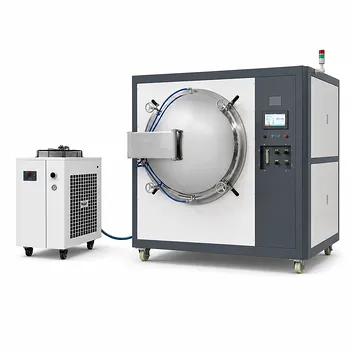
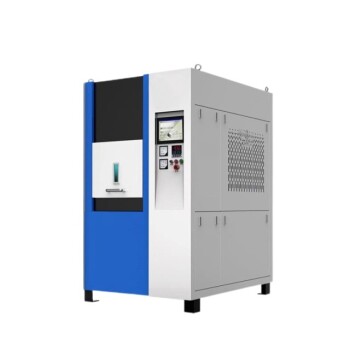
The definitive advantage of a vacuum hot pressing sintering furnace lies in its ability to decouple densification from extreme thermal exposure. By introducing a mechanical pressure field, this technology allows materials to reach full density at significantly lower temperatures and in shorter timeframes, effectively arresting the grain growth mechanism.
Core Takeaway Traditional sintering relies on heat to drive particle bonding, which inadvertently fuels grain expansion. Vacuum hot pressing substitutes thermal energy with mechanical pressure, forcing densification rapidly while the material remains cooler, thereby locking in fine-grained or nanocrystalline microstructures.
The Mechanics of Grain Size Control
The superior control over grain size in vacuum hot pressing is not accidental; it is a direct result of altering the physics of the sintering process.
The Role of the Pressure Field
In a standard furnace, temperature is the primary driver for moving atoms to close pores. Vacuum hot pressing adds a pressure field to this equation.
This mechanical force physically pushes particles together, inducing rearrangement and flow. This reduces the reliance on thermal diffusion, allowing the process to occur with much less heat.
Inhibiting Recrystallization
High temperatures are the catalyst for recrystallization and excessive grain growth. By lowering the required sintering temperature, vacuum hot pressing operates below the threshold where these phenomena become aggressive.
This preservation of the original microstructure is critical for engineering materials where fine grain size correlates with higher strength.
Shortening the Sintering Window
Grain growth is a function of both temperature and time. Vacuum hot pressing significantly accelerates the densification process.
Because the holding time at peak temperature is drastically reduced, the grains simply do not have the time required to migrate and merge into larger structures.
Synergistic Benefits of the Vacuum Environment
While pressure controls the grain size, the vacuum environment ensures the integrity of the grain boundaries.
Elimination of Pore Defects
Applying pressure during heating increases the rearrangement rate of grains, but this can trap gas if not managed. The vacuum environment effectively evacuates gases from powder gaps.
This prevents the formation of residual micropores that often occur when grains bond too quickly, ensuring the material is not just fine-grained, but also fully dense.
Chemical Stability
High temperatures often cause volatile elements, such as chromium, to evaporate, altering the material's composition.
The combination of lower temperatures and a vacuum environment suppresses volatilization. This maintains chemical stability, ensuring the final grain structure matches the intended design.
Operational Distinctions and Trade-offs
It is vital to distinguish between vacuum hot pressing and standard high-temperature vacuum sintering, as they achieve opposite results regarding grain structure.
Hot Pressing vs. Standard Sintering
Standard high-temperature vacuum sintering (without mechanical pressure) actually promotes grain growth. It uses a controlled thermal environment to encourage mass migration, which is useful for applications like coating densification where specific crystal phases (e.g., tetragonal or cubic) are desired.
The Trade-off of Complexity
Vacuum hot pressing achieves superior density using only a fraction of the pressure required for cold pressing (approximately 1/20th). However, it introduces the complexity of coupling heat and mechanical force simultaneously.
While this avoids the residual pores common in cold-pressed sintering, it requires precise management of the heating curve and pressure application to prevent cracking.
Making the Right Choice for Your Goal
Select the furnace technology that aligns with the specific microstructural requirements of your application.
- If your primary focus is Maximum Strength and Hardness: Utilize vacuum hot pressing to achieve high-density nanocrystalline structures by inhibiting grain growth through low-temperature, pressure-assisted densification.
- If your primary focus is Coating Densification or Phase Formation: Utilize standard high-temperature vacuum sintering to promote controlled mass migration and necessary grain growth for specific crystal structures.
By substituting thermal load with mechanical pressure, you transform the sintering process from a struggle against grain growth into a precision tool for microstructural engineering.
Summary Table:
| Feature | Traditional High-Temp Sintering | Vacuum Hot Pressing Sintering |
|---|---|---|
| Driving Force | Thermal energy only | Thermal energy + Mechanical pressure |
| Sintering Temp | High (promotes grain growth) | Lower (inhibits grain growth) |
| Process Time | Long holding cycles | Short, accelerated densification |
| Microstructure | Coarse grains | Fine-grained or nanocrystalline |
| Density | Variable; potential for pores | High density; gas evacuation |
| Mass Migration | High (fuels recrystallization) | Low (preserves initial structure) |
Elevate Your Material Engineering with KINTEK
Precision grain size control is the key to unlocking superior material strength and hardness. KINTEK specializes in advanced laboratory equipment, providing high-performance vacuum hot pressing systems, muffle furnaces, and hydraulic presses designed to meet the rigorous demands of nanocrystalline research.
Whether you are developing ceramics, advanced alloys, or battery materials, our comprehensive portfolio—including high-temperature furnaces, CVD/PECVD systems, and specialized crushing/milling tools—ensures your lab has the precision it needs to succeed.
Ready to optimize your sintering process? Contact our technical experts today to find the perfect solution for your research goals.
Related Products
- 600T Vacuum Induction Hot Press Furnace for Heat Treat and Sintering
- Vacuum Heat Treat and Sintering Furnace with 9MPa Air Pressure
- Vacuum Heat Treat and Pressure Sintering Furnace for High Temperature Applications
- 2200 ℃ Tungsten Vacuum Heat Treat and Sintering Furnace
- Vacuum Hot Press Furnace Heated Vacuum Press Machine Tube Furnace
People Also Ask
- What role does an induction vacuum hot pressing furnace play in sintering? Achieve 98% Density in Carbide Blocks
- What advantages does a vacuum hot press furnace provide for LSLBO ceramic electrolytes? Achieve 94% Relative Density
- What role does a Vacuum Hot Press (VHP) furnace play in the densification of austenitic stainless steel 316 composites?
- What role does mechanical pressure play during the vacuum diffusion bonding of tungsten and copper? Keys to Solid Bonding
- What are the advantages of a vacuum hot press furnace for W-50%Cu? Achieve 99.6% Density at Lower Temperatures