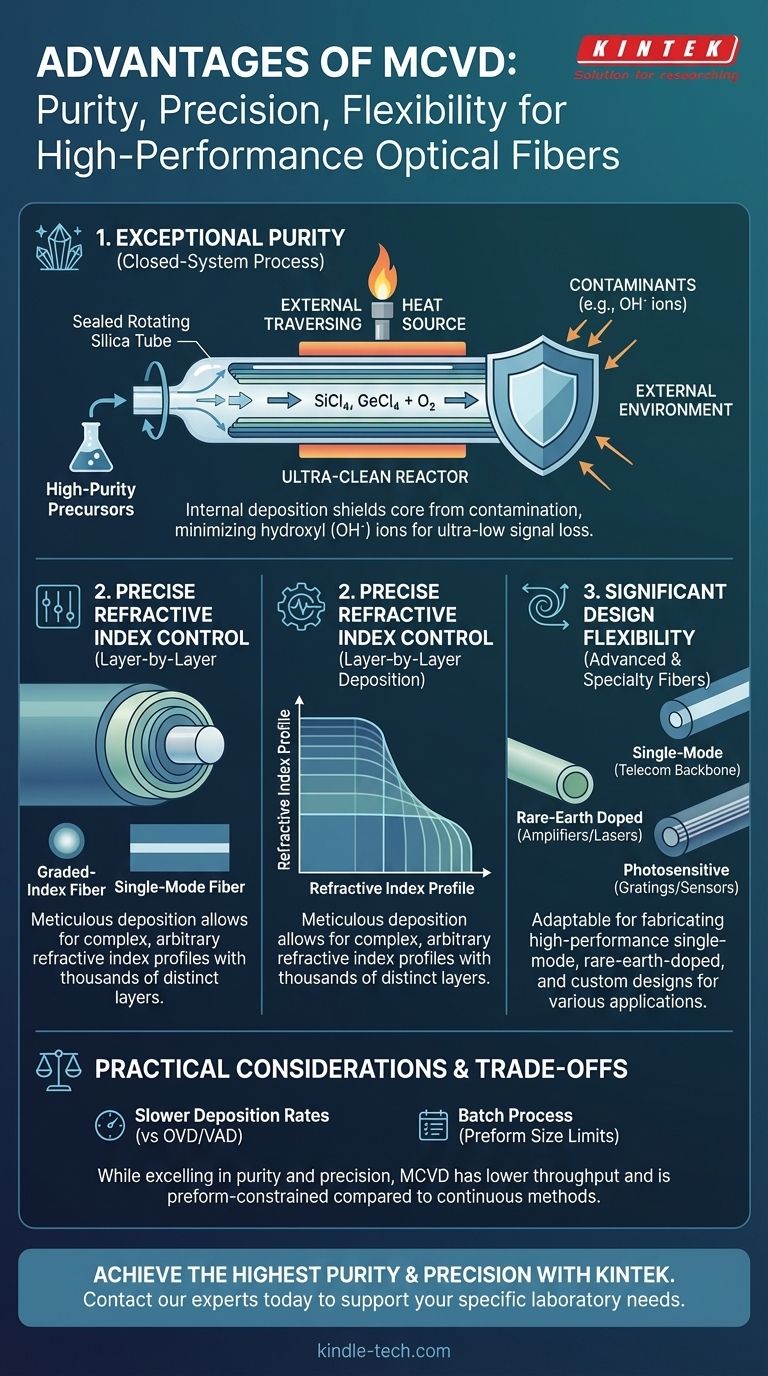
The primary advantages of Modified Chemical Vapor Deposition (MCVD) are the exceptional purity of the resulting glass, precise control over the refractive index profile, and significant flexibility in fiber design. This is achieved by using a closed-system process where deposition occurs inside a rotating silica tube, shielding the core materials from external contamination and allowing for meticulous layer-by-layer construction.
MCVD's core strength lies in its "inside-out" approach. By treating the substrate tube as a self-contained, ultra-clean reactor, it delivers the highest-purity glass and most precise profile control, making it the benchmark process for high-performance and specialty optical fibers.
The Core Principle: A Contamination-Free Internal Reactor
The fundamental design of the MCVD process is the source of its most significant advantages. It is an internal deposition method, which sets it apart from other common fabrication techniques.
How It Works
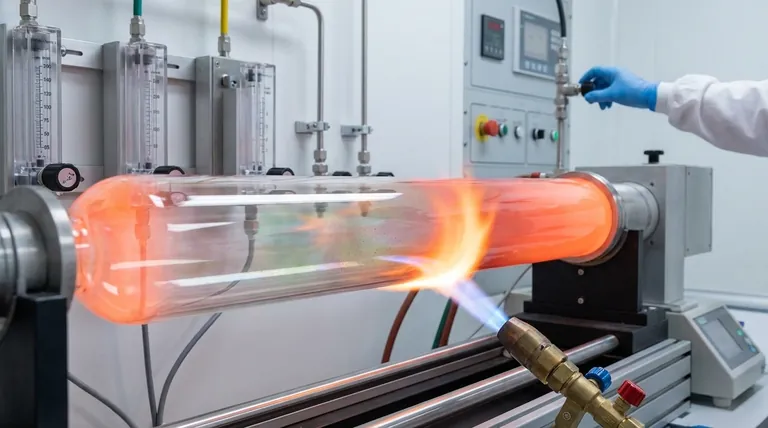
In MCVD, high-purity vapor-phase precursors, such as silicon tetrachloride (SiCl₄) and germanium tetrachloride (GeCl₄), are introduced with oxygen into a rotating, high-purity silica substrate tube. A traversing external heat source (like an oxy-hydrogen torch) heats the outside of the tube, causing the chemical precursors to react and deposit a thin layer of doped silica "soot" on the inner wall.
Eliminating External Contaminants
Because this entire reaction happens inside the sealed tube, the process is shielded from the ambient environment. This dramatically reduces the incorporation of contaminants, particularly hydroxyl (OH⁻) ions from water vapor, which are a primary cause of signal attenuation (loss) in optical fibers.
Ensuring Material Purity
The process uses vaporized metal halide precursors which can be distilled to extremely high levels of purity. This ensures that transition metal impurities, another source of signal absorption, are virtually nonexistent in the final deposited glass, leading to exceptionally low-loss fibers.
Unparalleled Control Over Fiber Properties
MCVD’s layer-by-layer deposition process provides a level of control that is difficult to achieve with other methods. This directly translates into superior performance and design flexibility.
Precise Refractive Index Profiling
The refractive index of each deposited layer is determined by the concentration of dopants (like Germanium) mixed into the gas stream. By precisely varying the gas mixture for each pass of the heat source, engineers can build complex and arbitrary refractive index profiles with hundreds or thousands of distinct layers. This control is critical for creating advanced graded-index fibers that minimize modal dispersion.
High-Performance Single-Mode Fibers
The ability to create exceptionally pure glass with a perfectly controlled index profile makes MCVD the standard for producing high-performance single-mode fibers. These are the fibers that form the backbone of long-haul telecommunications and submarine cable systems, where minimizing signal loss and dispersion is paramount.
Flexibility for Specialty Fibers
The same process control makes MCVD highly adaptable for fabricating specialty fibers. By introducing different precursors, it's possible to create rare-earth-doped fibers for amplifiers and lasers (e.g., Erbium-doped), photosensitive fibers for gratings, and other custom designs for sensing and research applications.
Understanding the Trade-offs
No process is perfect. While MCVD excels in purity and precision, it has practical limitations that are important to understand.
Slower Deposition Rates
Compared to outside deposition methods like OVD (Outside Vapor Deposition) and VAD (Vapor Axial Deposition), MCVD generally has a lower deposition rate. The process is inherently limited by the heat transfer through the substrate tube wall.
Batch Process and Throughput
MCVD is a batch process. Each preform is made one at a time from an individual tube. This can limit manufacturing throughput compared to more continuous or larger-batch methods.
Preform Size Limitations
The final size of the fiber preform is constrained by the starting dimensions of the silica substrate tube. Other methods can build up much larger preforms, which can then be drawn into a greater length of fiber, leading to better economies of scale.
Making the Right Choice for Your Goal
Selecting a fabrication method depends entirely on the technical and economic requirements of the final product.
- If your primary focus is ultimate performance and minimal signal loss: MCVD is the definitive choice for telecom-grade, single-mode, and specialty fibers where purity and profile control cannot be compromised.
- If your primary focus is creating complex or novel fiber designs: The precise layer-by-layer control of MCVD makes it the ideal platform for research, development, and advanced graded-index fiber production.
- If your primary focus is high-volume, cost-effective multimode fiber: Alternative methods like OVD or VAD are often preferred for their higher deposition rates and ability to produce larger preforms.
MCVD remains a cornerstone of the optical fiber industry because it offers an unmatched combination of purity and precision, enabling the creation of the world's most advanced optical waveguides.
Summary Table:
| Advantage | Key Benefit |
|---|---|
| Exceptional Purity | Closed-system process minimizes contamination (e.g., OH⁻ ions), leading to ultra-low signal loss. |
| Precise Index Control | Layer-by-layer deposition allows for complex, arbitrary refractive index profiles. |
| Design Flexibility | Ideal for high-performance single-mode and specialty fibers (e.g., rare-earth-doped). |
| Trade-off | Consideration |
| Slower Deposition | Lower throughput compared to OVD/VAD methods. |
| Batch Process | Limited by preform size and individual tube processing. |
Ready to achieve the highest purity and precision in your optical fiber research or production?
KINTEK specializes in providing the high-purity laboratory equipment and consumables essential for advanced fabrication processes like MCVD. Our materials and solutions support the creation of low-loss, high-performance optical fibers.
Contact our experts today to discuss how we can support your specific laboratory needs and help you build the next generation of optical waveguides.
Visual Guide
Related Products
- Microwave Plasma Chemical Vapor Deposition MPCVD Machine System Reactor for Lab and Diamond Growth
- 915MHz MPCVD Diamond Machine Microwave Plasma Chemical Vapor Deposition System Reactor
- Cylindrical Resonator MPCVD Machine System Reactor for Microwave Plasma Chemical Vapor Deposition and Lab Diamond Growth
- Multi Heating Zones CVD Tube Furnace Machine Chemical Vapor Deposition Chamber System Equipment
- Customer Made Versatile CVD Tube Furnace Chemical Vapor Deposition Chamber System Equipment
People Also Ask
- What are the primary advantages of the CVD method for growing diamonds? Engineering High-Purity Gems and Components
- Why is argon-rich gas phase chemistry used for UNCD growth? Unlock Precision Nano-Diamond Synthesis
- What are the advantages of a Microwave Plasma CVD reactor for MCD/NCD coatings? Precision Multilayer Diamond Engineering
- How does a microwave plasma reactor facilitate the synthesis of diamond? Master MPCVD with Precision Technology
- What is microwave plasma chemical vapor deposition? A Guide to High-Purity Diamond Film Growth