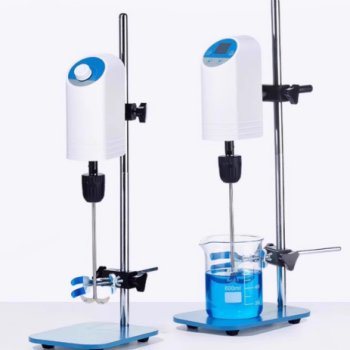
The primary advantage of a Continuous Stirred Tank Reactor (CSTR) in this context is its ability to faithfully simulate industrial-scale biogas operations while maintaining a stable environment for complex substrates. Unlike static batch systems, a CSTR utilizes an integrated stirring mechanism to process high-solid mixtures, such as Salix biomass and manure, preventing processing failures caused by lack of uniformity.
While batch reactors offer simplicity, they often fail to maintain the consistent environmental conditions required for difficult substrates. A CSTR addresses this through mechanical mixing and continuous feeding, allowing for the precise regulation of retention times and the prevention of localized biological crashes.
Optimizing Process Control and Scalability
Precise Operational Regulation
One of the distinct benefits of a CSTR is the ability to fine-tune critical operational parameters during active fermentation.
Operators can maintain precise control over the Organic Loading Rate (OLR) and the Hydraulic Retention Time (HRT). This flexibility allows for real-time adjustments that are difficult or impossible to achieve in a closed batch system.
Simulating Industrial Reality
Batch reactors often produce data that does not translate well to large-scale facilities.
A CSTR allows researchers and engineers to simulate industrial-scale biogas plant operations accurately. By replicating the continuous flow and mixing dynamics of a full-scale plant, the data gathered becomes highly applicable to real-world scenarios.
Managing Complex Substrates
Handling High Solid Content
Co-digesting manure with Salix biomass introduces a significant challenge regarding the physical consistency of the mix.
The CSTR's integrated stirring system is specifically capable of processing these mixed substrates with high solid content. This mechanical intervention ensures that the dense fibrous material of the Salix does not settle or float, which would inhibit digestion in a non-mixed vessel.
Maintaining Homogeneity
For efficient anaerobic digestion, the microbial environment must remain uniform throughout the reactor.
The stirring mechanism creates a homogeneous fermentation environment, ensuring nutrients and bacteria are evenly distributed. This uniformity is essential for consistent gas production and biological stability.
Preventing Localized Acidification
In static or poorly mixed reactors, pockets of the substrate can become too acidic, killing the necessary bacteria.
Continuous mixing prevents this localized acidification. By keeping the mixture uniform, the system optimizes the metabolic activity of methanogenic microorganisms, ensuring they remain healthy and productive throughout the digestion process.
Understanding the Trade-offs
Mechanical Complexity
While the integrated stirring system provides necessary homogeneity, it introduces mechanical complexity not present in batch reactors.
Moving parts require maintenance and energy input. If the stirring system fails when processing high-solid content like Salix, the reactor can quickly stratify, leading to the very process failures the CSTR is designed to prevent.
Making the Right Choice for Your Goal
To determine if a CSTR is the correct configuration for your biomass project, consider your specific objectives:
- If your primary focus is Industrial Application: Choose the CSTR to generate data that accurately predicts full-scale plant performance and operational limits.
- If your primary focus is Process Stability: Rely on the CSTR's mixing capabilities to prevent acidification and manage the high solid content of Salix mixtures.
By leveraging the continuous mixing and control capabilities of a CSTR, you ensure the biological stability necessary to turn complex biomass into reliable energy.
Summary Table:
| Feature | Continuous Stirred Tank Reactor (CSTR) | Batch Reactor |
|---|---|---|
| Operational Mode | Continuous feeding and discharge | Single-load process |
| Mixing Efficiency | Integrated mechanical stirring for high solids | Limited or no active mixing |
| Process Stability | High (prevents localized acidification) | Low (prone to biological crashes) |
| Scalability | High (simulates industrial conditions) | Low (lab-scale focus) |
| Control | Real-time OLR and HRT regulation | Pre-set initial conditions only |
| Best For | Complex substrates and industrial modeling | Simple pilot tests and batch studies |
Maximize Your Biogas Potential with KINTEK Precision
Transitioning from lab-scale experiments to industrial reality requires the right equipment. KINTEK specializes in advanced laboratory solutions designed to handle the toughest substrates. Whether you are optimizing co-digestion with our high-temperature high-pressure reactors and autoclaves or preparing samples with our robust crushing and milling systems, we provide the reliability your research demands.
Our comprehensive portfolio—from electrolytic cells to vacuum and atmosphere furnaces—is engineered to deliver stable, repeatable results for energy and battery research. Don't let localized acidification or poor mixing stall your progress. Contact KINTEK today to discover how our specialized laboratory equipment and consumables can streamline your path to sustainable energy production.
References
- Jonas Ohlsson, Anna Schnürer. Co-Digestion of Salix and Manure for Biogas: Importance of Clone Choice, Coppicing Frequency and Reactor Setup. DOI: 10.3390/en13153804
This article is also based on technical information from Kintek Solution Knowledge Base .
Related Products
- Laboratory Small Constant Temperature Heated Magnetic Stirrer Heater and Stirrer
- Customizable Laboratory High Temperature High Pressure Reactors for Diverse Scientific Applications
- High Performance Laboratory Stirrers for Diverse Applications
- Customizable High Pressure Reactors for Advanced Scientific and Industrial Applications
- High Pressure Laboratory Autoclave Reactor for Hydrothermal Synthesis
People Also Ask
- What role does a magnetic stirrer with heating play in ZnO nanoparticle synthesis? Precision Control for Quality Results
- What role does a constant temperature heating magnetic stirrer play in MFC-HAp synthesis? Achieve Material Homogeneity
- What is the function of a laboratory magnetic stirrer in Ni–Cr–P electrodeposition? Optimize Ion Transport & Coating
- Why is a laboratory magnetic stirrer required for benzoic acid esters? Boost Reaction Speed & Yield with High RPM
- What role does a laboratory magnetic stirrer play in TiO2 and TiO2-Ag sol preparation? Master Chemical Kinetics