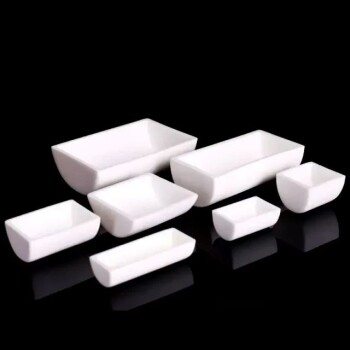
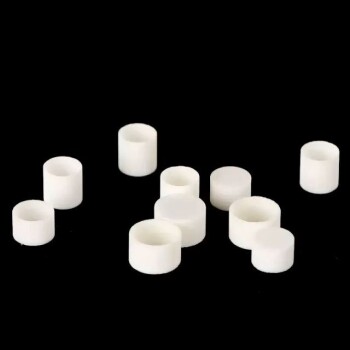
Using a covered ceramic boat during high-temperature sulfidation offers a dual advantage: it guarantees material purity through chemical inertness and creates a containment zone for sulfur vapor. This setup is essential for achieving a complete reaction, as the cover prevents the rapid escape of sulfur, forcing it to react thoroughly with the tungsten oxide even at temperatures reaching 900°C.
The primary value of the cover is the maintenance of a stable sulfur vapor atmosphere. This localized pressure promotes the deep diffusion of sulfur into the tungsten oxide particles, ensuring the conversion is uniform and complete rather than superficial.
The Role of Material Integrity
Thermal Stability at High Extremes
The sulfidation of tungsten oxide requires high thermal energy, often necessitating temperatures around 900°C. A high-purity ceramic boat is engineered to withstand this intense heat without degrading or deforming.
Chemical Inertness
At these elevated temperatures, many containment materials become reactive. High-purity ceramic is chemically inert, meaning it will not react with either the tungsten source or the corrosive sulfur vapor. This ensures the final product remains free of contaminants derived from the carrier vessel itself.
Controlling the Reaction Atmosphere
Trapping Sulfur Vapor
Sulfur is volatile and tends to vaporize and escape rapidly when heated. The addition of a cover on the ceramic boat acts as a physical barrier, significantly minimizing sulfur loss to the surrounding environment.
Creating a Stable Micro-Environment
By retaining sulfur vapor within the vessel, the cover maintains a high concentration of reactants directly around the tungsten oxide. This stable atmosphere is critical for driving the reaction forward efficiently.
Promoting Deep Diffusion
For the reaction to be successful, sulfur must penetrate beyond the surface of the tungsten oxide. The high vapor density created by the cover facilitates deep diffusion, allowing the sulfur to reach the core of the particles for a complete transformation.
Understanding the Operational Considerations
Batch Constraints
Using a covered boat typically implies a batch processing method. While excellent for controlling the atmosphere in small-to-medium quantities, it may limit continuous throughput compared to flow-through reactor designs.
Thermal Lag
The addition of a ceramic cover introduces a small amount of thermal mass. While generally negligible, operators should be aware that it may slightly delay the time required for the internal reactants to reach the target temperature compared to an open boat.
Making the Right Choice for Your Goal
To ensure you are optimizing your sulfidation process, consider the following specific objectives:
- If your primary focus is Product Purity: Rely on the chemical inertness of high-purity ceramic to prevent any cross-contamination between the vessel and the reactants.
- If your primary focus is Reaction Completeness: Ensure the boat is securely covered to maintain the vapor pressure necessary for sulfur to diffuse deeply into the tungsten oxide core.
By controlling both the containment material and the vapor atmosphere, you ensure a highly efficient and contamination-free synthesis.
Summary Table:
| Feature | Advantage in Sulfidation | Impact on Final Product |
|---|---|---|
| Chemical Inertness | No reaction with sulfur or tungsten oxide | High product purity and zero contamination |
| Thermal Stability | Resists temperatures up to 900°C+ | Prevents boat deformation and process failure |
| Covered Design | Traps sulfur vapor within the vessel | Ensures complete reaction and uniform conversion |
| Micro-Environment | Maintains high reactant concentration | Facilitates deep sulfur diffusion into particles |
Elevate Your Advanced Synthesis with KINTEK
Precision matters when your research involves extreme temperatures and corrosive atmospheres. KINTEK specializes in high-performance laboratory equipment and consumables designed for rigorous thermal processing. From high-purity ceramic boats and crucibles that ensure material integrity to advanced high-temperature muffle and tube furnaces for precise reaction control, we provide the tools you need for consistent results.
Whether you are performing sulfidation, CVD, or battery research, our comprehensive portfolio—including PTFE products, hydraulic presses, and high-pressure reactors—is engineered to meet the demands of modern science.
Ready to optimize your lab's efficiency and product purity? Contact KINTEK today to find the perfect carrier or furnace solution for your specific application!
References
- Nataša Gajić, Marija Korać. Synthesis of Tribological WS2 Powder from WO3 Prepared by Ultrasonic Spray Pyrolysis (USP). DOI: 10.3390/met9030277
This article is also based on technical information from Kintek Solution Knowledge Base .
Related Products
- Aluminized Ceramic Evaporation Boat for Thin Film Deposition
- Alumina Al2O3 Ceramic Crucible Semicircle Boat with Lid for Engineering Advanced Fine Ceramics
- Ceramic Evaporation Boat Set Alumina Crucible for Laboratory Use
- Carbon Graphite Boat -Laboratory Tube Furnace with Cover
- Folding Molybdenum Tantalum Boat With or Without Cover
People Also Ask
- What is the source of evaporation for thin film? Choosing Between Thermal and E-Beam Methods
- Why are high-purity ceramic boats used for lignin activation? Ensure Purity & Thermal Stability
- Why is an alumina boat and Ti3AlC2 powder bed necessary for Ti2AlC sintering? Protect MAX Phase Purity
- Why use an alumina boat for high-temperature carbon activation? Ensure Maximum Material Purity & Thermal Stability
- Why is an alumina boat selected for catalyst precursors? Ensure Sample Purity at 1000 °C