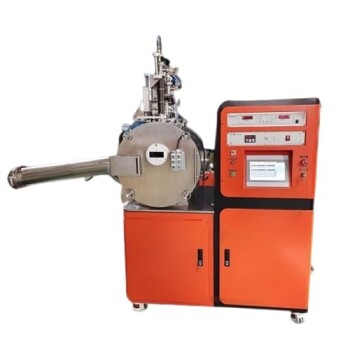
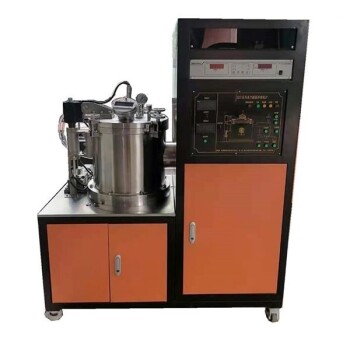
The definitive advantage of using a vacuum arc furnace with a water-cooled copper hearth for Al-Ni-Zr alloys is the elimination of crucible contamination while effectively melting high-melting-point elements. This system uses high-energy arcs to liquefy refractory metals like zirconium without compromising the chemical purity of the final ingot.
Core Takeaway Processing Al-Ni-Zr alloys requires balancing extreme heat with extreme chemical sensitivity. The vacuum arc furnace solves this by combining the thermal power needed to melt zirconium with a chilled hearth that physically prevents the molten alloy from reacting with its container.
Solving the Temperature Threshold
Overcoming the Zirconium Barrier
Al-Ni-Zr alloys present a specific thermal challenge due to the presence of zirconium. This element acts as a refractory metal with a significantly high melting point that standard furnaces may fail to process efficiently.
High-Energy Application
To address this, the vacuum arc furnace utilizes high-energy arcs. This mechanism generates the intense, localized temperatures required to fully melt the zirconium component, ensuring a homogeneous liquid phase.
Guaranteeing Material Purity
The Contamination Risk
In standard melting processes, molten alloys—especially those containing reactive elements—often attack the crucible walls. This chemical reaction leaches impurities from the container into the melt, degrading the alloy's properties.
The Water-Cooled Solution
The water-cooled copper hearth is the critical engineering solution to this problem. By rapidly removing heat at the point of contact, it prevents the copper hearth from reaching temperatures where it would react with or contaminate the molten Al-Ni-Zr.
Achieving High-Grade Ingots
This rapid heat removal effectively creates a barrier between the melt and the container. The result is an ingot with high purity, free from the ceramic or refractory inclusions common in other melting methods.
Understanding the Operational Context
System Complexity
While effective, this method relies on a complex interplay of systems. It requires not just the power supply for the arc, but a robust active water-cooling infrastructure to protect the hearth.
Specificity of Application
Unlike general induction furnaces which are often prized for broad efficiency and natural stirring in lower-temp metals like aluminum or copper, the vacuum arc furnace is a specialized tool. It is specifically optimized for scenarios where refractory capabilities and absolute purity outweigh standard efficiency metrics.
Making the Right Choice for Your Goal
When selecting a melting technology for Al-Ni-Zr alloys, consider your primary constraints:
- If your primary focus is Absolute Purity: The vacuum arc furnace is essential because the water-cooled hearth completely negates the risk of crucible-induced contamination.
- If your primary focus is Melting Refractory Elements: This method is required to generate the extreme, concentrated energy needed to liquefy zirconium components efficiently.
The vacuum arc furnace remains the superior choice for high-specification alloys where material integrity cannot be compromised by the melting vessel.
Summary Table:
| Feature | Advantage for Al-Ni-Zr Alloys | Key Benefit |
|---|---|---|
| High-Energy Arc | Generates intense localized heat | Fully melts refractory Zirconium (Zr) |
| Water-Cooled Copper Hearth | Prevents chemical reactions with the container | Eliminates crucible-induced contamination |
| Vacuum Environment | Removes atmospheric gases | Prevents oxidation and ensures ingot purity |
| Active Heat Removal | Creates a thermal barrier at contact points | Protects material integrity and equipment |
| Refractory Capability | Handles extreme melting points | Produces homogeneous, high-specification alloys |
Elevate Your Material Purity with KINTEK Specialized Melting Solutions
Processing sensitive Al-Ni-Zr alloys demands precision that standard furnaces simply cannot provide. At KINTEK, we specialize in high-performance laboratory equipment designed to solve your most complex thermal challenges.
Our advanced vacuum arc furnaces and water-cooled hearth systems are engineered to eliminate contamination and master refractory metals, ensuring your research and production meet the highest purity standards. Beyond melting, KINTEK offers a comprehensive range of laboratory solutions, including:
- High-Temperature Furnaces: Muffle, tube, rotary, vacuum, and CVD/PECVD systems.
- Material Processing: Crushing, milling, and high-precision hydraulic presses (pellet, hot, isostatic).
- Reactor Technology: High-temperature high-pressure reactors and autoclaves.
- Advanced Research Tools: Battery research consumables, electrolytic cells, and cooling solutions like ULT freezers and freeze dryers.
Ready to optimize your alloy development? Contact our technical experts today to discover how KINTEK’s precision equipment can enhance your lab's efficiency and material integrity.
References
- Qiang Chen, Zhanpeng Jin. Isothermal Sections of Al-Ni-Zr Ternary System at 850 and 1050 °C. DOI: 10.1007/s11669-013-0248-8
This article is also based on technical information from Kintek Solution Knowledge Base .
Related Products
- Vacuum Arc Induction Melting Furnace
- Non Consumable Vacuum Arc Induction Melting Furnace
- Vacuum Induction Melting Spinning System Arc Melting Furnace
- Vacuum Hot Press Furnace Heated Vacuum Press Machine Tube Furnace
- Vacuum Sealed Continuous Working Rotary Tube Furnace Rotating Tube Furnace
People Also Ask
- How do vacuum induction or arc melting furnaces facilitate the synthesis of U-Al-C MAX phases? Precision Heat & Purity
- What core role does a Vacuum Induction Melting furnace play in nickel-free steel production? Achieve High-Purity Alloys
- What is the primary function of a vacuum arc melting furnace in RHEA preparation? Achieving Extreme Thermal Fusion
- What is the function of a vacuum arc melting furnace? Master Homogeneity for Amorphous Alloy Ribbons
- What is the function of vacuum arc melting equipment? Creating High-Purity Ferrochrome (CrFe) Alloys