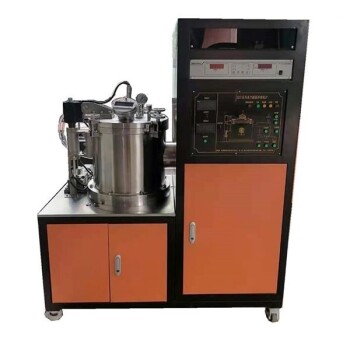
Combining a vacuum furnace with a flexible membrane creates a controlled, high-precision environment essential for bonding near-alpha titanium alloys. This dual approach simultaneously prevents material degradation caused by oxidation and utilizes uniform pressure to force atomic-level diffusion between layers, yielding a finished material with superior structural continuity and impact resistance.
Core Takeaway By removing oxygen and applying consistent pressure through a flexible membrane, this process transforms multiple thin titanium sheets into a single, indivisible solid. The result is a pore-free composite with isotropic mechanical properties, overcoming the inherent risks of oxidative embrittlement found in standard high-temperature joining.
The Chemistry of Control: Preventing Degradation
Eliminating Oxidative Embrittlement
Titanium alloys are highly reactive at elevated temperatures. A high-vacuum environment is non-negotiable because it removes oxygen from the reaction zone. Without this protection, titanium absorbs oxygen, leading to a brittle surface layer that drastically reduces the material's structural integrity.
Preserving Surface Purity
The vacuum furnace ensures a contamination-free atmosphere. This allows the titanium surfaces to remain chemically pure during the heating phase, which is a prerequisite for successful bonding. By strictly controlling the environment (sometimes introducing inert argon), the process prevents hydrogen absorption and surface scaling.
The Mechanics of Bonding: The Flexible Membrane
Achieving Atomic-Level Contact
The flexible membrane acts as the pressure delivery system. Unlike rigid mechanical clamps, a flexible membrane applies uniform, isostatic-like pressure across the entire surface of the stacked sheets. This forces the metal layers into intimate contact at the microscopic level.
Facilitating Solid-State Diffusion
Under this specific combination of heat and pressure, diffusion bonding occurs. Atoms migrate across the interface boundaries of the adjacent sheets. This is not merely adhesion; the layers physically merge to become a single solid unit.
Eradicating Microscopic Voids
The continuous pressure from the membrane ensures that interface pores are collapsed and eliminated. The result is a high-density bond where the original interfaces become chemically and visually indistinguishable from the base metal.
Resulting Material Properties
Isotropic Mechanical Performance
Because the interfaces are fully healed through diffusion, the material exhibits uniform macroscopic properties. The structure acts as a monolithic block rather than a laminate, providing consistent strength in all directions (isotropy).
Optimized Microstructure
The process preserves the desirable microstructure of the alloy. Specifically, it fosters the formation of uniform equiaxed alpha grains. This grain structure is critical for maintaining the material's ductility and strength.
Superior Fracture Toughness
The elimination of oxidation and voids directly translates to performance under stress. The resulting composite possesses excellent toughness, making it highly resistant to impact loads and fracture propagation.
Understanding the Trade-offs
Process Complexity and Cost
While technically superior, this method requires specialized, high-capital hardware. The need for high-vacuum systems and precise pressure control mechanisms makes this significantly more expensive than standard welding or adhesive bonding.
Stringent Preparation Requirements
Diffusion bonding is unforgiving of surface errors. The titanium sheets must be machined to precise thicknesses (e.g., 0.8 mm) and cleaned meticulously before entering the furnace. Any residual contaminants trapped inside will compromise the atomic bond.
Making the Right Choice for Your Goal
If you are evaluating this manufacturing method for your project, consider your specific performance requirements:
- If your primary focus is Maximum Fracture Toughness: This method is essential, as the vacuum environment prevents the embrittlement that causes premature failure under impact.
- If your primary focus is Structural Homogeneity: The flexible membrane is the key enabler here, ensuring void-free, atomic-level merging of layers into a single isotropic unit.
By leveraging the synergy of vacuum protection and flexible pressure application, you achieve a level of material quality that standard joining methods simply cannot replicate.
Summary Table:
| Feature | Advantage in Titanium Bonding | Impact on Material Quality |
|---|---|---|
| High-Vacuum Environment | Prevents oxidative embrittlement | Maintains surface purity and structural integrity |
| Flexible Membrane | Applies uniform, isostatic pressure | Eliminates microscopic voids and ensures atomic contact |
| Diffusion Bonding | Facilitates solid-state atomic migration | Creates a monolithic, indivisible solid structure |
| Controlled Heating | Fosters uniform equiaxed alpha grains | Optimizes ductility and isotropic mechanical properties |
| Surface Protection | Prevents hydrogen absorption | Ensures superior fracture toughness and impact resistance |
Elevate Your Material Engineering with KINTEK
Are you looking to achieve superior structural continuity and fracture toughness in your titanium alloy composites? KINTEK specializes in high-performance laboratory equipment designed for the most demanding thermal processes. From our advanced vacuum and atmosphere furnaces to high-precision hydraulic presses (isostatic and hot), we provide the tools necessary for successful diffusion bonding and material synthesis.
Our comprehensive portfolio supports every stage of your research and production, including:
- High-Temperature Furnaces: Muffle, tube, vacuum, and CVD systems.
- Pressure Solutions: Isostatic and pellet presses for uniform material density.
- Crucibles & Ceramics: Essential consumables for high-purity processing.
Ready to optimize your bonding process? Contact our experts today to discover how KINTEK’s precision equipment can transform your near-alpha titanium alloy manufacturing.
References
- Avgustina Danailova, Velichka Strijkova. Characterization and degradation of natural polysaccharide multilayer films. DOI: 10.21175/rad.abstr.book.2023.3.2
This article is also based on technical information from Kintek Solution Knowledge Base .
Related Products
- Vacuum Hot Press Furnace Heated Vacuum Press Machine Tube Furnace
- 600T Vacuum Induction Hot Press Furnace for Heat Treat and Sintering
- Vacuum Hot Press Furnace Machine Heated Vacuum Press
- Vacuum Heat Treat Furnace and Levitation Induction Melting Furnace
- 2200 ℃ Tungsten Vacuum Heat Treat and Sintering Furnace
People Also Ask
- What advantages does a vacuum hot press furnace provide for LSLBO ceramic electrolytes? Achieve 94% Relative Density
- What role does a Vacuum Hot Press (VHP) furnace play in the densification of austenitic stainless steel 316 composites?
- What are the advantages of using a vacuum hot pressing furnace? Superior Densification for 2024Al/Gr/SiC Composites
- What are the advantages of a vacuum hot press furnace for LTPO solid electrolytes? Boost Density and Conductivity
- What core processing conditions does a vacuum hot press furnace provide? Achieve High-Density Cu-SiC/Diamond Composites