The primary advantage of a coreless induction furnace is its superior operational flexibility. Unlike a core type furnace, a coreless model can be completely shut down and started from cold, which makes it far easier to switch between different metal alloys. This capability is essential for operations that do not run continuously or that need to produce a variety of materials.
Your choice between a coreless and a core type furnace is a fundamental trade-off. Coreless furnaces offer unmatched flexibility for diverse, intermittent operations, while core type furnaces deliver superior energy efficiency for continuous, high-volume production of a single alloy.
Understanding the Fundamental Design Difference
The operational advantages and disadvantages of each furnace stem directly from their core design. They operate on the same principle of induction but apply it in fundamentally different ways.
The Coreless Furnace: A Simple Crucible
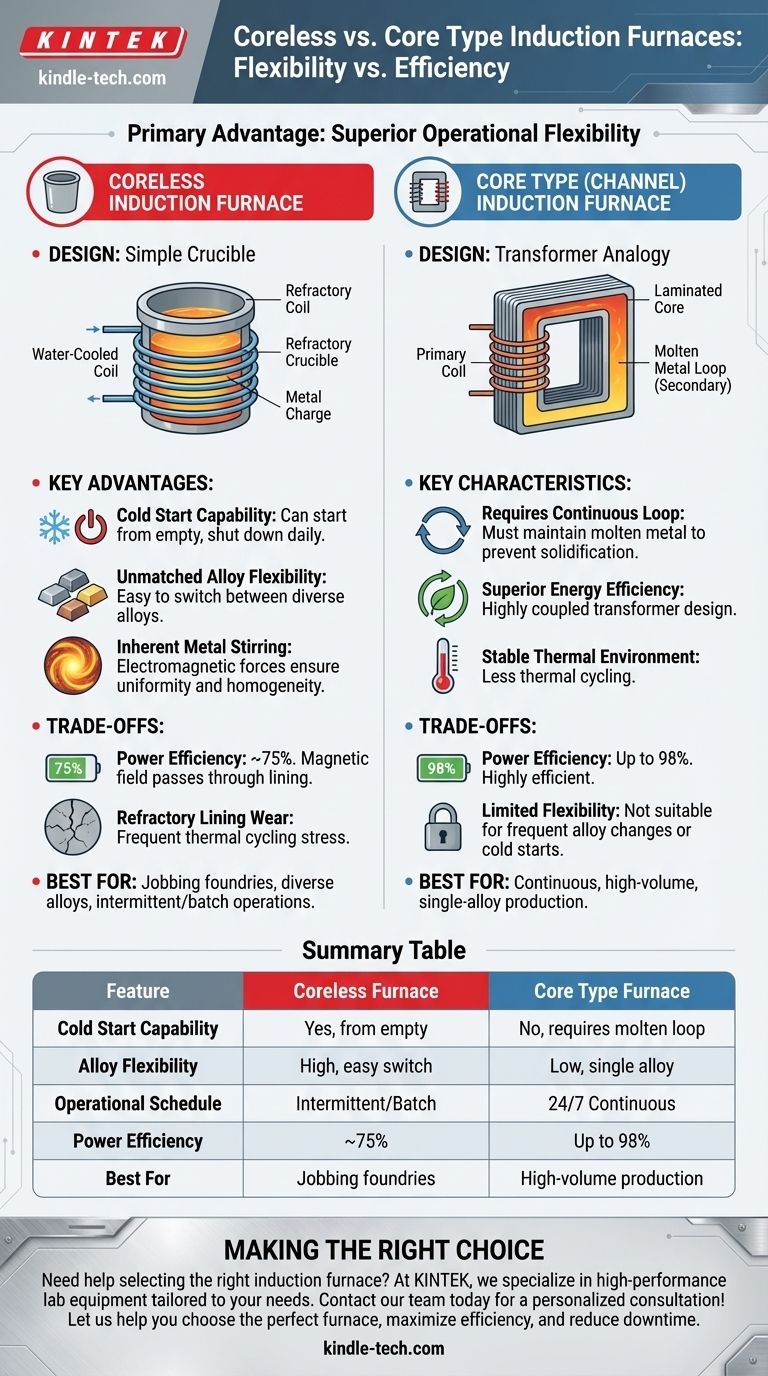
A coreless induction furnace is the simpler of the two designs. It consists of a refractory crucible containing the metal charge, which is surrounded directly by a water-cooled copper coil.
When an alternating current passes through the coil, it induces a powerful magnetic field and subsequent electrical currents directly within the metal, causing it to heat and melt rapidly.
The Core Type Furnace: A Transformer Analogy
A core type furnace, also known as a channel furnace, functions like a transformer. It has a laminated iron core with a primary electrical coil.
The "secondary coil" of this transformer is a closed loop or channel of molten metal that must be maintained at all times. The heat generated in this loop circulates through the main bath of metal, heating the furnace's contents.
Key Operational Advantages of the Coreless Furnace
The design of the coreless furnace gives it three distinct advantages for many modern foundries and metal processing facilities.
Cold Starting Capability
The most significant benefit is the ability to start from a cold, empty state. Because it doesn't require a continuous loop of molten metal to function, it can be shut down completely at the end of a shift or week.
This stands in stark contrast to a core type furnace, which must be kept running and holding molten metal to prevent the loop from solidifying, making it suitable only for 24/7 operations.
Unmatched Alloy Flexibility
The ability to completely empty the crucible makes changing alloys straightforward. A foundry can melt a batch of stainless steel, pour it, and then prepare the furnace to melt a batch of a different iron alloy.
This versatility is invaluable for jobbing foundries that serve multiple customers with diverse material requirements.
Inherent Metal Stirring
The electromagnetic forces generated by the large coil in a coreless furnace create a strong, natural stirring action throughout the molten bath.
This ensures excellent temperature uniformity and helps to quickly dissolve and homogenize alloying elements, resulting in a consistent final product.
Understanding the Trade-offs
The flexibility of a coreless furnace comes at a clear and measurable cost, primarily in energy consumption and maintenance considerations.
The Efficiency Cost of Flexibility
Coreless furnaces are less energy-efficient. Their power efficiency is typically around 75% because the magnetic field must pass through the refractory lining to reach the metal charge.
In contrast, the highly coupled transformer design of a core type furnace allows for an exceptional power efficiency of up to 98%, making it much cheaper to run for continuous, high-volume melting.
Refractory Lining Wear
The very flexibility that makes coreless furnaces attractive can also increase maintenance. Frequent thermal cycling—heating up from cold and cooling back down—puts significant stress on the refractory lining.
This can reduce the lining's service life, especially when compared to the stable thermal environment inside a continuously operating core type furnace.
Making the Right Choice for Your Operation
Selecting the correct furnace is critical and depends entirely on your production needs and operational model.
- If your primary focus is operational flexibility and alloy diversity: The coreless furnace is the superior choice for its ability to cold start and handle frequent product changeovers.
- If your primary focus is maximum energy efficiency for high-volume production: The core type (channel) furnace is the clear winner, provided you are processing a consistent alloy on a continuous schedule.
- If you operate on an intermittent, non-continuous schedule: The coreless furnace is the only practical option, as a core type furnace cannot be easily or economically shut down.
Ultimately, your decision hinges on balancing the unparalleled flexibility of the coreless furnace against the superior energy efficiency of the core type for your specific workflow.
Summary Table:
| Feature | Coreless Furnace | Core Type Furnace |
|---|---|---|
| Cold Start Capability | Yes, can start from empty | No, requires molten metal loop |
| Alloy Flexibility | High, easy to switch alloys | Low, suited for single alloy |
| Operational Schedule | Ideal for intermittent/batch | Requires 24/7 continuous operation |
| Power Efficiency | ~75% | Up to 98% |
| Best For | Jobbing foundries, diverse alloys | High-volume, single-alloy production |
Need help selecting the right induction furnace for your lab or foundry?
At KINTEK, we specialize in providing high-performance lab equipment and consumables tailored to your specific metal processing needs. Whether you require the flexibility of a coreless furnace for diverse alloy production or the efficiency of a core type furnace for continuous operation, our experts can help you optimize your workflow.
Let us help you:
- Choose the perfect furnace for your operational schedule and material requirements
- Maximize efficiency with equipment designed for your specific applications
- Reduce downtime with reliable performance and expert support
Contact our team today for a personalized consultation and discover how KINTEK's solutions can enhance your metal processing capabilities!
Visual Guide
Related Products
- Vacuum Heat Treat Furnace and Levitation Induction Melting Furnace
- 600T Vacuum Induction Hot Press Furnace for Heat Treat and Sintering
- Vertical Laboratory Tube Furnace
- Vacuum Induction Melting Spinning System Arc Melting Furnace
- Ultra-High Temperature Graphite Vacuum Graphitization Furnace
People Also Ask
- What is the difference between annealing hardening and tempering? Master Metal Properties for Your Lab
- What are the parts of a vacuum furnace? A Guide to the 5 Core Systems
- What is the process of vacuum quenching? Achieve Superior Hardness with a Pristine Surface Finish
- What are the three main heat treatments? Mastering Annealing, Hardening & Tempering
- What is a vacuum heat treatment furnace? The Ultimate Guide to Controlled Atmosphere Processing