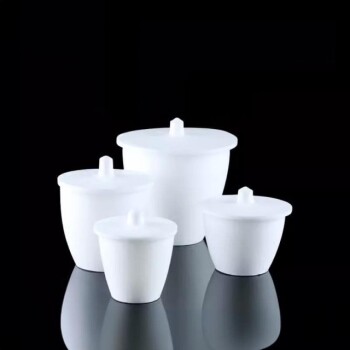
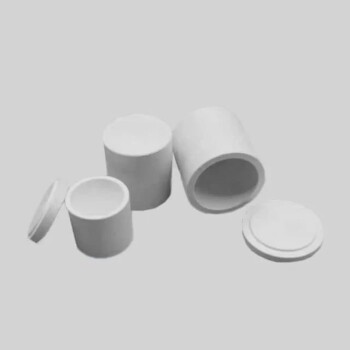
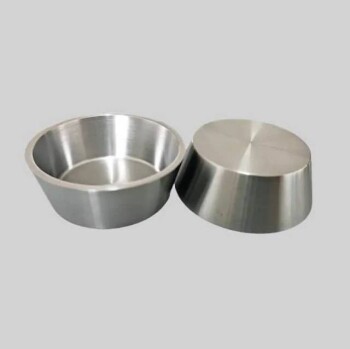
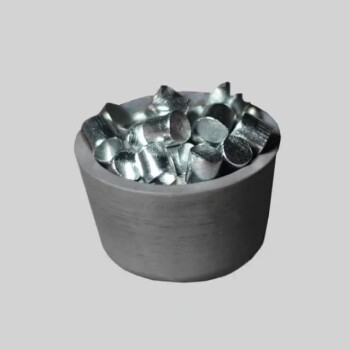
High-purity quartz crucibles are the optimal choice for processing Iron-Cobalt (Fe-Co) alloys due to their superior thermal shock stability and chemical inertness. They allow for the rapid, intense heating cycles inherent to induction remelting without structural failure, while simultaneously preventing contamination of the melt.
The defining advantage of high-purity quartz is its ability to maintain the compositional purity of the alloy; by remaining chemically inert at high temperatures, it ensures the final metallic glass ribbons retain their exact intended properties.
Thermal Resilience in Induction Processes
Withstanding Rapid Thermal Cycling
Induction remelting involves intense temperature fluctuations. The heating process is rapid and aggressive, creating significant thermal stress.
High-purity quartz possesses exceptional thermal shock stability. This allows the crucible to endure the rapid rise to melting temperatures and subsequent cooling without cracking or shattering.
High-Temperature Structural Integrity
Processing Fe-Co alloys requires sustaining high temperatures to achieve a homogeneous melt.
Quartz maintains its structural integrity under these extreme conditions. It provides a stable containment vessel that does not deform or fail during the critical melting phase.
Preserving Chemical Integrity
Preventing Melt Contamination
Molten metals, particularly iron and cobalt, can be highly reactive at elevated temperatures.
High-purity quartz offers high chemical stability, ensuring it does not react with the Fe-Co melt. This inertness is critical to prevent the crucible material from leaching into the alloy and altering its chemistry.
Ensuring Metallic Glass Quality
The production of metallic glass ribbons requires precise compositional control. Even trace impurities can degrade the material's glass-forming ability or magnetic properties.
By eliminating the risk of reaction, high-purity quartz preserves the compositional purity of the melt. This directly correlates to the production of high-quality, defect-free metallic glass ribbons.
Understanding the Critical Constraints
The Requirement for High Purity
It is important to note that standard quartz may not offer the same performance as high-purity variants.
Lower-grade materials may contain trace elements that could leach into the melt or suffer from reduced thermal shock resistance. The success of the process relies specifically on the "high-purity" designation to ensure total inertness.
Vulnerability to Physical Handling
While thermally robust, quartz remains a brittle material.
Its resistance to thermal shock does not equate to resistance to mechanical impact. Operators must handle these crucibles with care during loading and cleaning to prevent micro-fractures that could propagate during heating.
Making the Right Choice for Your Goal
To maximize the quality of your Fe-Co alloy production, consider the following regarding crucible selection:
- If your primary focus is Process Safety: Rely on high-purity quartz to prevent catastrophic crucible failure caused by the rapid temperature spikes of induction heating.
- If your primary focus is Material Quality: Use high-purity quartz to eliminate chemical reactivity, ensuring the metallic glass ribbons are free from crucible-induced impurities.
High-purity quartz provides the necessary balance of thermal toughness and chemical isolation required for advanced alloy manufacturing.
Summary Table:
| Feature | Advantage for Fe-Co Processing | Benefit for Metallic Glass |
|---|---|---|
| Thermal Shock Stability | Withstands rapid induction heating cycles | Prevents structural failure and cracking |
| Chemical Inertness | No reaction with molten iron or cobalt | Maintains exact compositional purity |
| High Purity Grade | Eliminates trace element leaching | Ensures superior magnetic properties |
| Structural Integrity | Maintains shape at extreme temperatures | Provides stable containment for homogeneous melts |
Elevate Your Advanced Alloy Research with KINTEK
Precision in metallic glass production starts with the quality of your consumables. KINTEK specializes in high-performance laboratory equipment, providing high-purity quartz crucibles, ceramics, and crucibles specifically designed to withstand the rigors of induction remelting and melt-spinning.
Whether you are producing Fe-Co based alloys or developing next-generation metallic glasses, our solutions—including high-temperature furnaces, crushing systems, and vacuum equipment—ensure your materials remain free from contamination and structural defects.
Ready to optimize your melt-spinning process? Contact KINTEK today to discover how our premium consumables and laboratory tools can enhance your research outcomes.
References
- Jiali Jiang, Jian Lü. Synergistic function of iron and cobalt in metallic glasses for highly improving persulfate activation in water treatment. DOI: 10.1016/j.jallcom.2019.153574
This article is also based on technical information from Kintek Solution Knowledge Base .
Related Products
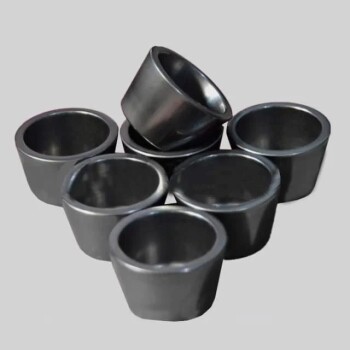
- High Purity Pure Graphite Crucible for Evaporation
- High Purity Pure Graphite Crucible for Electron Beam Evaporation
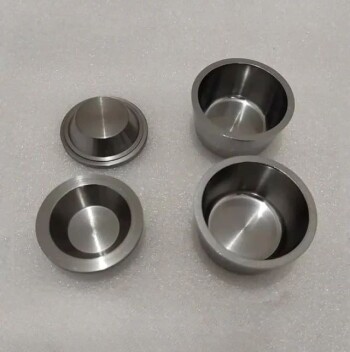
- Electron Beam Evaporation Coating Tungsten Crucible and Molybdenum Crucible for High Temperature Applications
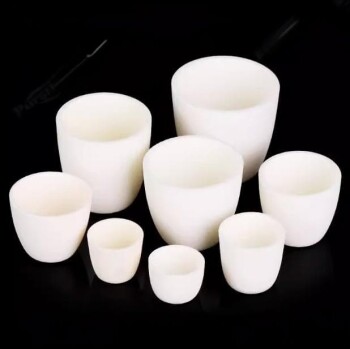
- Arc-Shaped Alumina Ceramic Crucible High Temperature Resistant for Engineering Advanced Fine Ceramics
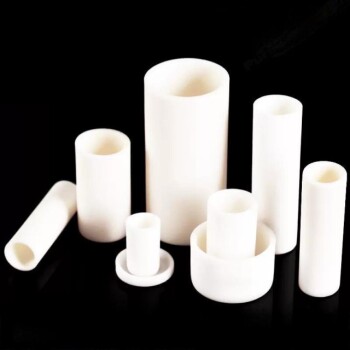
- Engineering Advanced Fine Ceramics Alumina Al2O3 Crucible With Lid Cylindrical Laboratory Crucible
People Also Ask
- Why are high-purity graphite crucibles preferred for sulfide solid electrolytes? Achieve Superior Material Purity
- Why is a high-purity graphite crucible required for Chromel-TaC composites? Ensure Peak Purity at 1400°C
- What role do high-purity graphite crucibles play in molten salt corrosion research? Ensure Reactor-Grade Precision
- Why are high-purity graphite crucibles used for magnesium distillation? Ensure 3N8 Purity & Thermal Stability
- Why is a high-purity graphite crucible ideal for nitrogen-doped graphene at 1500 °C? Maximize Purity and Stability