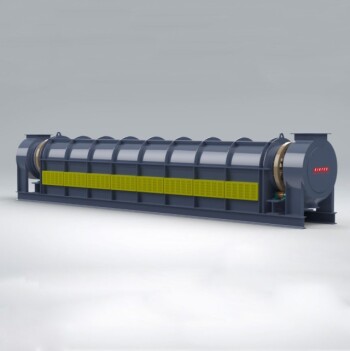
Power-frequency induction melting offers a decisive advantage through intrinsic electromagnetic stirring. By utilizing electromagnetic induction, these furnaces provide efficient heating while simultaneously agitating the melt. This ensures that complex alloy systems, such as Fe-P (Iron-Phosphorus) and Mn-Fe-P (Manganese-Iron-Phosphorus), rapidly achieve the compositional uniformity required for high-quality brazing applications.
The primary value of power-frequency induction lies in its ability to force compositional homogeneity through electromagnetic stirring. This uniformity is essential for defining accurate solidus and liquidus lines, which determine the precise melting intervals of the brazing filler.
The Mechanics of Homogeneity
The Power of Electromagnetic Stirring
The defining characteristic of power-frequency induction furnaces is the generation of strong electromagnetic stirring forces within the molten pool.
Unlike static heating methods, the induction current physically moves the liquid metal.
This natural agitation is critical when dealing with multicomponent alloys containing elements with varying densities and melting points, such as iron, manganese, phosphorus, boron, and silicon.
Rapid Alloying of Complex Elements
Achieving a uniform mix in Fe-P and Mn-Fe-P systems can be challenging due to the disparate properties of the constituent elements.
The stirring action ensures these elements are distributed evenly throughout the matrix.
This significantly reduces the time required to reach compositional homogeneity, preventing segregation where heavy elements sink or light elements float.
Why This Matters for Brazing Fillers
Establishing Precise Melting Intervals
For brazing filler alloys, thermal properties are the most critical performance metric.
You must establish accurate solidus (where melting begins) and liquidus (where melting ends) lines.
If the melt is not homogeneous, test samples will yield inconsistent thermal data, making it impossible to define the alloy's true melting range.
Supporting Experimental Development
The primary reference highlights the importance of this process for developing "experimental brazing fillers."
When creating new alloy formulations, researchers rely on the certainty that the chemical composition is consistent throughout the batch.
Power-frequency induction eliminates variables caused by poor mixing, ensuring that the resulting physical properties are strictly a result of the chemistry, not the process.
Understanding the Constraints
Turbulence and Oxidation Risk
While strong stirring is advantageous for mixing, it can introduce challenges if not managed.
Excessive turbulence at the surface of the melt can increase the surface area exposed to the atmosphere.
Without proper shielding (vacuum or inert gas), this can lead to increased oxidation or gas absorption in the alloy.
Crucible Wear
The kinetic energy imparted to the metal by power-frequency induction creates physical friction against the crucible walls.
This "scouring" effect can lead to faster erosion of the refractory lining compared to static melting methods.
Operators must monitor lining integrity closely to prevent contamination of the alloy or furnace failure.
Making the Right Choice for Your Goal
To maximize the benefits of power-frequency induction for your specific application, consider the following:
- If your primary focus is Research and Development: Prioritize this method to ensure your solidus and liquidus data points are not skewed by element segregation.
- If your primary focus is Production Speed: Leverage the rapid mixing capabilities to shorten cycle times for complex multi-element recipes.
Ultimately, power-frequency induction is the superior choice when the chemical uniformity of the alloy is the non-negotiable standard for success.
Summary Table:
| Feature | Benefit for Fe-P / Mn-Fe-P Alloys | Impact on Brazing Performance |
|---|---|---|
| Electromagnetic Stirring | Rapidly achieves compositional homogeneity across multi-element systems. | Ensures consistent melting intervals and reliable flow. |
| Uniform Distribution | Prevents segregation of elements like Phosphorus, Silicon, and Manganese. | Provides accurate solidus and liquidus thermal data. |
| Efficient Heating | Combines melting and agitation into a single high-speed process. | Shortens production cycles for complex alloy recipes. |
| Experimental Control | Eliminates variables caused by poor mixing in new formulations. | Guarantees physical properties are a result of chemistry, not process errors. |
Elevate Your Material Research with KINTEK Precision
Ensure your brazing filler alloys meet the highest standards of homogeneity and thermal accuracy. KINTEK specializes in advanced laboratory equipment, including high-performance induction melting furnaces, muffle furnaces, and vacuum systems designed for demanding metallurgical applications. Whether you are developing experimental Fe-P alloys or scaling production, our team provides the technical expertise and high-quality consumables—from ceramics to crucibles—to optimize your results.
Ready to refine your melting process? Contact KINTEK today to discover how our induction melting and high-temperature solutions can enhance your lab's efficiency and precision.
References
- Matija Zorc, Aleš Nagode. A Preliminary Study of New Experimental Low-Cost Fe–P-Based and Mn–Fe–P-Based Brazing Filler Metals for Brazing of Non-Alloy and Low-Alloy Steels. DOI: 10.3390/met13091513
This article is also based on technical information from Kintek Solution Knowledge Base .
Related Products
- Vacuum Arc Induction Melting Furnace
- Lab-Scale Vacuum Induction Melting Furnace
- Non Consumable Vacuum Arc Induction Melting Furnace
- Vacuum Heat Treat Furnace and Levitation Induction Melting Furnace
- 600T Vacuum Induction Hot Press Furnace for Heat Treat and Sintering
People Also Ask
- How do vacuum induction or arc melting furnaces facilitate the synthesis of U-Al-C MAX phases? Precision Heat & Purity
- What core role does a Vacuum Induction Melting furnace play in nickel-free steel production? Achieve High-Purity Alloys
- What is the primary function of a vacuum arc melting furnace in RHEA preparation? Achieving Extreme Thermal Fusion
- What is the function of vacuum arc melting equipment? Creating High-Purity Ferrochrome (CrFe) Alloys
- What is the function of a vacuum arc melting furnace? Prepare High-Purity Alx(CrFeNi)1-x High-Entropy Alloys