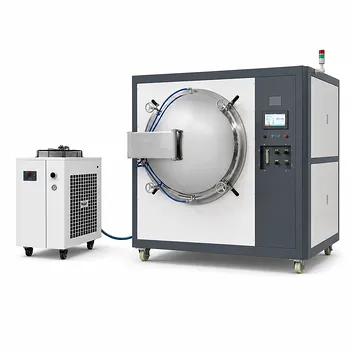
Vacuum hot pressing sintering offers a decisive advantage over conventional pressureless methods for (W,Al)C-Co cemented carbides by utilizing external mechanical force to amplify the sintering driving force. This approach enables complete densification in a significantly shorter timeframe—typically 10 to 15 minutes—compared to the hours required for standard sintering.
Core Takeaway The primary benefit of vacuum hot pressing is the ability to achieve rapid densification without the penalty of grain coarsening. This preserves a fine microstructure, directly resulting in superior mechanical properties, including exceptionally high hardness (up to 20.57 GPa) and enhanced flexural strength.
Achieving Superior Microstructure
The fundamental difference between the two methods lies in how they manage the relationship between density and grain size.
The Impact of Mechanical Force
In conventional sintering, densification relies primarily on thermal energy and surface tension. Vacuum hot pressing adds external mechanical pressure (axial pressure) to the equation. This additional force accelerates particle rearrangement and drives the liquid cobalt phase into pores, ensuring rapid and complete densification.
Inhibiting Grain Growth
Time is the enemy of a fine microstructure. Conventional sintering often requires hold times of one to two hours, which allows grains to merge and grow larger, reducing material strength. Vacuum hot pressing achieves full density in just 10 to 15 minutes, drastically reducing the window for diffusion and effectively inhibiting excessive or abnormal grain growth.
Resulting Mechanical Properties
Because the process maintains a fine grain structure while eliminating porosity, the physical performance of the alloy is significantly boosted. The resulting cemented carbides exhibit higher hardness—reaching levels such as 20.57 GPa—and superior flexural strength compared to materials processed via pressureless sintering.
The Role of the Vacuum Environment
Beyond mechanical pressure, the vacuum atmosphere plays a critical chemical role in optimizing the material matrix.
Purification and Degassing
The high-vacuum environment effectively removes volatile impurities and adsorbed gases from the powder surfaces during the heating phase. This "cleaning" effect is vital for preventing defects that could compromise the structural integrity of the final part.
Enhanced Wettability
By removing surface contaminants and preventing high-temperature oxidation, the vacuum improves the wettability of the liquid cobalt on the tungsten carbide particles. This ensures a stronger bond between the binder and the hard phase, which improves fracture toughness and eliminates pore defects.
Operational and Process Advantages
The benefits of this method extend to process efficiency and control.
Energy Efficiency and Speed
Because the process is an "activated sintering" technique, it significantly lowers the time required for phase changes and alloy formation. The combination of rapid heating rates and short holding times reduces overall energy consumption compared to the prolonged cycles of conventional furnaces.
Uniformity and Control
Vacuum hot pressing provides excellent uniformity in the temperature field of the workpiece. Modern systems allow for precise IT-based control over the densification process, ensuring consistent quality even when preparing large-diameter materials.
Understanding the Trade-offs
While vacuum hot pressing is superior for specific material properties, it is essential to recognize its operational context compared to other advanced methods.
Pressure Limitations vs. Isostatic Pressing
While hot pressing is effective, the pressure applied is typically an order of magnitude lower than isostatic pressing. This means that while it is superior to pressureless sintering, it may not achieve the extreme pressure uniformity of hot isostatic pressing (HIP) for complex geometries, though it requires a smaller equipment investment than HIP.
Geometric Constraints
The application of axial pressure generally limits the complexity of shapes that can be produced in a single step. Unlike pressureless sintering, which can accommodate complex pre-formed shapes, hot pressing is often best suited for simpler geometries like plates, discs, or cylinders that may require subsequent machining.
Making the Right Choice for Your Goal
To determine if vacuum hot pressing is the correct manufacturing route for your application, consider your specific performance requirements.
- If your primary focus is Maximum Hardness: Select vacuum hot pressing to leverage the rapid densification that preserves fine grain structure and maximizes GPa ratings.
- If your primary focus is Material Purity: Rely on the vacuum environment to eliminate oxidation and improve the binder-to-particle bond for better toughness.
- If your primary focus is Process Efficiency: Utilize this method to reduce sintering hold times from hours to minutes, significantly lowering energy consumption per cycle.
Summary: Vacuum hot pressing is the optimal choice when the goal is to produce high-performance cemented carbides with fine microstructures and minimal porosity without the extensive cycle times of conventional sintering.
Summary Table:
| Feature | Vacuum Hot Pressing | Pressureless Sintering |
|---|---|---|
| Sintering Time | 10 - 15 Minutes | 1 - 2 Hours |
| Driving Force | Thermal + Mechanical Axial Pressure | Thermal Energy + Surface Tension |
| Hardness (max) | Up to 20.57 GPa | Significantly Lower |
| Grain Growth | Inhibited (Fine Microstructure) | Common (Grain Coarsening) |
| Wettability | High (Vacuum Environment) | Moderate |
| Efficiency | High Energy Efficiency | Low (Prolonged Cycles) |
Elevate Your Material Performance with KINTEK
Precision and speed are the cornerstones of advanced material science. At KINTEK, we specialize in providing high-performance laboratory equipment designed to push the boundaries of densification and purity. Whether you are developing (W,Al)C-Co cemented carbides or exploring new ceramic composites, our state-of-the-art vacuum hot pressing systems, high-temperature furnaces, and hydraulic presses provide the precise control you need to achieve superior hardness and fine microstructures.
Our value to you:
- Advanced Sintering Solutions: From vacuum and atmosphere furnaces to CVD/PECVD systems.
- Material Integrity: High-vacuum environments to ensure purification and prevent oxidation.
- Comprehensive Support: Specialized tools for battery research, crushing, and milling to streamline your entire workflow.
Don't compromise on grain size or structural integrity. Contact KINTEK today to find the perfect sintering solution for your lab!
Related Products
- Vacuum Heat Treat and Pressure Sintering Furnace for High Temperature Applications
- Vacuum Heat Treat and Sintering Furnace with 9MPa Air Pressure
- 600T Vacuum Induction Hot Press Furnace for Heat Treat and Sintering
- Vacuum Heat Treat and Molybdenum Wire Sintering Furnace for Vacuum Sintering
- Vacuum Heat Treat Sintering Brazing Furnace
People Also Ask
- What is the purpose of the heat treatment (sintering) step? Engineering Robust Electroactive Membranes
- What is a vacuum sintering furnace? Unlock Purity and Performance in Advanced Materials
- Why must green bodies produced via binder jetting undergo treatment in a vacuum sintering furnace?
- What are some alternative atmospheres to pure hydrogen for powder metallurgy sintering processes? Top Sintering Solutions
- How does the vacuum environment impact sintering of diamond-copper composites? Protect Against Thermal Damage