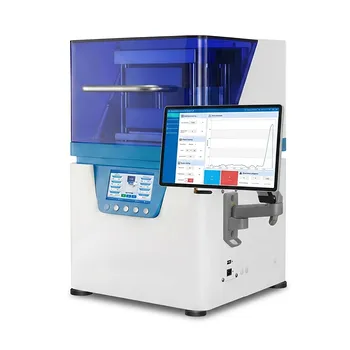
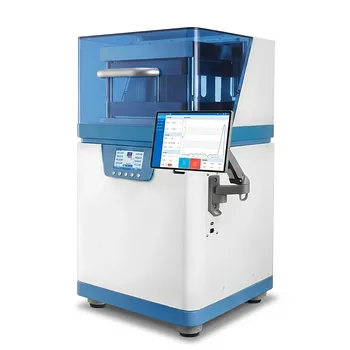
The laboratory hydraulic press is the primary tool for ensuring physical and electrical integration during supercapacitor assembly. By applying precise, uniform pressure to the layered stack of electrodes and separators, the press forces these components into intimate contact. This process is essential for minimizing internal resistance and ensuring the device can handle high current densities without mechanical failure.
The core function of a hydraulic press in this context is to transform a collection of loose components into a high-performance energy storage device by optimizing the interfaces between materials. This compression is what dictates the final power output and long-term cycling stability of the supercapacitor.
Optimizing Electrical Performance through Compression
Reduction of Interfacial Resistance
In wood-based supercapacitors, the interface between the porous electrode and the current collector is a common source of electrical loss. The hydraulic press applies controlled mechanical force to eliminate microscopic gaps between these layers. This reduction in interfacial resistance allows for faster electron transport and significantly improves the overall power density of the pack.
Enhancement of Rate Performance
The rate at which a supercapacitor can charge and discharge is heavily dependent on how well the active materials are bonded to the conductive substrate. By applying pressures often ranging from 10 MPa to 30 MPa, the press ensures that the active carbon or wood-derived materials are effectively "seated" against the current collector. This creates a robust electrical pathway that maintains performance even under high current densities.
Consistent Electrical Contact
Uniformity is critical when assembling multi-cell packs to prevent "hot spots" or uneven performance across the device. A laboratory hydraulic press provides isostatic-like pressure distribution, ensuring that every square centimeter of the electrode experiences the same force. This consistency results in a balanced electrical load across the entire supercapacitor pack.
Ensuring Mechanical and Structural Integrity
Strengthening Material Bonding
Wood-based electrodes often consist of mixtures including active carbon, binders, and conductive agents. The high pressure exerted by the press (up to 80 MPa in some specialized molding dies) causes these particles to rearrange and bond tightly. This physical compaction prevents the active material from delaminating or shedding during operation.
Stability During Electrolyte Flushing
Supercapacitors must withstand the physical stress of being submerged in liquid electrolytes. The mechanical consolidation provided by the hydraulic press ensures the structural integrity of the electrode sheets. Without this high-pressure compaction, the electrodes might swell or disintegrate when they come into contact with the electrolyte or during repeated charge-discharge cycles.
Secure Packaging and Sealing
Beyond the electrodes themselves, the press is used to ensure the tight contact of packaging materials. This creates a hermetic environment that protects the internal components from environmental degradation. In multi-cell assemblies, this ensures that the entire stack remains compressed and functional over thousands of cycles.
Understanding the Trade-offs
The Risk of Over-Compression
While high pressure is necessary for contact, excessive force can damage the porous structure of wood-based electrodes. Over-compressing the materials can collapse the micro-channels required for ion transport, which actually decreases the capacitance. Finding the "sweet spot" between contact and porosity is the primary challenge in this process.
Material Deformation and Stress
Repeatedly applying extreme pressure can lead to mechanical fatigue in the current collectors or separators. If the pressure is not applied perfectly parallel, it can cause shearing forces that tear thin separators, leading to internal short circuits. Precision-aligned dies and calibrated pressure gauges are mandatory to avoid these common pitfalls.
How to Apply This to Your Project
Integrating the Press into Your Workflow
- If your primary focus is maximizing power density: Use the press to apply higher pressures (20-30 MPa) to minimize contact resistance between the electrode and the current collector.
- If your primary focus is long-term cycle life: Prioritize moderate, sustained pressure to ensure mechanical bonding without crushing the delicate porous structure of the wood-derived active material.
- If your primary focus is multi-cell consistency: Utilize a press with a digital pressure gauge and high-precision platens to ensure every cell in the pack receives identical compression.
With the right balance of pressure and precision, the laboratory hydraulic press transforms raw materials into a cohesive, high-efficiency energy storage system.
Summary Table:
| Key Application | Core Benefit | Typical Pressure / Impact |
|---|---|---|
| Interfacial Resistance | Minimizes gaps between electrode & collector | 10 - 30 MPa |
| Material Bonding | Prevents delamination & material shedding | Up to 80 MPa |
| Rate Performance | Ensures fast electron transport for high current | Enhanced conductivity |
| Structural Integrity | Stabilizes electrodes during electrolyte flushing | Prevents swelling/cracking |
| Uniform Distribution | Eliminates hot spots in multi-cell packs | Isostatic-like pressure |
Elevate Your Energy Storage Research with KINTEK
Precision is the difference between a failing prototype and a high-performance supercapacitor. KINTEK specializes in advanced laboratory equipment, offering a premium range of hydraulic presses (pellet, hot, and isostatic) specifically designed for material science and battery research.
Whether you are optimizing wood-based electrodes or assembling complex multi-cell packs, our equipment ensures the exact pressure control needed to minimize resistance and maximize structural integrity. Beyond presses, explore our comprehensive portfolio of battery research tools, high-temperature furnaces, and specialized consumables.
Ready to achieve superior consistency in your lab?
Contact our specialists today to find the perfect equipment for your project!
References
- Ruimei Yuan, Hejun Li. Graphene nanotube array assists all‐wood supercapacitors to access high energy density and stability. DOI: 10.1002/bte2.20220055
This article is also based on technical information from Kintek Solution Knowledge Base .
Related Products
- Laboratory Hydraulic Press Split Electric Lab Pellet Press
- Laboratory Hydraulic Press Lab Pellet Press Machine for Glove Box
- Laboratory Hydraulic Press Lab Pellet Press for Button Battery
- Automatic Laboratory Hydraulic Pellet Press Machine for Lab Use
- Fully Automatic Heated Hydraulic Lab Press for Materials Sintering and Sample Preparation
People Also Ask
- What role does a laboratory hydraulic press play in platinum recovery research? Enhancing Sample Precision
- What are the specific applications of a lab hydraulic press in biochar evaluation? Optimize density and data accuracy.
- What are the roles of a laboratory hydraulic press and stainless steel molds in the preparation of graphite samples?
- What is the role of a laboratory hydraulic press in electrode prep? Maximize Energy Density & Sealing Precision
- Why must a laboratory hydraulic press equipped with cylindrical molds be used when preparing BZY green bodies? High Density