Knowledge What are the applications of roller mill? Achieve Superior Dispersion for Viscous Materials
Author avatar

Tech Team · Kintek Solution

Updated 6 days ago

What are the applications of roller mill? Achieve Superior Dispersion for Viscous Materials


At its core, a roller mill is a specialized machine for processing high-viscosity materials. It finds applications across a diverse range of industries, from manufacturing high-performance ceramics and electronic inks to creating smooth cosmetics, paints, pharmaceuticals, and even certain foods. Its primary function is to grind, homogenize, and disperse solid particles within a thick liquid or paste base, ensuring exceptional uniformity.

The true value of a roller mill lies in its ability to apply intense shear force to viscous materials. This makes it the ideal tool for applications where achieving an extremely fine and uniform particle dispersion is critical to the final product's quality, texture, and performance.
What are the applications of roller mill? Achieve Superior Dispersion for Viscous Materials

The Core Functions Driving Roller Mill Applications

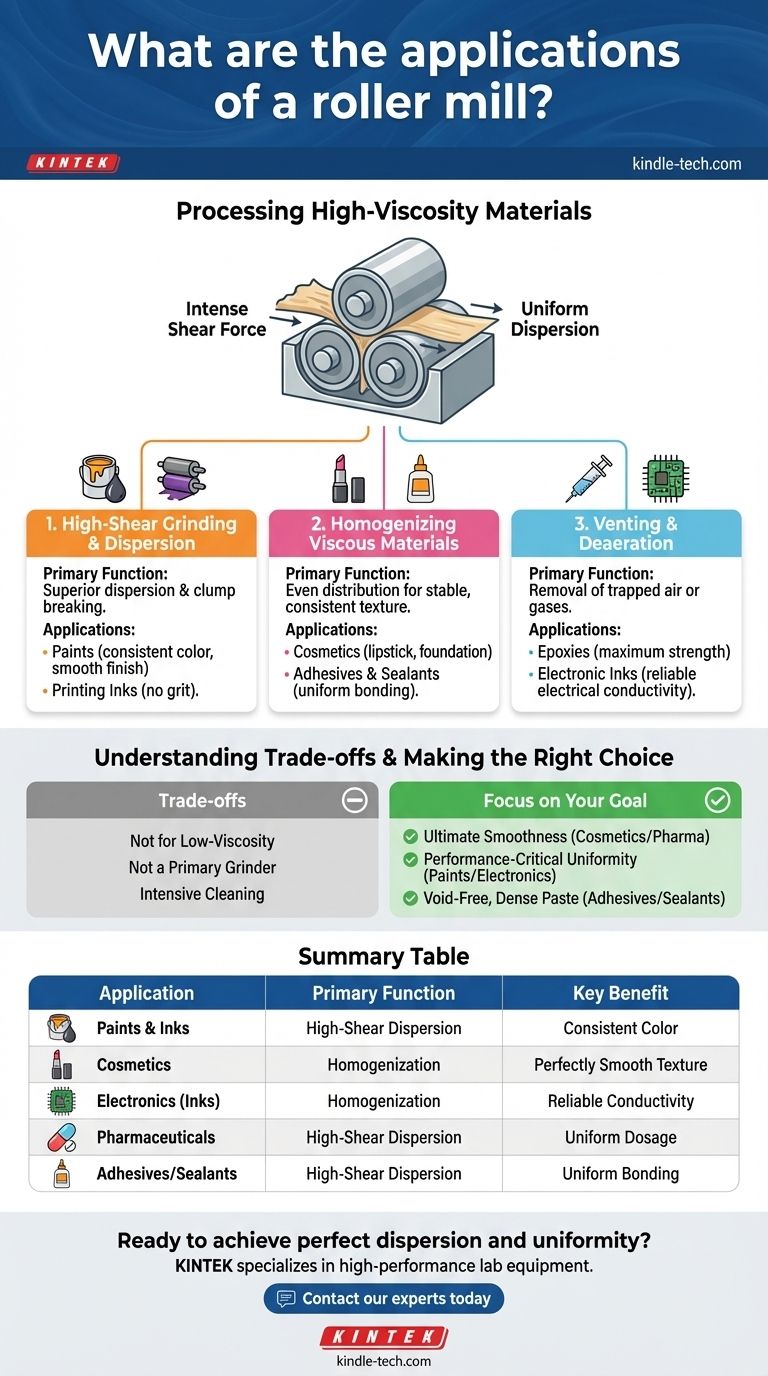
A roller mill, most commonly a three-roll mill, works by passing material through the gaps (or "nips") between rotating cylinders. Each successive gap is narrower, creating immense shear force that tears apart agglomerates and disperses particles evenly.

High-Shear Grinding and Dispersion

The primary purpose of a roller mill is to achieve a superior level of dispersion. The immense pressure and shear force break down clumps of solid particles.

This is critical in products like paints and printing inks, where undispersed pigment agglomerates would lead to inconsistent color, poor finish, and grit.

Homogenizing Viscous Materials

Homogenization ensures that every component is distributed evenly throughout the mixture, resulting in a stable and consistent final product.

In the cosmetics industry, this process is essential for creating products like lipstick or foundation with a perfectly smooth texture. For adhesives and sealants, it guarantees uniform bonding and curing properties.

Venting and Deaeration

The milling process can also help remove trapped air or gases from a mixture, a process known as venting or deaeration.

This is vital for epoxies and electronic thick film inks, where air bubbles could create weak points or disrupt electrical conductivity, compromising the performance of the final product.

Understanding the Trade-offs

While powerful, a roller mill is a specialized tool, not a universal solution. Understanding its limitations is key to using it effectively.

Not for Low-Viscosity Liquids

Roller mills rely on the material's high viscosity to be drawn into the roller gaps. They are inefficient for thin, watery liquids, which would simply splash off the rollers.

Primarily a Dispersion Tool, Not a Grinder

While a roller mill does reduce particle size, its main strength is breaking apart clumps (de-agglomeration) rather than fracturing primary crystals (true grinding). It perfects a pre-mixed paste.

Intensive Cleaning Requirements

The nature of the machine requires thorough cleaning between batches, especially when changing colors or formulations. This can make it less suitable for applications requiring rapid, frequent product changeovers.

Making the Right Choice for Your Goal

Choosing a roller mill depends entirely on the specific properties required in your final product.

  • If your primary focus is ultimate smoothness and texture: A roller mill is indispensable for high-end cosmetics, pharmaceuticals, and certain food products where a gritty feel is unacceptable.
  • If your primary focus is performance-critical uniformity: It is the standard for producing high-quality paints, printing inks, and electronic components where consistent dispersion is directly tied to function.
  • If your primary focus is creating a void-free, dense paste: The deaeration properties are crucial for adhesives, sealants, and epoxies that require maximum strength and reliability.

Ultimately, a roller mill is the definitive tool when the quality of your viscous product is defined by the fineness of its dispersion.

Summary Table:

Application Primary Function Key Benefit
Paints & Inks High-Shear Dispersion Consistent color, smooth finish, no grit
Cosmetics Homogenization Perfectly smooth texture (e.g., lipstick)
Electronics (Inks) Dispersion & Deaeration Reliable electrical conductivity
Pharmaceuticals Grinding & Homogenization Uniform dosage and efficacy
Adhesives/Sealants Homogenization & Deaeration Uniform bonding, maximum strength

Ready to achieve perfect dispersion and uniformity in your viscous products?

KINTEK specializes in high-performance lab equipment, including roller mills, designed to meet the rigorous demands of industries like yours. Whether you are developing paints, cosmetics, pharmaceuticals, or electronic materials, our solutions ensure the fine particle dispersion critical to your product's quality and performance.

Contact our experts today to discuss how a KINTEK roller mill can enhance your production process and deliver superior results for your target customers.

Visual Guide
What are the applications of roller mill? Achieve Superior Dispersion for Viscous Materials Visual Guide

Related Products

People Also Ask

Related Products

Laboratory Single Horizontal Jar Mill

Laboratory Single Horizontal Jar Mill

KT-JM3000 is a mixing and grinding instrument for placing a ball milling tank with a volume of 3000ml or less. It adopts frequency conversion control to realize timing, constant speed, direction change, overload protection and other functions.

High Energy Vibratory Laboratory Ball Mill Double Tank Type

High Energy Vibratory Laboratory Ball Mill Double Tank Type

High-energy vibration ball mill is a small desktop laboratory grinding instrument. It uses 1700r/min high-frequency three-dimensional vibration to make the sample achieve the result of grinding or mixing.

Laboratory Planetary Ball Mill Rotating Ball Milling Machine

Laboratory Planetary Ball Mill Rotating Ball Milling Machine

KT-P400E is a desktop multi-directional planetary ball mill with unique grinding and mixing capabilities. It offers continuous and intermittent operation, timing, and overload protection, making it ideal for various applications.

High-Energy Omnidirectional Planetary Ball Mill Milling Machine for Laboratory

High-Energy Omnidirectional Planetary Ball Mill Milling Machine for Laboratory

The KT-P4000E is a new product derived from the vertical high-energy planetary ball mill with a 360° swivel function. Experience faster, uniform, and smaller sample output results with 4 ≤1000ml ball mill jars.

High-Energy Omnidirectional Planetary Ball Mill Machine for Laboratory

High-Energy Omnidirectional Planetary Ball Mill Machine for Laboratory

The KT-P2000E is a new product derived from the vertical high-energy planetary ball mill with a 360°rotation function. The product not only has the characteristics of the vertical high-energy ball mill, but also has a unique 360°rotation function for the planetary body.

High Energy Planetary Ball Mill Milling Machine for Laboratory

High Energy Planetary Ball Mill Milling Machine for Laboratory

Experience fast and effective sample processing with the F-P2000 high-energy planetary ball mill. This versatile equipment offers precise control and excellent grinding capabilities. Perfect for laboratories, it features multiple grinding bowls for simultaneous testing and high output. Achieve optimal results with its ergonomic design, compact structure, and advanced features. Ideal for a wide range of materials, it ensures consistent particle size reduction and low maintenance.

High Energy Planetary Ball Mill Milling Machine for Laboratory

High Energy Planetary Ball Mill Milling Machine for Laboratory

The biggest feature is that the high energy planetary ball mill can not only perform fast and effective grinding, but also has good crushing ability

Laboratory Planetary Ball Mill Cabinet Planetary Ball Milling Machine

Laboratory Planetary Ball Mill Cabinet Planetary Ball Milling Machine

The vertical cabinet structure combined with ergonomic design enables users to obtain the best comfortable experience in standing operation. The maximum processing capacity is 2000ml, and the speed is 1200 revolutions per minute.

High Energy Planetary Ball Mill for Laboratory Horizontal Tank Type Milling Machine

High Energy Planetary Ball Mill for Laboratory Horizontal Tank Type Milling Machine

KT-P4000H uses the unique Y-axis planetary motion trajectory, and utilizes the collision, friction and gravity between the sample and the grinding ball to have a certain anti-sinking ability, which can obtain better grinding or mixing effects and further improve the sample output.

High Energy Vibratory Laboratory Ball Mill Grinding Mill Single Tank Type

High Energy Vibratory Laboratory Ball Mill Grinding Mill Single Tank Type

High-energy vibration ball mill is a small desktop laboratory grinding instrument.It can be ball-milled or mixed with different particle sizes and materials by dry and wet methods.

Laboratory Ten-Body Horizontal Jar Mill for Lab Use

Laboratory Ten-Body Horizontal Jar Mill for Lab Use

The Ten-body horizontal jar mill is for 10 ball mill pots (3000ml or less). It has frequency conversion control, rubber roller movement, and PE protective cover.

Laboratory Test Sieves and Sieving Machines

Laboratory Test Sieves and Sieving Machines

Precision lab test sieves & sieving machines for accurate particle analysis. Stainless steel, ISO-compliant, 20μm-125mm range. Request specs now!

HFCVD Machine System Equipment for Drawing Die Nano-Diamond Coating

HFCVD Machine System Equipment for Drawing Die Nano-Diamond Coating

The nano-diamond composite coating drawing die uses cemented carbide (WC-Co) as the substrate, and uses the chemical vapor phase method ( CVD method for short ) to coat the conventional diamond and nano-diamond composite coating on the surface of the inner hole of the mold.

Benchtop Laboratory Freeze Dryer for Lab Use

Benchtop Laboratory Freeze Dryer for Lab Use

Premium benchtop laboratory freeze dryer for lyophilization, preserving samples with ≤ -60°C cooling. Ideal for pharmaceuticals & research.

Laboratory Sterilizer Lab Autoclave Vertical Pressure Steam Sterilizer for Liquid Crystal Display Automatic Type

Laboratory Sterilizer Lab Autoclave Vertical Pressure Steam Sterilizer for Liquid Crystal Display Automatic Type

Liquid crystal display automatic vertical sterilizer is a safe, reliable and automatic control sterilization equipment, which is composed of heating system, microcomputer control system and overheating and overvoltage protection system.

Laboratory Sterilizer Lab Autoclave Pulse Vacuum Lifting Sterilizer

Laboratory Sterilizer Lab Autoclave Pulse Vacuum Lifting Sterilizer

The pulse vacuum lifting sterilizer is a state-of-the-art equipment for efficient and precise sterilization. It uses pulsating vacuum technology, customizable cycles, and a user-friendly design for easy operation and safety.

Benchtop Laboratory Vacuum Freeze Dryer

Benchtop Laboratory Vacuum Freeze Dryer

Benchtop laboratory freeze dryer for efficient lyophilization of biological, pharmaceutical, and food samples. Features intuitive touchscreen, high-performance refrigeration, and durable design. Preserve sample integrity—consult now!

Ring Press Mold for Lab Applications

Ring Press Mold for Lab Applications

Ring Press Dies, also known as Circular Pellet Press Die Sets, are integral components in various industrial and laboratory processes.

Anti-Cracking Press Mold for Lab Use

Anti-Cracking Press Mold for Lab Use

The anti-cracking press mold is a specialized equipment designed for molding various shapes and sizes of film using high pressure and electric heating.

915MHz MPCVD Diamond Machine Microwave Plasma Chemical Vapor Deposition System Reactor

915MHz MPCVD Diamond Machine Microwave Plasma Chemical Vapor Deposition System Reactor

915MHz MPCVD Diamond Machine and its multi-crystal effective growth, the maximum area can reach 8 inches, the maximum effective growth area of single crystal can reach 5 inches. This equipment is mainly used for the production of large-size polycrystalline diamond films, the growth of long single crystal diamonds, the low-temperature growth of high-quality graphene, and other materials that require energy provided by microwave plasma for growth.


Leave Your Message