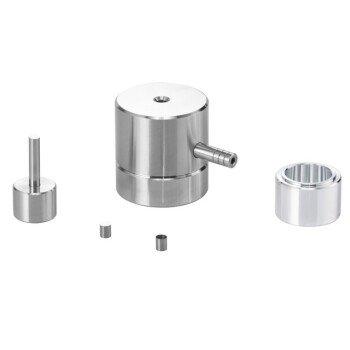
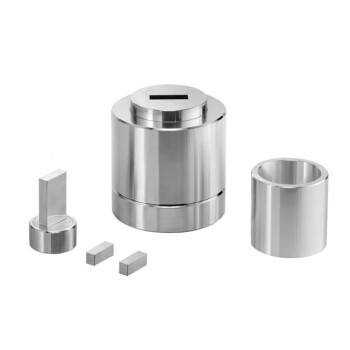
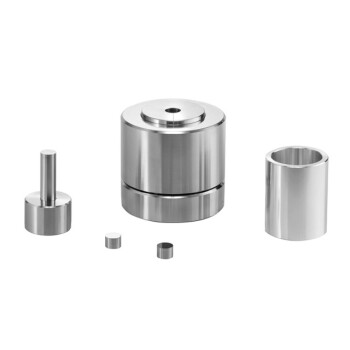
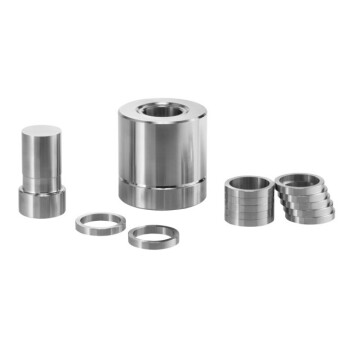
The cylindrical pelleting mold and hydraulic press function as the primary compaction unit in the solid-state preparation of LATP ceramics. Together, they transform loose, ball-milled glass powder into a cohesive, solid shape—known as a "green pellet"—by applying high uniaxial pressure, typically around 200 MPa.
The core purpose of this equipment is to bridge the gap between loose powder and a final ceramic product. By mechanically forcing particles into close contact, this stage creates the necessary material density and structural integrity required for successful pressureless sintering.
The Mechanics of Compaction
The Role of the Cylindrical Pelleting Mold
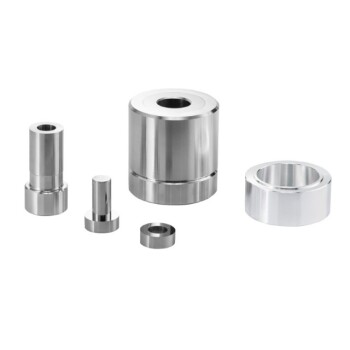
The mold serves as the geometric constraint for the material. It contains the loose ball-milled glass powder in a defined cylindrical cavity.
This tool ensures the powder is distributed evenly before pressure is applied. It defines the final diameter and general shape of the pellet.
The Role of the Hydraulic Press
The hydraulic press acts as the engine of force generation. It applies a massive, controlled load to the plungers of the mold.
In this context, the press typically delivers approximately 200 MPa of pressure. This force is what physically squeezes the air out of the powder and forces particles to lock together.
Creating the "Green Pellet"
The immediate result of this process is the "green pellet." This term refers to the compacted ceramic object before it has been fired (sintered).
The press and mold ensure this pellet has specific strength and density. Without this step, the material would remain a loose dust that cannot be handled or shaped.
Why Cold Pressing is Critical for Sintering
Promoting Optimal Particle Contact
The primary reference highlights that this stage promotes optimal particle contact. This is physically essential for the chemistry of the next step.
During the subsequent pressureless sintering, atoms must diffuse across particle boundaries to fuse the material. The hydraulic press forces these particles close enough to make that diffusion possible.
Ensuring Geometric Integrity
The cold pressing stage dictates the sample's ability to retain its shape. The compacted density prevents the sample from collapsing or distorting significantly during the heating process.
This ensures that the final LATP ceramic maintains the desired cylindrical form factor required for testing or integration.
Understanding the Trade-offs
Uniaxial Pressure Limitations
The primary reference notes the use of "uniaxial pressure," meaning force is applied in one direction (top-down).
While effective for simple shapes, this can sometimes lead to density gradients. The edges of the pellet may be slightly denser than the center due to friction against the mold walls.
The Fragility of Green Bodies
While the press creates "specific strength," the green pellet is not yet a fully robust ceramic. It relies on mechanical interlocking rather than chemical bonding.
Careful handling is required when ejecting the pellet from the mold to avoid micro-cracks before the sintering phase.
Making the Right Choice for Your Goal
To maximize the quality of your LATP ceramics, consider how you apply this compaction step:
- If your primary focus is high final density: Ensure the hydraulic press consistently achieves the recommended 200 MPa to maximize initial particle contact.
- If your primary focus is geometric precision: meticulous cleaning of the pelleting mold is essential to prevent friction that causes shape distortion or sticking.
The success of your final sintering process is directly dependent on the quality of the green body produced by this mold and press combination.
Summary Table:
| Component | Primary Function | Key Role in LATP Preparation |
|---|---|---|
| Cylindrical Mold | Geometric Constraint | Defines pellet shape, diameter, and ensures even powder distribution. |
| Hydraulic Press | Force Generation | Applies ~200 MPa uniaxial pressure to remove air and lock particles. |
| The Result | Green Pellet Creation | Produces a handleable, dense solid ready for pressureless sintering. |
| Critical Goal | Particle Contact | Facilitates atomic diffusion by forcing particles into intimate contact. |
Elevate Your Solid-State Synthesis with KINTEK Precision
Achieving the perfect green pellet is the foundation of high-performance LATP ceramics. At KINTEK, we specialize in providing the high-pressure tools necessary for superior material density. From our precision-engineered cylindrical pelleting molds to our robust manual and automatic hydraulic presses, we offer the complete compaction solution for laboratory research and industrial development.
Our extensive portfolio also includes high-temperature furnaces (muffle, tube, vacuum) for sintering, crushing and milling systems for powder preparation, and a wide range of PTFE and ceramic consumables.
Ready to optimize your ceramic density and structural integrity? Contact KINTEK today to discover how our high-pressure systems can enhance your laboratory's efficiency and material quality.
Related Products
- Automatic Laboratory Hydraulic Pellet Press Machine for Lab Use
- Cylindrical Press Mold for Lab Applications
- Assemble Square Lab Press Mold for Laboratory Applications
- Cylindrical Lab Electric Heating Press Mold for Laboratory Applications
- Laboratory Hydraulic Press Lab Pellet Press Machine for Glove Box
People Also Ask
- What is the role of a laboratory hydraulic pellet press and stainless steel molds in the fabrication of RuO2/NbC anodes?
- What role does a laboratory pellet press play in the enhancement of biomass energy products? Optimize Fuel Efficiency
- What is the purpose of using a laboratory pellet press when evaluating the electronic conductivity of carbon powders? Guide
- How does a laboratory hydraulic pellet press contribute to SiCw/2024 aluminum composite preforms? Optimize Densification
- What is the significance of applying 200 MPa of pressure with a laboratory hydraulic pellet press for composite ceramics?