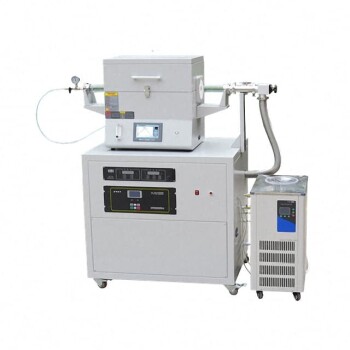
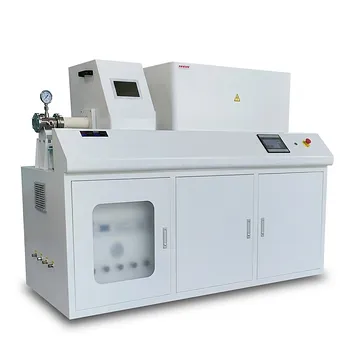
A tube Chemical Vapor Deposition (CVD) furnace facilitates the preparation of Graphene/Carbon Nanotube (G/CNT) hybrids by providing a precisely controlled high-temperature environment (950°C–1050°C) and a stable gas-phase atmosphere. These conditions allow for the simultaneous pyrolysis of carbon precursors and the formation of covalent bonds between the graphene layers and the carbon nanotube architecture.
The core function of a tube CVD furnace is to synchronize thermal energy with chemical precursors, creating an isothermal reaction zone that drives the growth of graphene directly onto carbon nanotubes through high-temperature pyrolysis and molecular rearrangement.
Thermal Environment and Temperature Control
Precise High-Temperature Ranges
For G/CNT hybrid synthesis, the furnace must maintain a specific thermal window, typically between 950°C and 1050°C. This high energy is required to break the molecular bonds of hydrocarbon precursors and facilitate the growth of high-crystallinity graphene.
Maintenance of Isothermal Zones
The horizontal layout of the tube furnace creates a stable isothermal zone where the temperature remains uniform across the substrate. This uniformity is critical to ensure that the growth rate of graphene is consistent across the entire surface of the carbon nanotubes.
Catalyst Activation and Stability
The precise temperature control system ensures that catalyst active sites (often metal-based) are maintained throughout the process. Proper thermal management prevents the sintering or deactivation of catalysts, which is essential for the orderly deposition of carbon atoms.
Atmospheric and Gas Flow Dynamics
Control of Precursor Pyrolysis Kinetics
By introducing specific precursor gases—such as methane (CH₄) or acetylene (C₂H₂)—the furnace regulates the pyrolysis kinetics of the carbon source. This ensures a steady supply of carbon atoms for the formation of covalent bonds between the graphene and nanotubes.
Stable Gas Flow Fields
The horizontal tube design allows for a stable gas flow field across the material surface. This controlled movement of gases guides the carbon atoms to deposit uniformly, preventing structural defects and ensuring the hybrid material achieves the desired morphology.
Pressure Management
While many G/CNT processes occur at stable atmospheric pressure, the CVD furnace can also be configured for low-pressure or high-vacuum environments. Adjusting the pressure allows researchers to fine-tune the mean free path of the gas molecules, which influences the thickness and quality of the graphene coating.
Chemical Synthesis and Bonding
Facilitation of Covalent Bonding
The primary environmental advantage of the CVD furnace is its ability to foster covalent bonding between the graphene and the CNTs. This direct growth results in a hybrid material with superior mechanical and electrical properties compared to simple physical mixtures.
Reducing Atmosphere via Hydrogen
The furnace often utilizes a mixture of hydrogen (H₂) and hydrocarbon gases. The hydrogen acts as an etchant to remove amorphous carbon and helps control the grain size of the graphene, resulting in a higher-purity hybrid structure.
Substrate Interaction
The furnace environment allows carbon atoms to undergo rearrangement on various substrates, such as copper or nickel foils. These substrates act as templates, assisting the furnace in defining the final shape and layer count of the graphene components.
Understanding the Trade-offs
Temperature Sensitivity vs. Structural Integrity
While higher temperatures (above 1000°C) improve graphene crystallinity, they also risk damaging the underlying carbon nanotube structure or causing unwanted substrate melting. Finding the thermal equilibrium is a constant challenge for researchers.
Throughput vs. Uniformity
Increasing gas flow rates can speed up the production of hybrid materials, but it often leads to gas turbulence. This turbulence can result in non-uniform growth and "hot spots" where the carbon deposition is too thick or poorly bonded.
Cooling Rate Complexities
The environmental control does not end at growth; the cooling phase is equally vital. Rapid cooling can introduce thermal stress and cracking in the graphene layers, while slow cooling may lead to secondary, unwanted carbon precipitation.
How to Apply This to Your Project
Selecting the Right Parameters
Successfully preparing G/CNT hybrids requires matching the furnace environment to your specific material requirements and substrate type.
- If your primary focus is high electrical conductivity: Prioritize a higher temperature range (1000°C+) and low-pressure conditions to maximize graphene crystallinity and covalent bond density.
- If your primary focus is structural uniformity over large areas: Focus on maintaining a stable atmospheric pressure and a long isothermal zone to ensure consistent growth across the entire substrate.
- If your primary focus is preventing CNT damage: Utilize a slightly lower temperature (approx. 900°C-950°C) and optimize the hydrogen flow rate to protect the nanotube walls during pyrolysis.
By mastering these environmental variables, you can transform a standard tube furnace into a high-precision tool for advanced carbon nanotechnology.
Summary Table:
| Parameter | Optimal Condition | Role in G/CNT Synthesis |
|---|---|---|
| Temperature | 950°C – 1050°C | Facilitates hydrocarbon pyrolysis and high-crystallinity growth. |
| Atmosphere | Reducing (H₂ + CH₄/C₂H₂) | Controls grain size, removes amorphous carbon, and fosters covalent bonding. |
| Gas Flow | Stable/Laminar Flow | Ensures uniform deposition and prevents structural defects. |
| Thermal Zone | Isothermal | Maintains consistent growth rates across the entire substrate surface. |
| Pressure | Atmospheric to Low-Pressure | Influences the mean free path of molecules and coating thickness. |
Elevate Your Nanomaterial Research with KINTEK Precision
Achieving the perfect covalent bond in G/CNT hybrids requires more than just heat—it requires absolute environmental control. KINTEK specializes in high-performance laboratory equipment, providing researchers with the advanced tube furnaces (CVD, PECVD, atmosphere) and vacuum systems necessary to master isothermal stability and gas kinetics.
Beyond our industry-leading furnaces, KINTEK offers a comprehensive range of tools, including high-pressure reactors, hydraulic pellet presses, and precision crushing systems, tailored for advanced material science. Whether you are optimizing electrical conductivity or scaling up structural composites, our technical experts are ready to provide the reliable equipment and consumables (PTFE, ceramics, crucibles) your lab demands.
Ready to refine your synthesis process? Contact KINTEK today for a customized solution!
References
- Jian Sheng, Yan Li. Covalently Bonded Graphene Sheets on Carbon Nanotubes: Direct Growth and Outstanding Properties. DOI: 10.1002/adfm.202306785
This article is also based on technical information from Kintek Solution Knowledge Base .
Related Products
- Split Chamber CVD Tube Furnace with Vacuum Station Chemical Vapor Deposition System Equipment Machine
- Customer Made Versatile CVD Tube Furnace Chemical Vapor Deposition Chamber System Equipment
- Multi Heating Zones CVD Tube Furnace Machine Chemical Vapor Deposition Chamber System Equipment
- Chemical Vapor Deposition CVD Equipment System Chamber Slide PECVD Tube Furnace with Liquid Gasifier PECVD Machine
- Laboratory High Pressure Vacuum Tube Furnace
People Also Ask
- What is the function of a tube furnace in CVD SiC synthesis? Achieving Ultra-Pure Silicon Carbide Powders
- What is a CVD tube furnace? A Complete Guide to Thin-Film Deposition
- What are the technical advantages of using a CVD tube furnace? Optimize Silicon-Carbon Battery Anodes
- What is the function of a high-temperature CVD tube furnace in 3D graphene foam prep? Master 3D Nanomaterial Growth
- How does a CVD tube furnace inhibit the sintering of silver supports? Boost Membrane Durability and Performance