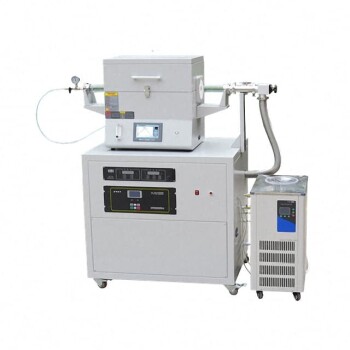
A tube CVD furnace acts as a precision-controlled thermal reactor that transforms polymer precursors into high-performance carbon structures. Specifically, it provides the regulated environment necessary to first oxidize fibers in an air atmosphere for stability and then thermally decompose them in an inert atmosphere to achieve carbonization and structural integrity.
Core Takeaway: The tube CVD furnace is the critical link in fiber synthesis, managing both the chemical atmosphere and thermal ramps to convert organic precursor molecules into a high-strength, conductive carbon framework while preventing unwanted oxidation or structural collapse.
The Role of the Furnace in Stabilization
Facilitating Pre-Oxidation and Cross-Linking
During the stabilization phase, the furnace maintains a constant temperature—typically around 260°C—within an air atmosphere. This stage is crucial for promoting cross-linking and solidification of polymer molecules, effectively turning linear molecules into a heat-resistant ladder structure.
Ensuring Chemical Resistance
By providing a stable thermal environment, the furnace allows the precursor fibers to undergo a chemical transformation that makes them infusible. This ensures the fibers do not melt or fuse together during the subsequent high-temperature carbonization stages.
Precision Temperature Ramping
Advanced furnaces utilize programmable controls to manage slow heating rates, often as low as 1°C/min. This prevents the exothermic reactions during stabilization from spiraling out of control, which would otherwise damage the fiber's internal structure.
The Role of the Furnace in Carbonization
Creating an Inert Protective Environment
In the carbonization phase, the furnace switches to a high-purity nitrogen (99.993%) or argon atmosphere to displace all oxygen. This inert environment is vital to prevent the carbon fibers from burning (oxidizing) as temperatures climb toward 700°C to 1200°C.
Driving Thermal Decomposition
The furnace provides the high-energy environment required for pyrolysis, the process of removing non-carbon elements like hydrogen, nitrogen, and oxygen. This thermal decomposition collapses the molecular structure into a dense, high-carbon matrix with increased mechanical strength.
Guiding Graphitization and Pore Structure
As temperatures rise, the furnace guides the orderly construction of triazine structures and the graphitization of carbon nanostructures. This precise thermal management is used to create specific surface areas and hierarchical pore structures necessary for electrochemical applications.
Understanding the Trade-offs and Pitfalls
Atmospheric Leaks and Contamination
The most common pitfall in CVD furnace operation is a compromise in atmospheric sealing. Even trace amounts of oxygen during the high-temperature carbonization phase can lead to the "pitting" of the fiber surface, significantly reducing its final tensile strength.
Heating Rate Sensitivity
Choosing a heating rate that is too aggressive can lead to internal defects and structural voids. While faster ramps increase throughput, they often result in amorphous carbon structures rather than the desired crystalline or graphitic structures required for high-conductivity applications.
Temperature Gradient Inconsistency
In larger tube furnaces, maintaining a uniform temperature field across the entire length of the tube is difficult. If the temperature fluctuates, the resulting fibers will have inconsistent mechanical and electrical properties throughout the batch.
How to Apply This to Your Project
Making the Right Choice for Your Goal
To achieve the best results with your tube CVD furnace, tailor your parameters based on your desired material characteristics:
- If your primary focus is mechanical strength: Prioritize a furnace with exceptional atmospheric sealing and a high-temperature threshold (up to 1200°C) to ensure complete non-carbon element removal.
- If your primary focus is electrochemical activity: Focus on a furnace with highly precise programmable ramping (around 1°C/min) to carefully control the development of the micro-mesoporous pore structure.
- If your primary focus is composite "carbon bridges": Utilize a vacuum-capable tube furnace to facilitate the thermal decomposition of hydrogels into amorphous carbon at contact points between fibers.
By mastering the furnace's atmospheric and thermal controls, you can precisely engineer the molecular architecture of composite fibers for any demanding industrial application.
Summary Table:
| Process Phase | Temperature Range | Atmosphere | Primary Function |
|---|---|---|---|
| Stabilization | ~260°C | Air (Oxygen) | Facilitates cross-linking & prevents melting |
| Carbonization | 700°C – 1200°C | Inert (N2 / Ar) | Pyrolysis & removal of non-carbon elements |
| Graphitization | High (>1200°C) | Inert / Vacuum | Structural ordering for mechanical strength |
| Pore Engineering | Variable | Controlled Gas | Creates specific surface areas for batteries |
Elevate Your Fiber Synthesis with KINTEK Precision
Achieving the perfect molecular architecture for composite fibers requires absolute control over temperature and atmosphere. KINTEK specializes in advanced laboratory solutions, offering a comprehensive range of tube furnaces, CVD and PECVD systems, and vacuum furnaces designed to eliminate atmospheric contamination and ensure uniform thermal fields.
Why choose KINTEK for your research?
- Precise Thermal Management: Programmable ramping as low as 1°C/min to prevent internal defects.
- Superior Sealing: High-integrity atmospheric controls to prevent "pitting" and maintain tensile strength.
- Complete Lab Ecosystem: From high-temperature high-pressure reactors to ceramic crucibles and milling systems, we support your entire workflow.
Ready to optimize your carbonization process for superior mechanical or electrochemical results? Contact our technical experts at KINTEK today to find the ideal equipment for your laboratory!
References
- Bayan Kaidar, З. А. Мансуров. Pitch/Metal Oxide Composite Fibers via Electrospinning for Environmental Applications. DOI: 10.3390/technologies11060156
This article is also based on technical information from Kintek Solution Knowledge Base .
Related Products
- Split Chamber CVD Tube Furnace with Vacuum Station Chemical Vapor Deposition System Equipment Machine
- Customer Made Versatile CVD Tube Furnace Chemical Vapor Deposition Chamber System Equipment
- Multi Heating Zones CVD Tube Furnace Machine Chemical Vapor Deposition Chamber System Equipment
- Chemical Vapor Deposition CVD Equipment System Chamber Slide PECVD Tube Furnace with Liquid Gasifier PECVD Machine
- Laboratory High Pressure Vacuum Tube Furnace
People Also Ask
- What is the function of a tube furnace in CVD SiC synthesis? Achieving Ultra-Pure Silicon Carbide Powders
- What is a CVD tube furnace? A Complete Guide to Thin-Film Deposition
- What are the technical advantages of using a CVD tube furnace? Optimize Silicon-Carbon Battery Anodes
- What is the function of a high-temperature CVD tube furnace in 3D graphene foam prep? Master 3D Nanomaterial Growth
- How does a CVD tube furnace inhibit the sintering of silver supports? Boost Membrane Durability and Performance