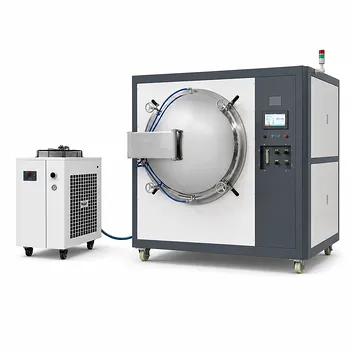
The primary function of a vacuum hot press sintering furnace is to execute a "one-step" consolidation process that transforms precursor powders into high-density uranium nitride (UN) ceramic pellets. It achieves this by simultaneously applying high temperature (up to 1600°C) and mechanical pressure (50 MPa) within a high-vacuum environment to drive chemical decomposition and physical densification concurrently.
Core Takeaway The distinct advantage of this technology is the ability to facilitate the in-situ decomposition of $U_2N_3$ precursors into pure Uranium Nitride (UN) while simultaneously forcing pore closure. This integrated approach bypasses the need for separate synthesis and sintering steps, resulting in higher purity and density than thermal treatment alone.
The Synergistic Processing Environment
To produce high-quality UN pellets, the furnace creates a specific environment that combines three physical forces. This synergy allows for the processing of materials that are otherwise difficult to sinter to full density.
Precise Thermal Regulation
The furnace maintains a high-temperature environment ranging from 1350°C to 1600°C.
This thermal energy is necessary to activate the sintering mechanism, promoting the diffusion of atoms across grain boundaries. It also provides the activation energy required for the chemical conversion of the uranium precursors.
Active Mechanical Pressure
Unlike standard sintering, which relies solely on heat, this furnace applies an axial mechanical pressure of 50 MPa.
This pressure acts as an external driving force. It physically forces powder particles together, significantly accelerating densification. It creates contact points between particles that heat alone might not achieve, effectively squeezing out porosity.
High-Vacuum Atmosphere
The chamber operates under a high vacuum of $10^{-2}$ Pa.
This environment is critical for preventing oxidation of the uranium, which is highly reactive. Furthermore, the vacuum creates a pressure differential that helps extract gases released during the process, ensuring the final ceramic is free of gas pockets.
The Chemical Function: In-Situ Decomposition
The most specialized function of this furnace in the context of Uranium Nitride is managing chemical changes during the heating cycle.
Converting Precursors to Pure Phase
The process typically starts with a precursor material, such as $U_2N_3$ (diuranium trinitride).
As the temperature rises, the furnace facilitates the decomposition of $U_2N_3$ into the desired UN (uranium mononitride) phase. This is a delicate chemical transition that must be controlled precisely to ensure phase purity.
Gas Discharge Management
The decomposition of $U_2N_3$ releases nitrogen gas as a byproduct.
The furnace's vacuum system actively removes this discharged nitrogen gas. Effective removal is vital; if nitrogen were trapped within the matrix, it would inhibit densification and result in a porous, low-quality pellet.
Mechanisms of Densification
Beyond the chemistry, the furnace utilizes specific physical mechanisms to achieve high relative density.
Particle Rearrangement
The application of pressure causes the powder particles to slide past one another and pack more tightly before distinct bonding begins.
Plastic Flow and Diffusion Creep
Under high heat and pressure, the ceramic material exhibits plastic flow.
The solid material deforms slightly to fill voids, while diffusion creep moves atoms from areas of high stress (contact points) to areas of low stress (pores). This eliminates internal pores that thermal sintering typically leaves behind.
Understanding the Trade-offs
While vacuum hot pressing is superior for density and purity, it introduces specific constraints you must evaluate.
Geometric Limitations
The application of axial pressure generally limits part geometry to simple shapes, such as flat plates or cylindrical pellets. Complex 3D geometries are difficult to manufacture uniformly using this method.
Process Throughput
This is typically a batch process rather than a continuous one.
The requirement to heat, pressurize, cool, and cycle the vacuum for each batch can limit production speed compared to continuous pressureless sintering furnaces.
Making the Right Choice for Your Goal
When deciding if this specific furnace configuration is right for your nuclear fuel production, consider your primary success metric:
- If your primary focus is Phase Purity: The vacuum environment is non-negotiable for effectively removing nitrogen gas during the $U_2N_3$ to UN decomposition.
- If your primary focus is Maximum Density: The 50 MPa mechanical pressure is the decisive factor for eliminating residual porosity that standard heating cannot remove.
- If your primary focus is Process Efficiency: The ability to combine decomposition and densification into a single step reduces overall handling and contamination risks.
Summary: The vacuum hot press sintering furnace is the definitive tool for UN production because it uniquely integrates chemical conversion and physical compaction into a single, controlled operation.
Summary Table:
| Feature | Function in UN Production | Benefit |
|---|---|---|
| High Vacuum ($10^{-2}$ Pa) | Prevents oxidation and extracts $N_2$ gas | Ensures high chemical purity |
| Mechanical Pressure (50 MPa) | Forces powder compaction and pore closure | Achieves maximum material density |
| High Temperature (Up to 1600°C) | Activates atom diffusion and phase conversion | Facilitates in-situ decomposition |
| One-Step Processing | Combines synthesis and densification | Reduces contamination and processing time |
Elevate Your Nuclear Materials Research with KINTEK
Precision is paramount when producing advanced ceramics like Uranium Nitride. KINTEK specializes in high-performance laboratory equipment, providing state-of-the-art vacuum hot press sintering furnaces and high-temperature furnaces designed to meet the rigorous demands of nuclear fuel and battery research.
Our comprehensive range of crushing and milling systems, isostatic presses, and high-purity ceramic crucibles ensures you have the tools needed for every stage of material consolidation. From CVD/PECVD systems to specialized cooling solutions, we empower researchers to achieve superior density and phase purity in their samples.
Ready to optimize your sintering process? Contact KINTEK today to discuss your project requirements and discover how our advanced furnace technology can enhance your lab's output.
Related Products
- 600T Vacuum Induction Hot Press Furnace for Heat Treat and Sintering
- Vacuum Heat Treat and Sintering Furnace with 9MPa Air Pressure
- Vacuum Heat Treat and Pressure Sintering Furnace for High Temperature Applications
- 2200 ℃ Tungsten Vacuum Heat Treat and Sintering Furnace
- Vacuum Hot Press Furnace Heated Vacuum Press Machine Tube Furnace
People Also Ask
- What role does an induction vacuum hot pressing furnace play in sintering? Achieve 98% Density in Carbide Blocks
- What advantages does a vacuum hot press furnace provide for LSLBO ceramic electrolytes? Achieve 94% Relative Density
- What role does a Vacuum Hot Press (VHP) furnace play in the densification of austenitic stainless steel 316 composites?
- What role does mechanical pressure play during the vacuum diffusion bonding of tungsten and copper? Keys to Solid Bonding
- What are the advantages of a vacuum hot press furnace for W-50%Cu? Achieve 99.6% Density at Lower Temperatures