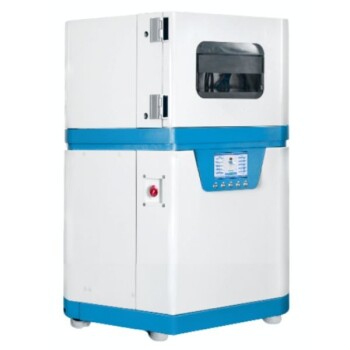
The primary advantages of using a vacuum hot pressing furnace for Cu–8Cr–4Nb alloy powders are the achievement of near-theoretical density and the preservation of chemical purity. By integrating high-temperature heating with mechanical pressurization in a vacuum, this process eliminates porosity and prevents the oxidation of the reactive Chromium (Cr) and Niobium (Nb) components.
Core Insight: Vacuum hot pressing leverages the synergy of thermal energy and mechanical force to overcome the limitations of traditional sintering. By promoting plastic flow while simultaneously shielding the material from oxygen, it produces a dense, uniform, and mechanically superior dispersion-strengthened alloy that cold-pressing methods cannot achieve.
Achieving Maximum Densification
Overcoming Porosity Through Synergy
The defining feature of a vacuum hot pressing furnace is the simultaneous application of heat and uniaxial mechanical pressure. This combination effectively closes the interstitial gaps between gas-atomized powder particles.
While thermal energy softens the material, the mechanical pressure forces particles together, driving plastic deformation and atomic diffusion. This dual action is critical for eliminating the internal porosity that often plagues pressureless sintering methods.
Eliminating the "Spring-Back" Effect
Traditional cold pressing significantly suffers from elastic strain, where powder particles "rebound" after pressure is removed. This can leave residual pores even when extremely high pressures (up to 1100 MPa) are used.
Vacuum hot pressing utilizes thermal effects to neutralize this elastic strain. By maintaining the powder in a heated, plastic state, it achieves higher relative densities (exceeding 90%) at significantly lower pressures—often roughly 1/20th of the pressure required for cold pressing.
Reaching Near-Theoretical Density
For dispersion-strengthened alloys like Cu–8Cr–4Nb, mechanical performance relies heavily on bulk density. The vacuum hot pressing process allows these materials to consolidate to a state approaching their theoretical density limit.
This high density directly translates to superior macroscopic properties, including enhanced electrical conductivity and hardness, which are compromised by the presence of voids in less dense materials.
Preserving Alloy Integrity
Protecting Reactive Elements
The Cu–8Cr–4Nb alloy system contains Chromium and Niobium, both of which are susceptible to oxidation at elevated temperatures. Oxidation during consolidation can form brittle oxide inclusions that degrade the alloy's performance.
The high-vacuum environment (typically around 10^-5 mbar or lower) of the furnace acts as a protective shield. It prevents oxygen from reacting with the powder surfaces during the critical heating phase, ensuring the chemical composition remains pure.
Ensuring Microstructural Uniformity
Beyond simple density, the quality of the internal structure is paramount. The controlled environment allows for uniform atomic diffusion without the interference of trapped gases or oxide layers.
This results in a uniform microstructure with fine grains. A consistent microstructure is essential for the reliability of the material, ensuring that its strength and thermal stability are predictable across the entire component.
Understanding the Trade-offs
Process Speed and Complexity
While physically superior, vacuum hot pressing is generally a slower, batch-oriented process compared to continuous sintering methods. The requirement to heat, pressurize, and cool within a vacuum chamber limits throughput.
Geometrical Limitations
The application of uniaxial pressure typically restricts the geometry of the final product to simple shapes (like disks or cylinders). Producing complex, near-net-shape components often requires additional machining or post-processing steps.
Making the Right Choice for Your Goal
To determine if vacuum hot pressing is the correct consolidation method for your Cu–8Cr–4Nb application, consider your specific performance requirements:
- If your primary focus is maximum mechanical strength: Use this method to eliminate porosity and ensure the full dispersion-strengthening effect of the Nb and Cr precipitates.
- If your primary focus is electrical conductivity: Rely on this process to remove oxide barriers and voids that would otherwise impede electron flow.
- If your primary focus is complex part geometry: Be aware that this process produces simple billets that will likely require secondary machining.
In summary, for critical applications where material integrity cannot be compromised, vacuum hot pressing provides the necessary environment to transform loose powder into a dense, high-performance alloy.
Summary Table:
| Feature | Vacuum Hot Pressing | Traditional Cold Pressing |
|---|---|---|
| Densification | Near-theoretical (>90%) | Limited by elastic "spring-back" |
| Required Pressure | Low (approx. 1/20th of cold pressing) | Extremely high (up to 1100 MPa) |
| Oxidation Control | High vacuum (10^-5 mbar) prevents oxide formation | High risk of brittle oxide inclusions |
| Microstructure | Uniform grain with plastic deformation | Potential internal voids and gaps |
| Primary Benefit | Maximum mechanical strength & conductivity | Lower process complexity |
Elevate Your Material Consolidation with KINTEK
Are you looking to achieve near-theoretical density and superior purity in your advanced alloy research? KINTEK specializes in high-performance laboratory equipment, including state-of-the-art vacuum hot pressing furnaces and isostatic presses designed for critical material consolidation.
Whether you are working with Cu–8Cr–4Nb or other reactive dispersion-strengthened alloys, our systems provide the precise thermal and mechanical control needed to eliminate porosity and prevent oxidation. From high-temperature furnaces and crushing systems to specialized PTFE consumables and crucibles, we provide the end-to-end solutions your lab requires for excellence.
Ready to optimize your sintering process? Contact our experts today to find the perfect equipment configuration for your specific research goals.
Related Products
- Vacuum Hot Press Furnace Heated Vacuum Press Machine Tube Furnace
- 600T Vacuum Induction Hot Press Furnace for Heat Treat and Sintering
- Vacuum Hot Press Furnace Machine Heated Vacuum Press
- Vacuum Hot Press Furnace Machine for Lamination and Heating
- Vacuum Heat Treat and Pressure Sintering Furnace for High Temperature Applications
People Also Ask
- What advantages does a vacuum hot press furnace provide for LSLBO ceramic electrolytes? Achieve 94% Relative Density
- What role does a Vacuum Hot Press (VHP) furnace play in the densification of austenitic stainless steel 316 composites?
- What are the advantages of using a vacuum hot pressing furnace? Superior Densification for 2024Al/Gr/SiC Composites
- What are the advantages of a vacuum hot press furnace for LTPO solid electrolytes? Boost Density and Conductivity
- What core processing conditions does a vacuum hot press furnace provide? Achieve High-Density Cu-SiC/Diamond Composites