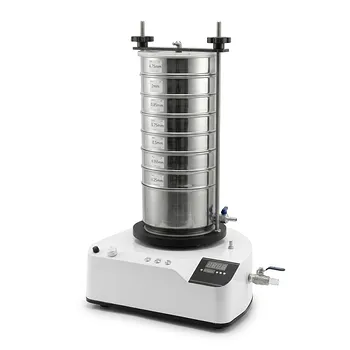
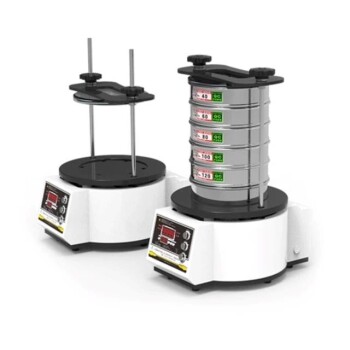
High-precision impact vibratory sieving machines function as the critical classification stage that separates raw atomized titanium powder into distinct, usable particle size intervals. Through the use of mechanical vibration and standard aperture screens, these machines accurately isolate specific size ranges while removing oversized particles and irregularities.
Core Takeaway The primary value of these machines lies in transforming raw, variable powder into a consistent feedstock. By enforcing a narrow particle size distribution, they ensure the flowability and packing density required for sensitive applications like Selective Laser Melting (SLM).
The Mechanics of Classification
Precise Mechanical Separation
The core function of the machine is to subject raw atomized powder to mechanical vibration across a series of screens.
This movement forces the powder to interact with standard aperture meshes, physically segregating particles based on their geometric dimensions.
Isolation of Target Intervals
The machine is configured to isolate specific particle size ranges, known as "cuts," that are dictated by the end-use application.
For titanium alloys used in Selective Laser Melting (SLM), the machine is typically calibrated to harvest the 15-53 micrometer range.
Achieving Process-Ready Specifications
Ensuring Flowability
Raw atomized powder often contains irregularities that hinder how the material moves.
Effective sieving removes these impediments, ensuring the flowability necessary for the powder to spread evenly across a build plate during 3D printing.
Optimizing Packing Density
The density of the final printed part depends heavily on how tightly the powder particles pack together before melting.
By removing oversized and undersized particles, the sieving process creates a narrow size distribution that optimizes this packing density.
Removal of Oversized Particles
A primary function of the classification process is the elimination of "oversize" material that exceeds the specified aperture.
Removing these larger particles prevents defects in the final product and ensures the consistency required for high-quality manufacturing.
Understanding the Trade-offs
Specificity vs. Yield
High-precision sieving is a subtractive process designed to prioritize quality over total volume.
By strictly enforcing a specific range (e.g., 15-53 µm), the process inevitably rejects a portion of the raw material that falls outside these parameters, reducing the total yield of usable powder from a single batch.
Complexity of Narrow Distributions
Obtaining an extremely narrow size distribution requires rigorous screening that can be time-intensive.
While this precision is vital for uniformity in tasks like characterization or printing, it demands a well-calibrated system to prevent the inclusion of marginal particles.
Making the Right Choice for Your Goal
To maximize the utility of high-precision sieving, aligns your machine's configuration with your specific output requirements:
- If your primary focus is Additive Manufacturing (SLM): Prioritize screens that isolate the 15-53 µm range to guarantee the flowability and packing density needed for structural integrity.
- If your primary focus is Material Characterization: Configure the system for the narrowest possible size distribution to ensure uniformity in analysis techniques like X-ray diffraction.
Effective classification turns variable raw material into a reliable, engineering-grade resource.
Summary Table:
| Function | Description | Key Benefit |
|---|---|---|
| Mechanical Separation | Subjects powder to vibration across standard meshes | Accurate segregation by geometric dimension |
| Target Interval Isolation | Calibrates screens for specific ranges (e.g., 15-53 μm) | Harvests feedstock ready for SLM applications |
| Impurity Removal | Eliminates oversized particles and irregularities | Prevents structural defects in final printed parts |
| Flowability Optimization | Removes impediments to powder movement | Ensures even spreading across 3D printer build plates |
| Density Control | Enforces narrow particle size distribution | Increases packing density for higher part integrity |
Elevate Your Material Consistency with KINTEK
Precision is non-negotiable in titanium powder metallurgy. KINTEK specializes in advanced laboratory equipment, providing high-performance sieving equipment and crushing systems designed to meet the rigorous demands of Selective Laser Melting (SLM) and material characterization.
From high-temperature furnaces and vacuum systems to our specialized sieving solutions, we empower researchers and manufacturers to achieve superior flowability and packing density. Whether you are refining titanium alloys or conducting battery research, our comprehensive range of tools—including hydraulic presses, cooling solutions, and ceramic consumables—ensures your lab operates at peak efficiency.
Ready to optimize your powder classification process? Contact KINTEK today to find the perfect sieving solution for your lab!
References
- Shiyi Gao, O.V. Ganushchak. Evaluation of the possibility of obtaining spherical powders of titanium alloy Ti 6Al 4V by supersonic reverse polarity plasma torch for use in additive manufacturing. DOI: 10.12913/22998624/205855
This article is also based on technical information from Kintek Solution Knowledge Base .
Related Products
- Laboratory Vibratory Sieve Shaker Machine for Dry and Wet Three-Dimensional Sieving
- Vibratory Sieve Shaker Machine Dry Three-Dimensional Vibrating Sieve
- Laboratory Vibratory Sieve Shaker Machine Slap Vibrating Sieve
- Laboratory Test Sieves and Vibratory Sieve Shaker Machine
- Vibrating Disc Mill Small Laboratory Grinding Machine
People Also Ask
- How does a laboratory vibratory sieve shaker facilitate the microstructural study of gas-atomized alloy powders?
- What role does a laboratory vibrating sieve shaker play in the LiFePO4 powder processing workflow? Ensure Batch Quality
- Why use a vibratory sieve shaker for PET powder? Achieve Precise Particle Size Control for Chemical Research
- What is the principle of vibratory sieve shaker? Achieve Accurate Particle Size Analysis
- What is the function of a vibratory sieve shaker? Achieve Precise Particle Size Analysis