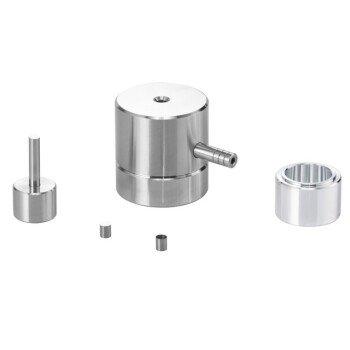
High-strength graphite molds serve two fundamental purposes in Vacuum Hot Pressing (VHP): they act as the precise containment vessel for the powder mixture and function as the critical medium for pressure transmission. By uniformly transferring uniaxial force—often reaching benchmarks like 67 MPa—from the hydraulic cylinder to the powder, these molds drive the plastic deformation and densification necessary to create solid composite materials.
Core Takeaway: Graphite molds do not merely hold material; they are active mechanical components that define the composite's geometry while translating hydraulic force into the internal pressure necessary for sintering and densification.
The Dual Primary Roles
Based on the core mechanics of VHP, the graphite mold performs two non-negotiable functions that directly impact the quality of the final composite.
1. Containment and Geometric Definition
The most immediate function of the mold is to serve as a container for the raw powder mixture, such as diamond and aluminum powder or copper-based alloys.
The mold rigidly defines the final shape and dimensions of the sintered billet. It constrains the loose powder, ensuring that as heat and pressure are applied, the material consolidates into a specific, controlled geometry rather than dispersing.
2. Uniaxial Pressure Transmission
The more complex function of the mold is acting as a pressure transmission medium.
The mold acts as the bridge between the machine's hydraulic cylinder and the powder itself. It must transfer significant uniaxial pressure (e.g., 67 MPa to 100 MPa) uniformly to the powder body.
This transfer of force is what causes plastic deformation at high temperatures, forcing the powder particles to bond and densify into a solid structure.
Why Graphite is the Material of Choice
While the primary reference highlights containment and pressure, supplementary contexts reveal why high-strength graphite is uniquely suited to execute these functions under extreme conditions.
Thermal Conductivity and Heat Transfer
Graphite is not just a pressure vessel; it is also a thermal conductor.
The molds facilitate the rapid and uniform transfer of heat from the heating elements to the internal powder. This ensures that the temperature distribution within the sample is consistent, preventing defects caused by uneven sintering.
High-Temperature Structural Stability
VHP processes often operate at temperatures ranging from 750°C to over 1373 K (approx. 1100°C).
High-strength graphite maintains its dimensional stability and mechanical strength at these extremes. It resists deformation even when subjected to axial pressures of 30 MPa or more while glowing hot, ensuring the final product maintains precise tolerances.
Chemical Inertness and Purity
For composites involving reactive materials like aluminum-silicon or titanium, the mold must remain chemically passive.
Graphite is generally chemically inert in vacuum or reducing atmospheres. This prevents harmful reactions between the mold and the composite, ensures the purity of the material, and facilitates easy demolding of the finished billet.
Understanding the Trade-offs
While high-strength graphite is the standard for VHP, it is not without limitations. Understanding these constraints is vital for process planning.
The "Consumable" Nature of Molds
Despite their high strength, graphite molds are often treated as consumables.
Repeated exposure to extreme thermal cycling and high mechanical pressure eventually degrades the graphite structure. Over time, surface wear or slight oxidation can affect dimensional accuracy, requiring mold replacement to maintain strict tolerances.
Mechanical Limits and Brittleness
Graphite has excellent compressive strength, but it is brittle compared to metals.
While it can withstand uniform pressures like 67 MPa, it is susceptible to cracking if subjected to shock loading, shear forces, or misalignment in the press. Careful alignment of the punch and die is critical to prevent catastrophic mold failure during the pressure cycle.
Making the Right Choice for Your Goal
Selecting the correct graphite grade and mold design depends on the specific constraints of your composite material and processing parameters.
- If your primary focus is Dimensional Accuracy: Prioritize graphite grades with the highest possible density and compressive strength to minimize mold deformation at maximum pressure.
- If your primary focus is Material Purity: Ensure the graphite is of high purity and chemically compatible with your specific alloy (e.g., Al-Si or Ti-based) to prevent surface contamination or sticking.
- If your primary focus is Process Efficiency: Select graphite with superior thermal conductivity to shorten heating cycles and ensure rapid, uniform densification.
Success in VHP relies on viewing the graphite mold not as simple tooling, but as an integral, active component of the thermodynamic process.
Summary Table:
| Function | Description | Impact on Final Product |
|---|---|---|
| Containment | Defines geometric shape and holds powder mixture | Ensures precise dimensional accuracy and tolerance |
| Pressure Transmission | Transfers uniaxial force (67-100 MPa) to the powder | Drives plastic deformation and material densification |
| Thermal Conductivity | Facilitates uniform heat transfer from elements | Prevents sintering defects through consistent temperature |
| Structural Stability | Maintains strength at temperatures >1100°C | Prevents mold deformation during high-pressure cycles |
| Chemical Inertness | Remains passive in vacuum or reducing atmospheres | Protects material purity and allows easy demolding |
Elevate Your Composite Manufacturing with KINTEK
Precision in Vacuum Hot Pressing (VHP) starts with high-performance tooling and equipment. At KINTEK, we specialize in providing the high-strength graphite molds and advanced thermal systems essential for achieving superior material densification.
Whether you are developing diamond-aluminum composites or high-purity alloys, our comprehensive portfolio—including high-temperature furnaces (vacuum, CVD, induction), hydraulic presses, and precision graphite consumables—is designed to meet the most rigorous laboratory and production standards.
Ready to optimize your sintering process? Contact us today to consult with our experts on the best solutions for your research and manufacturing needs!
Related Products
- 2200 ℃ Graphite Vacuum Heat Treat Furnace
- Ultra-High Temperature Graphite Vacuum Graphitization Furnace
- Anti-Cracking Press Mold for Lab Use
- Horizontal High Temperature Graphite Vacuum Graphitization Furnace
- Ball Press Mold for Lab
People Also Ask
- What is the process of vacuum heat treating? Achieve Superior Hardening with a Clean, Bright Finish
- How does heat transmit in a vacuum? Mastering Thermal Radiation for Purity & Precision
- Why do you heat treat in a vacuum? Achieve Perfect Surface Finish and Material Integrity
- How does a vacuum heat treat furnace work? Achieve Pristine, Oxide-Free Metal Parts
- What is graphite heating? A Guide to Durable, High-Temp Industrial Furnace Solutions