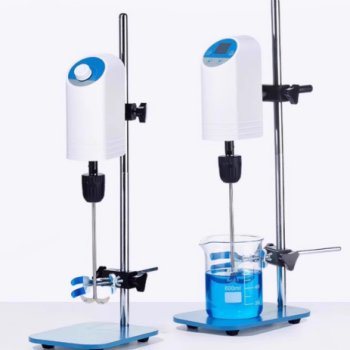
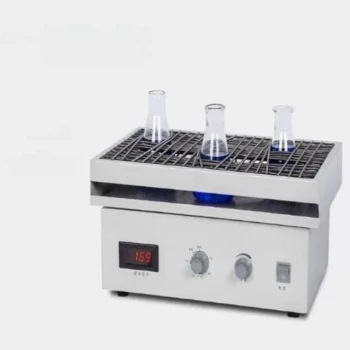
The primary technical function of the mechanical stirrer and its nickel impellers is to maintain the stability and uniformity of the Calcium Oxide slurry system. By providing continuous, strong agitation, the assembly prevents the solid absorbent from settling out of the liquid molten salt, ensuring a consistent reaction environment.
The mechanical stirrer is the critical control mechanism that transforms a heterogeneous mixture of solids and liquids into a uniform, predictable slurry suitable for precise kinetic analysis.
Managing Slurry Dynamics
The Molten Salt Carbon Capture (CCMS) process relies on Calcium Oxide, which does not dissolve but rather forms a suspension. The stirrer controls the physical behavior of this mixture.
Counteracting Particle Sedimentation
In a static state, solid Calcium Oxide particles will naturally settle to the bottom of the reactor.
The nickel impellers provide continuous agitation to counteract gravity. This keeps the solid particles buoyant and suspended within the liquid medium.
Achieving Homogeneity
Effective capture requires the absorbent to be available throughout the reactor volume.
The stirrer ensures a uniform distribution of the Calcium Oxide. This prevents localized "dead zones" where no absorbent is present.
Optimizing Reaction Kinetics
Beyond simple mixing, the stirrer plays a sophisticated role in how the chemical reaction is measured and understood.
Erasing Bulk Gradients
In poorly mixed systems, the concentration of reactants can vary significantly from one side of the tank to the other.
Strong stirring eliminates these concentration gradients within the bulk molten salt. This ensures the chemical composition is consistent throughout the liquid phase.
Defining the Reaction Boundary
By homogenizing the bulk liquid, the stirrer forces the critical chemical interactions to occur at a specific location.
The reaction is limited strictly to the gas-liquid interface. This simplifies the boundary conditions, allowing researchers to conduct accurate kinetic studies without the interference of complex bulk diffusion variables.
Critical Operational Requirements
While the reference highlights the benefits, the mechanics of the system dictate specific operational necessities.
The Necessity of Continuous Operation
The text specifies that agitation must be "continuous."
If the mechanical stirrer stops or fails, the slurry system collapses as sedimentation begins immediately. The process is entirely dependent on active mechanical energy to maintain the suspension.
Making the Right Choice for Your Goal
The mechanical stirrer serves two distinct masters: physical stability and experimental precision.
- If your primary focus is Process Stability: Prioritize continuous agitation to prevent sedimentation and ensure the Calcium Oxide remains fully suspended and active.
- If your primary focus is Research & Modeling: Ensure "strong" stirring to eliminate bulk gradients, isolating the reaction at the gas-liquid interface for clearer kinetic data.
The stirrer is not merely a mixer; it is the tool that standardizes the reactor's physical and chemical state.
Summary Table:
| Feature | Function | Impact on Reactor |
|---|---|---|
| Slurry Dynamics | Counteracts particle sedimentation | Prevents solids from settling; ensures consistent suspension. |
| Homogeneity | Eliminates bulk concentration gradients | Removes localized "dead zones" for uniform reactant distribution. |
| Kinetic Control | Isolates reaction to gas-liquid interface | Simplifies boundary conditions for accurate kinetic modeling. |
| Mechanical Energy | Provides continuous, strong agitation | Maintains system stability and prevents immediate slurry collapse. |
Elevate Your Carbon Capture Research with KINTEK Precision
Achieving precise kinetic analysis and slurry stability in molten salt reactors requires high-performance agitation systems that withstand extreme environments. KINTEK specializes in advanced laboratory equipment designed for rigorous chemical research, including custom high-temperature high-pressure reactors, mechanical stirrers, and specialized nickel impellers.
Whether you are focusing on process stability or complex experimental modeling, our comprehensive portfolio—ranging from muffle and tube furnaces to electrolytic cells and battery research tools—provides the reliability your lab demands.
Ready to optimize your reaction kinetics? Contact our technical experts today to find the perfect stirring and reactor solution for your carbon capture application.
References
- Sondre G. Iveland, Heidi S. Nygård. A Kinetic Model of CO<sub>2</sub> Absorption in Molten CaO-CaF<sub>2</sub>-CaCl<sub>2</sub>. DOI: 10.5796/electrochemistry.23-69155
This article is also based on technical information from Kintek Solution Knowledge Base .
Related Products
- High Performance Laboratory Stirrers for Diverse Applications
- Laboratory Multifunctional Small Speed-Adjustable Horizontal Mechanical Shaker for Lab
- Laboratory Small Constant Temperature Heated Magnetic Stirrer Heater and Stirrer
- Custom PTFE Teflon Parts Manufacturer for PTFE Stirring Bar Recovery Rod
- Custom PTFE Teflon Parts Manufacturer for Magnetic Stirring Bar
People Also Ask
- How does a laboratory stirrer influence MOF product quality? Master Precision in Non-Solvothermal Synthesis
- What critical role does a Laboratory Stirrer play during leaching? Enhance Titanium-Magnesium Waste Recovery
- What is the primary function of laboratory stirring equipment in the preparation of compost leachate? Optimize Extraction
- What is a laboratory mixer? A Guide to Achieving Perfect Sample Homogeneity
- What is a laboratory mixer used for? Choose the Right Tool for Liquids or Solids