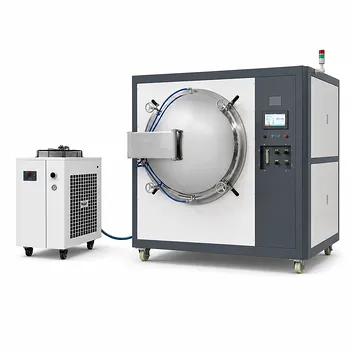
The primary process advantage of a vacuum hot press furnace is the application of mechanical energy (axial pressure) in addition to thermal energy, which significantly increases the driving force for sintering. Unlike traditional pressureless sintering, this method accelerates particle rearrangement and forces liquid cobalt into voids, enabling rapid densification while effectively suppressing abnormal grain growth.
Core Takeaway The vacuum hot press effectively decouples densification from grain growth. By substituting high temperatures and long hold times with mechanical pressure, it produces ultrafine cemented carbides that are fully dense yet retain a fine, hard microstructure—a balance that is difficult to achieve with pressureless sintering.
The Mechanics of Superior Densification
The Role of External Pressure
In traditional pressureless sintering, the process relies almost exclusively on capillary forces and high temperatures to close pores. A vacuum hot press furnace applies an external axial pressure (often between 10 to 40 MPa). This mechanical force physically pushes particles together, promoting plastic flow and rapid rearrangement.
Accelerated Liquid Infiltration
The applied pressure does more than just compact the powder; it actively drives the liquid cobalt (Co) phase into the pores between the tungsten carbide (WC) particles. This forced infiltration ensures that voids are filled quickly and completely, leading to relative densities exceeding 98%.
Lower Thermal Requirements
Because mechanical pressure adds energy to the system, the thermal requirements change. Sintering can occur at lower temperatures (e.g., 1380°C) compared to pressureless methods. Lower temperatures reduce the risk of the material degrading or grains coarsening due to excessive heat.
Preservation of Microstructure
Inhibiting Grain Growth
For ultrafine cemented carbides, grain size is directly linked to performance. High temperatures and long soaking times—common in pressureless sintering—often lead to "Ostwald ripening," where grains grow large and reduce material strength. Vacuum hot pressing achieves densification so rapidly (often within 10 to 15 minutes) that the grains do not have time to grow excessively.
Achieving Superior Hardness
The result of retaining a fine microstructure is superior mechanical properties. By keeping the grain size ultrafine, these furnaces can produce alloys with exceptional hardness (up to 20.57 GPa) and high flexural strength.
The Vacuum Environment Advantage
Enhancing Wettability
The vacuum environment (often as low as $5 \times 10^{-1}$ Pa) is critical for surface chemistry. It effectively removes adsorbed gases and volatile impurities from the powder surface. This purification significantly improves the wettability of the liquid cobalt on the tungsten carbide particles, ensuring a strong metallurgical bond.
Chemical Stability
High-temperature processing in a vacuum prevents oxidation of the powder. Furthermore, for specific alloy grades, the vacuum suppresses the volatilization of critical elements like chromium (Cr). This ensures the final chemical composition remains stable and consistent with the design specifications.
Understanding the Trade-offs
While the vacuum hot press offers superior material properties, the process introduces specific constraints compared to pressureless sintering.
Complexity of Process Control
The integration of high vacuum, rapid heating (up to 150°C/min), and precise mechanical pressure creates a complex processing window. Operators must carefully balance pressure application with the onset of the liquid phase to avoid squeezing liquid cobalt out of the matrix rather than into the pores.
Geometric Limitations
The application of axial pressure generally limits the geometry of the parts. While pressureless sintering can handle complex, net-shape components in large batches, hot pressing is typically restricted to simpler shapes (plates, discs, or cylinders) constrained by the die/mold configuration.
Making the Right Choice for Your Goal
To determine if vacuum hot pressing is the correct solution for your cemented carbide production, evaluate your specific performance metrics:
- If your primary focus is Maximum Hardness: Choose vacuum hot pressing to leverage rapid densification that locks in an ultrafine grain structure (nanocrystalline).
- If your primary focus is Defect Elimination: Use this method to utilize mechanical pressure for closing stubborn pores and vacuum for removing impurities that reduce fracture toughness.
- If your primary focus is Chemical Precision: Rely on the vacuum environment to prevent oxidation and the loss of volatile binders or additives like Chromium.
Summary: Vacuum hot pressing transforms the sintering of ultrafine cemented carbides by using pressure to force densification before grains can coarsen, delivering a harder, stronger material than thermal energy alone can produce.
Summary Table:
| Feature | Vacuum Hot Pressing | Pressureless Sintering |
|---|---|---|
| Primary Energy | Thermal + Mechanical Pressure | Thermal Only |
| Densification Rate | Very Rapid (10-15 min) | Slow (Extended Hold Times) |
| Grain Control | High (Suppresses Growth) | Low (Prone to Grain Growth) |
| Atmosphere | High Vacuum ($5 \times 10^{-1}$ Pa) | Inert Gas or Low Vacuum |
| Typical Hardness | Up to 20.57 GPa | Generally Lower |
| Shape Capability | Simple Geometries (Plates/Discs) | Complex Net-Shapes |
Elevate Your Material Performance with KINTEK
Ready to achieve maximum hardness and defect-free microstructures? KINTEK specializes in advanced laboratory solutions designed for precision. Our high-performance vacuum hot press furnaces and isostatic presses empower researchers and manufacturers to decouple densification from grain growth, ensuring your ultrafine cemented carbides meet the highest industry standards.
From high-temperature furnaces and crushing systems to specialized PTFE and ceramic consumables, KINTEK provides the comprehensive toolkit needed for cutting-edge material science.
Unlock the full potential of your alloys—Contact KINTEK today for a custom consultation!
Related Products
- Vacuum Hot Press Furnace Machine for Lamination and Heating
- Vacuum Hot Press Furnace Heated Vacuum Press Machine Tube Furnace
- Vacuum Heat Treat and Pressure Sintering Furnace for High Temperature Applications
- 600T Vacuum Induction Hot Press Furnace for Heat Treat and Sintering
- Vacuum Hot Press Furnace Machine Heated Vacuum Press
People Also Ask
- What advantages does a vacuum hot press furnace provide for LSLBO ceramic electrolytes? Achieve 94% Relative Density
- Why is it necessary to maintain a high-vacuum environment within a vacuum hot press furnace? Optimize Cu-SiC Sintering
- What are the advantages of using a vacuum hot press furnace for sintering CNT/Cu composites? Superior Density & Bonding
- What are the advantages of a vacuum hot press furnace for W-50%Cu? Achieve 99.6% Density at Lower Temperatures
- What role does mechanical pressure play during the vacuum diffusion bonding of tungsten and copper? Keys to Solid Bonding