Knowledge Resources What are the safety precautions for heat treatment of metals? A Guide to Protecting Personnel and Equipment
Author avatar

Tech Team · Kintek Solution

Updated 2 months ago

What are the safety precautions for heat treatment of metals? A Guide to Protecting Personnel and Equipment


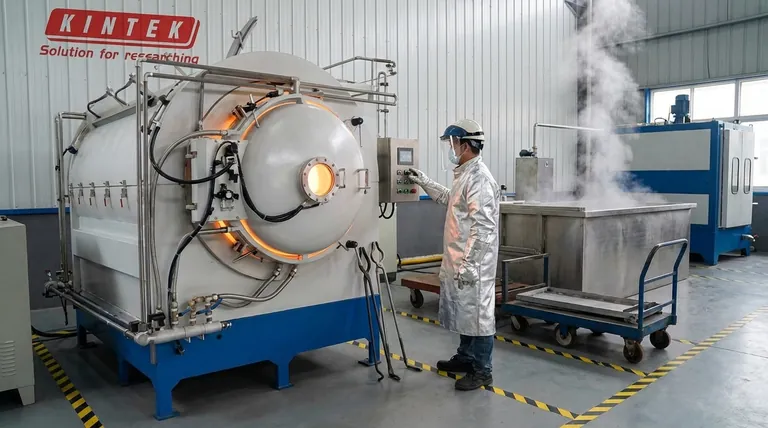
At its core, ensuring safety in metal heat treatment requires a disciplined approach to managing extreme temperatures, hazardous atmospheres, and heavy materials. Key precautions involve wearing specialized Personal Protective Equipment (PPE), maintaining furnace and handling equipment meticulously, ensuring adequate ventilation, and following strict, documented procedures for moving materials at every stage of the process.

The fundamental principle of heat treatment safety is not merely following a checklist, but cultivating a deep awareness of the multiple, overlapping risks—thermal, chemical, and mechanical—and implementing redundant layers of protection to mitigate them.
What are the safety precautions for heat treatment of metals? A Guide to Protecting Personnel and Equipment

Understanding the Core Hazards

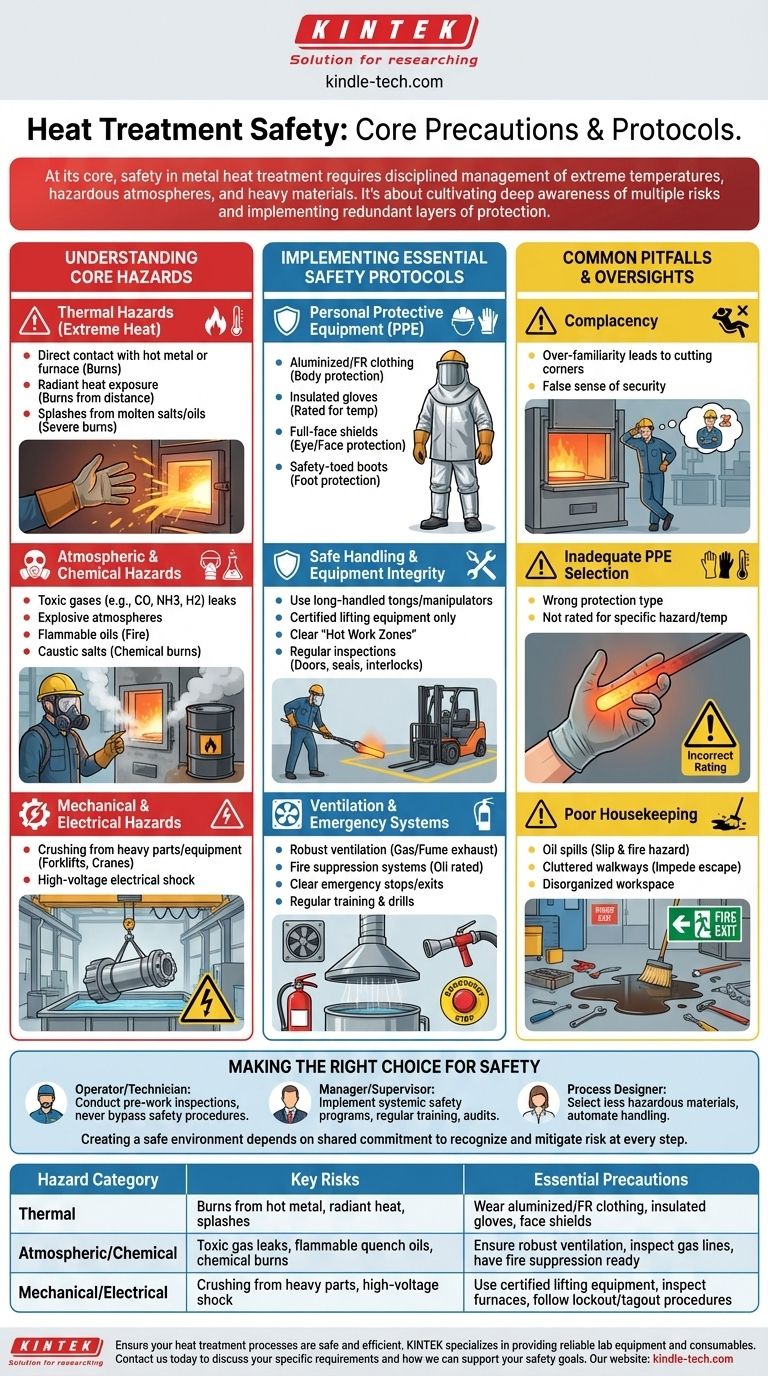
To implement effective safety measures, you must first understand the specific dangers inherent in the heat treatment process. These processes involve temperatures that can exceed 2,400°F (1315°C) and can present severe, immediate threats.

Thermal Hazards

The most obvious risk is the extreme heat. This danger manifests in several ways: direct contact with hot metal or furnace interiors, radiant heat that can cause burns from a distance, and the potential for splashes from molten salts or quenching oils.

Atmospheric and Chemical Hazards

Many heat treatment processes, like carburizing, occur in controlled atmospheres containing gases such as carbon monoxide, ammonia, or hydrogen. Leaks can create toxic environments or explosive atmospheres. Quenching baths often use oils, which are flammable, or caustic salts, which can cause severe chemical burns.

Mechanical and Electrical Hazards

Furnaces, quenching tanks, and the metal parts themselves are often heavy. The equipment used to move them, such as cranes and forklifts, presents significant crushing hazards. Furthermore, the high-power requirements of industrial furnaces introduce the risk of high-voltage electrical shock.

Implementing Essential Safety Protocols

A safe operation is built on a foundation of clear, non-negotiable protocols designed to counter the core hazards. These rules must be understood, practiced, and enforced without exception.

Personal Protective Equipment (PPE) is Non-Negotiable

Standard work clothes are inadequate. Proper PPE is your first and most critical line of defense. This includes aluminized or flame-resistant (FR) clothing, insulated gloves rated for the specific temperatures, full-face shields, and safety-toed boots. The specific PPE must match the specific task.

Safe Handling and Material Transport

Never handle hot materials without the proper tools, such as long-handled tongs or specialized manipulators. For heavy parts, use only certified and inspected lifting equipment. Work areas must have clearly marked "hot work zones," and communication between team members during transport is critical.

Furnace and Equipment Integrity

Regularly inspect furnaces, paying close attention to door seals, gas and electrical connections, and temperature controllers. Ensure all safety interlocks, which prevent doors from being opened under dangerous conditions, are functional. A preventative maintenance schedule is not optional; it is essential.

Ventilation and Emergency Systems

Your facility must have robust ventilation to safely exhaust process gases and fumes from quench tanks. Fire suppression systems, especially those rated for oil fires, must be readily available and regularly inspected. All personnel must know the location of emergency stops and fire extinguishers.

Common Pitfalls and Oversights

Accidents rarely occur in a vacuum. They are often the result of seemingly small oversights or a gradual erosion of discipline.

Complacency: The Greatest Danger

The most significant risk in any routine industrial process is complacency. Experienced operators who become overly familiar with the process may be tempted to cut corners. This false sense of security is where the majority of incidents originate.

Inadequate PPE Selection

Using the wrong type of protection can be as dangerous as using none at all. For example, a glove rated for 500°F provides no protection when handling a part at 1,500°F. Always verify that your PPE is rated for the specific hazard you face.

Poor Housekeeping

An untidy work environment creates numerous secondary risks. Oil spills on the floor are a slip and fire hazard. Cluttered walkways can impede a swift escape in an emergency. Maintaining a clean and organized workspace is a foundational safety practice.

Making the Right Choice for Your Goal

Building a culture of safety requires every person to understand their role and responsibilities.

  • If you are an operator or technician: Always conduct a pre-work inspection of your PPE and workspace, and never bypass a safety procedure, no matter how routine the task feels.
  • If you are a manager or supervisor: Your priority is to implement and enforce a systemic safety program, including regular training, equipment audits, and clear emergency response plans.
  • If you are designing a heat treatment process: Build safety in from the start by selecting the least hazardous materials and automating handling where possible to minimize human exposure.

Ultimately, creating a safe heat treatment environment depends on the shared commitment of every individual to recognize and mitigate risk at every step.

Summary Table:

Hazard Category Key Risks Essential Precautions
Thermal Burns from hot metal, radiant heat, splashes Wear aluminized/FR clothing, insulated gloves, face shields
Atmospheric/Chemical Toxic gas leaks, flammable quench oils, chemical burns Ensure robust ventilation, inspect gas lines, have fire suppression ready
Mechanical/Electrical Crushing from heavy parts, high-voltage shock Use certified lifting equipment, inspect furnaces, follow lockout/tagout procedures

Ensure your heat treatment processes are safe and efficient. KINTEK specializes in providing reliable lab equipment and consumables for laboratory needs. Our expertise helps you mitigate risks and maintain a secure working environment. Contact us today to discuss your specific requirements and how we can support your safety goals.

Visual Guide
What are the safety precautions for heat treatment of metals? A Guide to Protecting Personnel and Equipment Visual Guide

Related Products

People Also Ask

Related Products

2200 ℃ Tungsten Vacuum Heat Treat and Sintering Furnace

2200 ℃ Tungsten Vacuum Heat Treat and Sintering Furnace

Experience the ultimate refractory metal furnace with our Tungsten vacuum furnace. Capable of reaching 2200℃, perfect for sintering advanced ceramics and refractory metals. Order now for high-quality results.

Molybdenum Vacuum Heat Treat Furnace

Molybdenum Vacuum Heat Treat Furnace

Discover the benefits of a high-configuration molybdenum vacuum furnace with heat shield insulation. Ideal for high-purity, vacuum environments like sapphire crystal growth and heat treatment.

2200 ℃ Graphite Vacuum Heat Treat Furnace

2200 ℃ Graphite Vacuum Heat Treat Furnace

Discover the power of the KT-VG Graphite Vacuum Furnace - with a maximum working temperature of 2200℃, it's perfect for vacuum sintering of various materials. Learn more now.

Vacuum Heat Treat Sintering Brazing Furnace

Vacuum Heat Treat Sintering Brazing Furnace

A vacuum brazing furnace is a type of industrial furnace used for brazing, a metalworking process that joins two pieces of metal using a filler metal that melts at a lower temperature than the base metals. Vacuum brazing furnaces are typically used for high-quality applications where a strong, clean joint is required.

1400℃ Controlled Atmosphere Furnace with Nitrogen and Inert Atmosphere

1400℃ Controlled Atmosphere Furnace with Nitrogen and Inert Atmosphere

Achieve precise heat treatment with KT-14A controlled atmosphere furnace. Vacuum sealed with a smart controller, it's ideal for lab and industrial use up to 1400℃.

1200℃ Controlled Atmosphere Furnace Nitrogen Inert Atmosphere Furnace

1200℃ Controlled Atmosphere Furnace Nitrogen Inert Atmosphere Furnace

Discover our KT-12A Pro Controlled atmosphere furnace - high precision, heavy duty vacuum chamber, versatile smart touch screen controller, and excellent temperature uniformity up to 1200C. Ideal for both laboratory and industrial application.

600T Vacuum Induction Hot Press Furnace for Heat Treat and Sintering

600T Vacuum Induction Hot Press Furnace for Heat Treat and Sintering

Discover the 600T Vacuum Induction Hot Press Furnace, designed for high-temperature sintering experiments in vacuum or protected atmospheres. Its precise temperature and pressure control, adjustable working pressure, and advanced safety features make it ideal for nonmetal materials, carbon composites, ceramics, and metal powders.

1700℃ Controlled Atmosphere Furnace Nitrogen Inert Atmosphere Furnace

1700℃ Controlled Atmosphere Furnace Nitrogen Inert Atmosphere Furnace

KT-17A Controlled atmosphere furnace: 1700℃ heating, vacuum sealing technology, PID temperature control, and versatile TFT smart touch screen controller for laboratory and industrial use.

Vacuum Heat Treat Furnace with Ceramic Fiber Liner

Vacuum Heat Treat Furnace with Ceramic Fiber Liner

Vacuum furnace with polycrystalline ceramic fiber insulation liner for excellent heat insulation and uniform temperature field. Choose from 1200℃ or 1700℃ max. working temperature with high vacuum performance and precise temperature control.

Vacuum Heat Treat and Pressure Sintering Furnace for High Temperature Applications

Vacuum Heat Treat and Pressure Sintering Furnace for High Temperature Applications

Vacuum pressure sintering furnaces are designed for high temperature hot pressing applications in metal and ceramic sintering. Its advanced features ensure precise temperature control, reliable pressure maintenance, and a robust design for seamless operation.

Vacuum Heat Treat and Molybdenum Wire Sintering Furnace for Vacuum Sintering

Vacuum Heat Treat and Molybdenum Wire Sintering Furnace for Vacuum Sintering

A vacuum molybdenum wire sintering furnace is a vertical or bedroom structure, which is suitable for withdrawal, brazing, sintering and degassing of metal materials under high vacuum and high temperature conditions. It is also suitable for dehydroxylation treatment of quartz materials.

Laboratory Rapid Thermal Processing (RTP) Quartz Tube Furnace

Laboratory Rapid Thermal Processing (RTP) Quartz Tube Furnace

Get lightning-fast heating with our RTP Rapid Heating Tube Furnace. Designed for precise, high-speed heating and cooling with convenient sliding rail and TFT touch screen controller. Order now for ideal thermal processing!

Non Consumable Vacuum Arc Induction Melting Furnace

Non Consumable Vacuum Arc Induction Melting Furnace

Explore the benefits of Non-Consumable Vacuum Arc Furnace with high melting point electrodes. Small, easy to operate & eco-friendly. Ideal for laboratory research on refractory metals & carbides.

Ultra-High Temperature Graphite Vacuum Graphitization Furnace

Ultra-High Temperature Graphite Vacuum Graphitization Furnace

The ultra-high temperature graphitization furnace utilizes medium frequency induction heating in a vacuum or inert gas environment. The induction coil generates an alternating magnetic field, inducing eddy currents in the graphite crucible, which heats up and radiates heat to the workpiece, bringing it to the desired temperature. This furnace is primarily used for graphitization and sintering of carbon materials, carbon fiber materials, and other composite materials.

Graphite Vacuum Furnace Bottom Discharge Graphitization Furnace for Carbon Materials

Graphite Vacuum Furnace Bottom Discharge Graphitization Furnace for Carbon Materials

Bottom-out graphitization furnace for carbon materials, ultra-high temperature furnace up to 3100°C, suitable for graphitization and sintering of carbon rods and carbon blocks. Vertical design, bottom discharging, convenient feeding and discharging, high temperature uniformity, low energy consumption, good stability, hydraulic lifting system, convenient loading and unloading.

Horizontal High Temperature Graphite Vacuum Graphitization Furnace

Horizontal High Temperature Graphite Vacuum Graphitization Furnace

Horizontal Graphitization Furnace: This type of furnace is designed with the heating elements placed horizontally, allowing for uniform heating of the sample. It's well-suited for graphitizing large or bulky samples that require precise temperature control and uniformity.

High Temperature Muffle Oven Furnace for Laboratory Debinding and Pre Sintering

High Temperature Muffle Oven Furnace for Laboratory Debinding and Pre Sintering

KT-MD High temperature debinding and pre-sintering furnace for ceramic materials with various molding processes. Ideal for electronic components such as MLCC and NFC.

1700℃ Laboratory High Temperature Tube Furnace with Alumina Tube

1700℃ Laboratory High Temperature Tube Furnace with Alumina Tube

Looking for a high-temperature tube furnace? Check out our 1700℃ Tube Furnace with Alumina Tube. Perfect for research and industrial applications up to 1700C.

1200℃ Split Tube Furnace with Quartz Tube Laboratory Tubular Furnace

1200℃ Split Tube Furnace with Quartz Tube Laboratory Tubular Furnace

KT-TF12 split tube furnace: high-purity insulation, embedded heating wire coils, and max. 1200C. Widely used for new materials and chemical vapour deposition.

Electric Rotary Kiln Continuous Working Small Rotary Furnace Heating Pyrolysis Plant

Electric Rotary Kiln Continuous Working Small Rotary Furnace Heating Pyrolysis Plant

Efficiently calcine and dry bulk powder and lump fluid materials with an electric heating rotary furnace. Ideal for processing lithium ion battery materials and more.


Leave Your Message



















