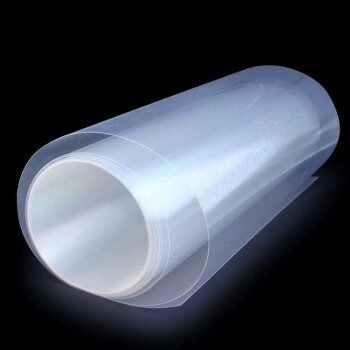
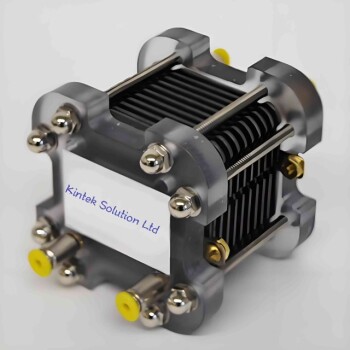
Membrane materials for Sulfur Dioxide (SO2) Depolarized Electrolyzers are defined strictly by their ability to withstand harsh, concentrated acidic environments. Specifically, these membranes must maintain high ionic conductivity and chemical stability in concentrated sulfuric acid while acting as a rigorous separator between oxidation and reduction products.
The success of the Westinghouse or Hybrid Sulfur cycle hinges on the membrane's capacity to act as a selective barrier—permitting efficient proton transport while resisting degradation from concentrated sulfuric acid and preventing the cross-contamination of reactant gases.
Chemical Stability in Aggressive Environments
Surviving Concentrated Acid
The primary challenge for these membranes is the operating environment. Materials, such as Nafion, are required because they must endure exposure to concentrated sulfuric acid without degrading chemically.
Long-Term Structural Integrity
Beyond immediate survival, the material must maintain its structure over time. Any chemical breakdown would lead to mechanical failure, allowing reactants to mix and effectively halting the cycle.
Critical Transport Properties
Efficient Proton Passage
The core function of the membrane is to facilitate the movement of protons. It must possess high ionic conductivity even when saturated with concentrated acid to ensure the electrolysis process remains energy-efficient.
Blocking Product Mixing
While protons must pass through, other species must not. The membrane acts as a separator to effectively block the physical mixing of oxidation and reduction products.
Preventing Gas Crossover
This separation capability extends to preventing gas crossover. Keeping the sulfur dioxide and oxygen separate is essential for both safety and process efficiency.
Understanding the Trade-offs
Permeability vs. Selectivity
A major engineering challenge is balancing conductivity with isolation. A membrane optimized solely for high proton flow may inadvertently allow unwanted species to cross over.
Metal Ion Contamination risks
In similar processes like the Copper-Chlorine (Cu-Cl) cycle, membranes require extremely low metal ion permeability. If metal ions permeate the membrane, they can contaminate the electrodes, leading to significant efficiency losses in the electrolyzer.
Making the Right Choice for Your Goal
When selecting or designing membranes for SO2 Depolarized Electrolyzers, you must weigh longevity against performance.
- If your primary focus is Cycle Longevity: Prioritize materials with proven chemical stability in concentrated sulfuric acid to minimize degradation and maintenance intervals.
- If your primary focus is Energy Efficiency: Select membranes with the highest possible ionic conductivity that still maintain an effective barrier against product mixing.
- If your primary focus is System Purity: Ensure the material has low permeability to metal ions to prevent electrode contamination and sustain long-term catalytic performance.
Ultimately, the ideal membrane is a highly selective gatekeeper that withstands the corrosive reality of the sulfur cycle without compromising ionic flow.
Summary Table:
| Requirement | Key Characteristic | Impact on Performance |
|---|---|---|
| Chemical Stability | Resistance to concentrated sulfuric acid | Ensures long-term structural integrity and longevity |
| Proton Conductivity | High ionic flow (e.g., Nafion-based) | Maximizes energy efficiency and electrolysis speed |
| Product Separation | Rigorous physical barrier | Prevents gas crossover and oxidation/reduction mixing |
| Ion Selectivity | Low metal ion permeability | Prevents electrode contamination and catalyst degradation |
Elevate Your Electrolysis Efficiency with KINTEK
Navigating the harsh environments of the Westinghouse or Hybrid Sulfur cycle requires materials that never compromise. KINTEK specializes in high-performance laboratory equipment and specialized consumables designed for the most demanding electrochemical research.
Whether you are optimizing electrolytic cells and electrodes, developing next-generation battery research tools, or requiring robust high-temperature furnaces and PTFE consumables for acidic processing, our expert team provides the precision solutions you need.
Ready to enhance your lab’s output? Contact KINTEK today to discover how our premium portfolio—from high-pressure reactors to specialized electrolytic components—can streamline your research and industrial applications.
References
- Chen Chen, Hongguang Jin. Challenges and perspectives for solar fuel production from water/carbon dioxide with thermochemical cycles. DOI: 10.1007/s43979-023-00048-6
This article is also based on technical information from Kintek Solution Knowledge Base .
Related Products
- Customizable PEM Electrolysis Cells for Diverse Research Applications
- Proton Exchange Membrane for Batteries Lab Applications
- Double-Layer Water Bath Electrolytic Electrochemical Cell
- Thin-Layer Spectral Electrolysis Electrochemical Cell
- FS Electrochemical Hydrogen Fuel Cells for Diverse Applications
People Also Ask
- What are the risks of improper voltage control in an electrolysis cell? Avoid Costly Damage and Inefficiency
- What are the opening configurations for the non-sealed and sealed versions of the electrolysis cell? Optimize Your Electrochemical Setup
- What is an electrolysis cell? A Guide to Driving Chemical Reactions with Electricity
- What parameters must be strictly controlled during the electrolysis process? Ensure Precision and Efficiency
- What are the precautions for heating or sterilizing an electrolysis cell? Avoid Damaging Sensitive Components