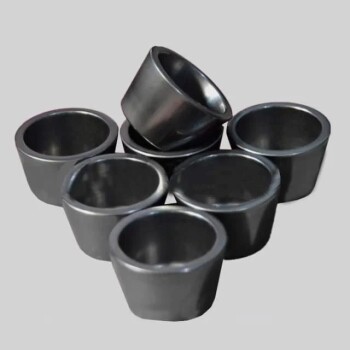
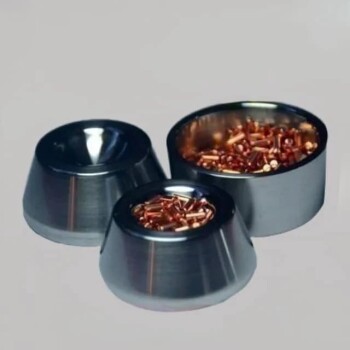
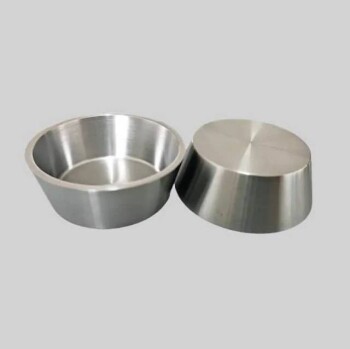
The technical advantages of using graphite crucibles for the carbonization of microcrystalline cellulose (MCC) include exceptional high-temperature stability, superior thermal conductivity for uniform heating, and inherent chemical inertness. These properties ensure the production of high-purity carbon materials—such as graphene microcrystals or porous carbon—by preventing metal impurity infiltration and maintaining a consistent thermal field during the reaction.
Graphite crucibles serve as more than just containers; they act as a controlled "micro-chamber" that optimizes the thermal and chemical environment required for cellulose transformation. By facilitating uniform heat distribution and a self-regulating reducing atmosphere, they ensure the structural integrity and purity of the resulting carbonized product.
Superior Thermal Management
High Thermal Conductivity and Uniformity
Graphite possesses excellent thermal conductivity, which allows the crucible to act as a thermal buffer. This ensures that the microcrystalline cellulose precursors are heated uniformly throughout the sample volume, preventing localized hotspots that could lead to inconsistent carbonization.
High-Temperature Structural Integrity
Unlike many materials that degrade or deform under extreme heat, graphite maintains its structural stability at temperatures exceeding 1000°C, and even up to 3000°C in inert atmospheres. This resistance to thermal shock prevents cracking during the rapid heating or cooling cycles often required in furnace processing.
Efficient Induction Coupling
Because graphite is electrically conductive, it is highly effective for use in induction furnaces. It allows for direct induction coupling, leading to rapid preheating and the creation of an isothermal reduction environment that is critical for achieving a consistent carbonized structure.
Chemical Purity and Reaction Control
Prevention of Impurity Infiltration
The use of high-purity, low-ash graphite prevents the infiltration of external metal impurities into the precursor. This is essential for applications requiring high-purity graphene or porous carbon, as even trace metals can act as unwanted catalysts or create defects in the carbon lattice.
The "Micro-Chamber" Reducing Atmosphere
When used with a lid, a graphite crucible creates a spontaneous CO/CO2 equilibrium environment with extremely low oxygen partial pressure. This "micro-chamber" design can eliminate the need for expensive external reducing gas mixtures while keeping the sample surface clean and facilitating efficient reduction.
Erosion Resistance and Low Porosity
Specialized manufacturing processes result in graphite with high bulk density and low porosity. This structure resists erosion from volatile gases generated during cellulose decomposition, preventing the formation of spots, holes, or other structural defects in the final carbonized coating.
Understanding the Trade-offs
Susceptibility to Oxidation
The primary limitation of graphite is its vulnerability to oxidation in the presence of oxygen at high temperatures. While it excels in reducing atmospheres (like those found in tube furnaces), it will rapidly degrade if the environment is not strictly controlled or if an inert purge gas is not maintained.
Porosity and Volatile Trapping
While high-purity graphite is designed for low porosity, standard grades may still trap some volatile substances. To mitigate this, technical users must ensure the use of low-ash, specially treated graphite to avoid the release of substances that could interfere with the delicate carbonization of MCC.
How to Apply This to Your Project
Recommendations Based on Your Objectives
The choice of crucible grade and treatment should align with the specific requirements of your carbonization process.
- If your primary focus is maximum product purity: Use a high-purity, low-ash graphite crucible to ensure no metallic contaminants or volatile residues affect the MCC transformation.
- If your primary focus is process longevity: Select a crucible with a specialized anti-oxidation coating to extend its service life through multiple heating cycles.
- If your primary focus is structural consistency: Prioritize a crucible with high thermal conductivity and a "micro-chamber" lid design to maintain a uniform thermal and chemical field.
By leveraging the unique thermal and chemical properties of graphite, you can achieve the precise control necessary for the high-quality carbonization of microcrystalline cellulose.
Summary Table:
| Feature | Technical Advantage | Impact on Carbonization |
|---|---|---|
| Thermal Conductivity | Rapid, uniform heat distribution | Prevents hotspots and ensures consistent carbon structure |
| Chemical Purity | Low-ash, high-purity material | Prevents metal infiltration and unwanted catalytic defects |
| Atmosphere Control | Creates a "micro-chamber" effect | Maintains a self-regulating CO/CO2 reducing environment |
| Thermal Stability | Stable up to 3000°C (inert) | Maintains structural integrity under extreme heat cycles |
| Induction Coupling | High electrical conductivity | Enables efficient, direct heating in induction furnaces |
Elevate Your Material Research with KINTEK Precision
Achieving high-purity graphene or porous carbon from microcrystalline cellulose requires more than just heat—it requires the perfect thermal and chemical environment. KINTEK provides the specialized laboratory equipment and high-purity consumables necessary for flawless carbonization.
From high-purity graphite crucibles and ceramic tools to advanced tube furnaces, vacuum furnaces, and high-pressure reactors, our solutions are designed to meet the rigorous demands of material science. Whether you are scaling up battery research or perfecting a lab-scale synthesis, our team ensures you have the right tools to achieve structural integrity and purity.
Ready to optimize your carbonization process? Contact KINTEK today to consult with our experts and find the ideal high-temperature solutions for your lab.
References
- Siyu Long, Qi-Shi Du. Study on the microcrystal cellulose and the derived 2D graphene and relative carbon materials. DOI: 10.1038/s41598-023-48393-x
This article is also based on technical information from Kintek Solution Knowledge Base .
Related Products
- High Purity Pure Graphite Crucible for Electron Beam Evaporation
- Carbon Graphite Boat -Laboratory Tube Furnace with Cover
- High Purity Pure Graphite Crucible for Evaporation
- Graphite Vacuum Furnace Bottom Discharge Graphitization Furnace for Carbon Materials
- Graphite Vacuum Furnace Negative Material Graphitization Furnace
People Also Ask
- What is the container that holds the metal source material called in e-beam evaporation? Ensure Purity and Quality in Your Thin-Film Deposition
- What role do high-purity graphite crucibles play in molten salt corrosion research? Ensure Reactor-Grade Precision
- Why is a high-purity graphite crucible ideal for nitrogen-doped graphene at 1500 °C? Maximize Purity and Stability
- What dual roles do high-purity graphite crucibles play? Expert Insights into Fluoride Salt Testing
- What role does a high-purity graphite crucible play in CaO-MgO-Al2O3-SiO2 system equilibrium experiments? Maximize Accuracy