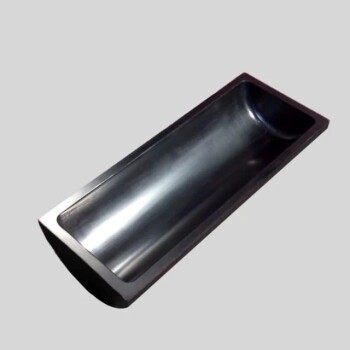
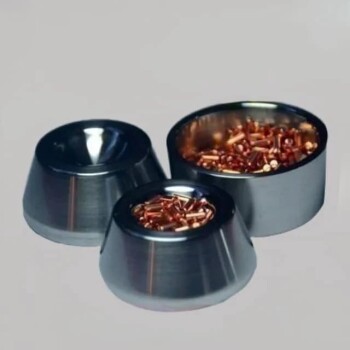
The high-purity graphite crucible serves as the foundational containment vessel for quaternary slag equilibrium studies. It provides a chemically inert environment that prevents external contamination while maintaining structural integrity at extreme temperatures reaching 1650°C. By leveraging high thermal conductivity and oxidation resistance under inert conditions, it ensures that the slag system reaches a stable, uniform equilibrium without interference from the vessel itself.
Core Takeaway: In CaO-MgO-Al2O3-SiO2 equilibrium experiments, a high-purity graphite crucible acts as a non-reactive micro-reactor that isolates the sample from atmospheric oxygen and prevents crucible-to-slag contamination. This isolation is essential for ensuring that the resulting data accurately reflects the chemical behavior of the slag components rather than unintended side reactions.
Ensuring Chemical and Thermal Stability
Chemical Inertness and Purity
High-purity graphite crucibles are typically 99.9% pure, which minimizes the risk of leaching impurity elements into the slag. This level of purity ensures that the CaO-MgO-Al2O3-SiO2 system maintains its intended chemical ratio throughout the duration of the experiment.
High-Temperature Structural Integrity
These crucibles maintain their strength at temperatures ranging from 1200°C to 1650°C, which is the standard window for slag melting. Unlike some ceramic materials, graphite will not soften or deform, providing a stable geometry for the molten slag.
Thermal Conductivity and Uniformity
Graphite possesses excellent thermal conductivity, which facilitates rapid and even heat distribution across the sample. This uniformity is critical in equilibrium experiments to ensure there are no temperature gradients that could cause localized variations in the slag phase.
Atmospheric Control and Isolation
Prevention of Unintended Oxidation
When used in a furnace with a constant inert gas flow (such as Argon), the graphite crucible creates a protective environment. This prevents the slag components from reacting with atmospheric oxygen, which could otherwise alter the oxidation states of the minerals.
Resistance to Thermal Shock
Equilibrium experiments often require quenching or rapid temperature changes to "freeze" the slag structure for later analysis. The low thermal expansion coefficient of graphite allows it to withstand these sudden shifts without cracking or failing.
Smooth Interior Surface
The smooth interior finish of high-purity graphite reduces the likelihood of the molten slag sticking to the walls. This feature is vital for the post-experiment recovery of the slag sample for chemical and mineralogical analysis.
Understanding the Trade-offs
Sensitivity to Oxidizing Environments
The primary limitation of graphite is its vulnerability to oxygen at high temperatures. If the furnace seal fails or the inert gas flow is interrupted, the crucible will oxidize and degrade rapidly, potentially ruining the experiment.
Carbon Interaction Potential
While graphite is generally inert to oxide slags, it can introduce carbon saturation if a metallic phase is present in the experiment. Researchers must account for this if they are studying slag-metal equilibrium rather than pure slag systems.
Comparison to Alumina Crucibles
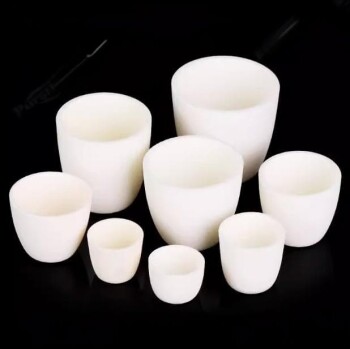
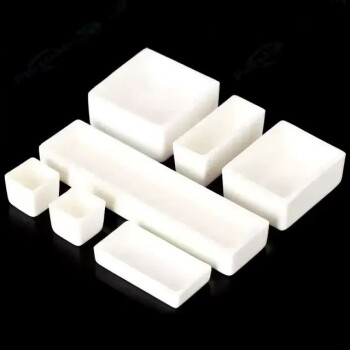
While high-purity alumina crucibles offer excellent resistance to certain slags, they may be more susceptible to corrosion from the quaternary slag phase over long durations. Graphite is often preferred for its superior ability to resist the aggressive chemical nature of molten oxide systems.
Making the Right Choice for Your Goal
How to Apply This to Your Project
- If your primary focus is precise chemical composition: Use 99.9% high-purity graphite to ensure that no metallic impurities or silica variations are introduced from the crucible walls.
- If your primary focus is thermal quenching and sample recovery: Leverage graphite’s superior thermal shock resistance and smooth surface to ensure the sample can be cooled rapidly and removed easily.
- If your primary focus is extreme temperature stability above 1600°C: Prioritize graphite over standard ceramics, as it maintains mechanical strength far beyond the deformation point of most alumina or silicate-based containers.
By utilizing the unique properties of high-purity graphite, researchers can ensure their equilibrium data is both reproducible and technically sound.
Summary Table:
| Feature | Benefit in Slag Equilibrium Experiments | Technical Specification |
|---|---|---|
| Chemical Purity | Minimizes leaching; prevents contamination of the quaternary system. | 99.9% High-Purity Graphite |
| Temperature Stability | Maintains structural integrity without softening or deformation. | 1200°C – 1650°C |
| Thermal Conductivity | Ensures rapid, uniform heat distribution; eliminates gradients. | Excellent Heat Transfer |
| Thermal Shock Resistance | Withstands rapid quenching to "freeze" slag structures for analysis. | Low Expansion Coefficient |
| Surface Finish | Facilitates easy sample recovery and post-experiment analysis. | Smooth Interior Walls |
Elevate Your High-Temperature Research with KINTEK
Precise slag equilibrium studies demand high-performance containment that won't compromise your data. KINTEK specializes in premium laboratory equipment and consumables designed for extreme environments. Our high-purity graphite crucibles and specialized ceramics provide the chemical inertness and thermal stability required for complex quaternary system experiments.
Whether you need robust muffle or tube furnaces for controlled atmospheres, or high-quality consumables like PTFE products and crucibles, KINTEK delivers the reliability your lab depends on.
Ready to optimize your experimental accuracy? Contact KINTEK today to discuss our full range of high-temperature solutions, from induction melting systems to precision crushing and milling tools. Let us help you achieve superior material treatment results.
References
- Jinfa Liao, Baojun Zhao. Phase Equilibria Studies in the CaO-MgO-Al2O3-SiO2 System with Al2O3/SiO2 Weight Ratio of 0.4. DOI: 10.3390/met13020224
This article is also based on technical information from Kintek Solution Knowledge Base .
Related Products
- High Purity Pure Graphite Crucible for Evaporation
- High Purity Pure Graphite Crucible for Electron Beam Evaporation
- Carbon Graphite Boat -Laboratory Tube Furnace with Cover
- Arc-Shaped Alumina Ceramic Crucible High Temperature Resistant for Engineering Advanced Fine Ceramics
- Horizontal High Temperature Graphite Vacuum Graphitization Furnace
People Also Ask
- Why are high-purity graphite crucibles preferred for sulfide solid electrolytes? Achieve Superior Material Purity
- Why is a high-purity graphite crucible required for Chromel-TaC composites? Ensure Peak Purity at 1400°C
- What role do high-purity graphite crucibles play in molten salt corrosion research? Ensure Reactor-Grade Precision
- Why are high-purity graphite crucibles used for magnesium distillation? Ensure 3N8 Purity & Thermal Stability
- Why is a high-purity graphite crucible ideal for nitrogen-doped graphene at 1500 °C? Maximize Purity and Stability