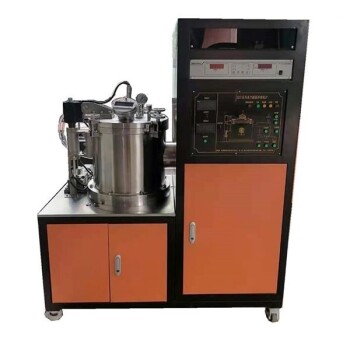
Reactive Melt Infiltration (RMI) offers a distinct advantage in ceramic manufacturing by utilizing capillary forces to infiltrate porous preforms with molten metals like silicon or zirconium. This technique allows you to produce nearly fully dense ceramic matrices in a fraction of the time required by traditional methods, without sacrificing the dimensional accuracy of the original molded part.
Core Takeaway The RMI furnace solves the traditional conflict between processing speed and material quality. It achieves near-total densification at relatively low temperatures through in-situ chemical reactions, ensuring the final component retains its shape while attaining superior structural integrity.
The Mechanics of Reactive Melt Infiltration
Leveraging Capillary Forces
The RMI process does not rely on external mechanical pressure to force material together. Instead, it operates in a high-temperature vacuum environment.
Here, metals such as silicon or zirconium are melted. Capillary forces naturally draw this molten metal into the pores of a carbon or boron preform.
In-Situ Chemical Reactions
Once the metal infiltrates the preform, it triggers an immediate chemical reaction.
This in-situ reaction transforms the precursor materials into a solid ceramic composite. Because the reaction happens internally, it fills voids efficiently, leading to a highly cohesive structure.
Key Technical Advantages
Rapid Densification
One of the most significant benefits of the RMI furnace is speed.
The combination of rapid capillary filling and fast chemical kinetics allows for the creation of a dense matrix in a very short time. This contrasts with diffusion-based processes that often require long holding times to eliminate porosity.
Lower Thermal Processing Requirements
RMI achieves high density at relatively low temperatures compared to purely thermal sintering methods.
By relying on the reactivity of the melt rather than just thermal diffusion, you avoid the extreme heat often required to sinter advanced ceramics, which can save energy and reduce thermal stress on the equipment.
Superior Dimensional Stability
For engineers requiring precision, RMI offers a critical advantage: high dimensional stability.
Because the preform is infiltrated rather than crushed or significantly shrunk, the final product closely matches the shape of the molded preform. This "near-net-shape" capability reduces the need for expensive and difficult post-process machining.
Understanding the Process Constraints
Material Compatibility Dependencies
While RMI is highly effective, it is strictly governed by chemical compatibility.
The process relies on the specific reaction between the infiltrant (e.g., Silicon, Zirconium) and the preform (e.g., Carbon, Boron). Unlike pressure-assisted methods that force distinct materials together, RMI requires a reactive pair that wets well and forms the desired ceramic phase.
Vacuum Environment Necessity
The process is dependent on a controlled atmosphere.
A high-temperature vacuum is essential to facilitate the flow of molten metal and prevent contamination. Without this vacuum, the capillary action would be impeded by trapped gas or surface oxides, leading to incomplete infiltration and lower density.
Making the Right Choice for Your Goal
When selecting a manufacturing method for ceramic composites, consider how the specific strengths of RMI align with your project requirements.
- If your primary focus is Production Speed: RMI is the superior choice due to its ability to infiltrate and densify matrices in very short processing times.
- If your primary focus is Dimensional Precision: RMI is ideal because it maintains the original shape of the preform, minimizing shrinkage and warping issues common in other sintering methods.
Ultimately, the RMI furnace is the optimal tool when you need to combine rapid throughput with the precision of near-net-shape manufacturing.
Summary Table:
| Feature | RMI Process Advantage | Impact on Production |
|---|---|---|
| Densification Speed | Rapid capillary action & fast kinetics | Significant reduction in processing time |
| Dimensional Accuracy | Near-net-shape manufacturing | Minimal shrinkage; less post-process machining |
| Processing Temp | Lower than traditional sintering | Energy efficiency & reduced equipment thermal stress |
| Material Integrity | In-situ chemical reactions | High cohesion and near-total matrix density |
| Mechanism | Capillary-driven vacuum infiltration | Eliminates need for high-pressure mechanical force |
Elevate Your Ceramic Manufacturing with KINTEK Precision
Unlock the full potential of Reactive Melt Infiltration with KINTEK’s advanced thermal solutions. Whether you are developing high-density composites or pioneering new material phases, our high-temperature vacuum and atmosphere furnaces provide the precise control necessary for successful capillary infiltration and in-situ reactions.
Why choose KINTEK?
- Expertise in High-Performance Ceramics: From muffle and vacuum furnaces to specialized CVD systems, we provide the tools needed for complex material synthesis.
- Comprehensive Lab Support: Enhance your workflow with our crushing systems, hydraulic presses, and ceramic crucibles designed for rigorous research and production.
- Tailored Solutions: We assist laboratory professionals and engineers in achieving superior dimensional stability and rapid throughput.
Ready to optimize your densification process? Contact KINTEK today to discover how our high-temperature technology can transform your lab’s capabilities.
References
- Dewei Ni, Guo‐Jun Zhang. Advances in ultra-high temperature ceramics, composites, and coatings. DOI: 10.1007/s40145-021-0550-6
This article is also based on technical information from Kintek Solution Knowledge Base .
Related Products
- Vacuum Arc Induction Melting Furnace
- Lab-Scale Vacuum Induction Melting Furnace
- Non Consumable Vacuum Arc Induction Melting Furnace
- Vacuum Heat Treat Furnace and Levitation Induction Melting Furnace
- High Temperature Muffle Oven Furnace for Laboratory Debinding and Pre Sintering
People Also Ask
- How do vacuum induction or arc melting furnaces facilitate the synthesis of U-Al-C MAX phases? Precision Heat & Purity
- What core role does a Vacuum Induction Melting furnace play in nickel-free steel production? Achieve High-Purity Alloys
- What is the function of vacuum arc melting equipment? Creating High-Purity Ferrochrome (CrFe) Alloys
- What is the function of a vacuum arc melting furnace? Prepare High-Purity Alx(CrFeNi)1-x High-Entropy Alloys
- What is the primary function of a vacuum arc melting furnace in RHEA preparation? Achieving Extreme Thermal Fusion