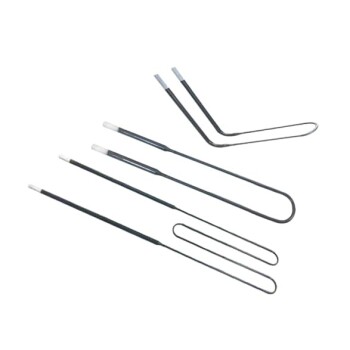
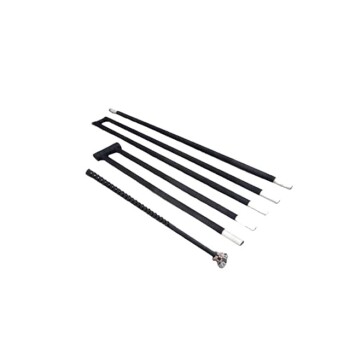
Molybdenum Disilicide (MoSi2) heating elements provide the extreme temperature capabilities and oxidation resistance required for high-precision roasting experiments, reaching operating temperatures as high as 1850°C. These elements are distinguished by their ability to form a protective passivation layer of silicon dioxide (SiO2), which ensures long-term stability in oxidizing atmospheres. This chemical resilience, combined with stable electrical resistance, allows for the strict thermal consistency essential for accurate kinetic studies.
Core Takeaway: MoSi2 elements solve the fundamental challenge of maintaining a stable, high-temperature environment in oxidizing conditions, providing the thermal precision necessary for reproducible roasting and sintering data.
Superior Thermal Stability and Performance
Exceptional Temperature Range and Watt Loading
MoSi2 elements offer the highest operating temperatures of all comparable electric heating elements, with some grades reaching 1850°C. They support high watt loadings, allowing furnaces to reach target temperatures quickly and maintain them under heavy process loads.
Self-Healing Oxidation Protection
At high temperatures, MoSi2 reacts with oxygen to form a dense, protective silicon dioxide (SiO2) film. This layer shields the core material from further oxidation, allowing the elements to operate reliably in air for extended periods without degrading.
Precision for Kinetic Studies
In roasting experiments, such as chlorination or Lead Oxide (PbO) reduction, even minor temperature fluctuations can skew kinetic data. MoSi2 elements ensure that temperature deviations remain within a minimal range, providing the consistency required for rigorous scientific analysis.
Operational Efficiency in Research Settings
Stable Electrical Resistance
Unlike many other materials, the electrical resistance of MoSi2 remains stable over time and does not increase with age. This allows researchers to connect new and old elements in the same circuit without causing power imbalances or needing complex voltage adjustments.
Rapid Thermal Cycling Capabilities
The material is engineered to endure fast thermal cycling without physical degradation. This is a significant advantage for labs performing multiple roasting runs per day, as it reduces the "soak time" and cooling periods required between experiments.
Hot-Swap Maintenance and Versatility
These elements are relatively easy to replace even while the furnace is hot, minimizing downtime during critical experimental phases. They are also available in a wide variety of shapes and sizes, making them adaptable to custom tube or muffle furnace designs.
Understanding the Trade-offs
The "Pest" Oxidation Phenomenon
A critical limitation is the low-temperature eutectic range (400-600°C), where MoSi2 can undergo "pest" oxidation. In this specific range, the material may turn to powder if held there for prolonged periods; high-precision controllers must be used to move through this zone quickly.
Physical Fragility and Weight
MoSi2 is a refractory ceramic, meaning it is brittle at room temperature and can break easily if subjected to mechanical shock. Additionally, while the material has a moderate density, it requires stable mechanical support within the furnace to prevent sagging at extreme temperatures.
Cost Considerations
MoSi2 elements generally carry a higher initial cost compared to silicon carbide or metallic heating elements. However, their long inherent life and the stability of their resistance often lead to a lower total cost of ownership in high-temperature applications.
How to Apply This to Your Roasting Experiments
Integrating MoSi2 elements into your workflow requires matching the element grade to your specific atmospheric and thermal requirements.
- If your primary focus is ultra-high temperature roasting (>1500°C): Utilize MoSi2 elements to achieve temperatures that would melt or oxidize standard metallic or silicon carbide components.
- If your primary focus is kinetic accuracy and repeatability: Prioritize MoSi2 for its stable resistance, which ensures the furnace power output remains consistent across hundreds of experimental cycles.
- If your primary focus is minimizing experimental downtime: Leverage the "hot-swap" capability and the ability to mix old and new elements to maintain continuous operation without full-set replacements.
By leveraging the unique chemical properties of Molybdenum Disilicide, researchers can ensure their roasting experiments are governed by precise thermal control rather than the limitations of their heating hardware.
Summary Table:
| Feature | Technical Advantage | Benefit for Roasting Experiments |
|---|---|---|
| Max Operating Temp | Up to 1850°C | Enables ultra-high temperature roasting & sintering |
| Chemical Stability | Self-healing SiO2 passivation layer | Exceptional oxidation resistance in air |
| Electrical Profile | Stable resistance (no aging) | Consistent power output; allows mixing old & new elements |
| Thermal Response | Supports high watt loading | Rapid heating cycles and increased experiment throughput |
| Maintenance | Hot-swap capability | Minimizes downtime during critical research phases |
Elevate Your Thermal Research with KINTEK
Precision is non-negotiable in high-temperature kinetic studies. KINTEK specializes in advanced laboratory equipment, offering a comprehensive range of high-temperature furnaces (muffle, tube, vacuum, and atmosphere) designed to leverage the superior stability of MoSi2 heating elements.
From high-pressure reactors and autoclaves to precision crushing, milling, and pellet presses, we provide the robust tools needed for reproducible results. Whether you are optimizing a roasting process or conducting advanced sintering, our technical experts are ready to help you select the perfect system for your lab.
Ready to upgrade your laboratory’s performance? Contact KINTEK Today to Request a Quote
References
- Weiwei Wang, Shaochun Hou. Kinetics of simultaneous recovering of Au and Ag from CTs by chloridizing volatilization methods. DOI: 10.37190/ppmp/172522
This article is also based on technical information from Kintek Solution Knowledge Base .
Related Products
- Molybdenum Disilicide (MoSi2) Thermal Elements Electric Furnace Heating Element
- Molybdenum Vacuum Heat Treat Furnace
- Silicon Carbide SiC Thermal Heating Elements for Electric Furnace
- 1400℃ Controlled Atmosphere Furnace with Nitrogen and Inert Atmosphere
- Vacuum Heat Treat and Molybdenum Wire Sintering Furnace for Vacuum Sintering
People Also Ask
- What is the temperature range of molybdenum disilicide heating elements? Choose the Right Grade for Your High-Temp Needs
- What is molybdenum disilicide used for? Powering High-Temperature Furnaces Up to 1800°C
- What is the temperature range of a MoSi2 heating element? Unlock 1900°C Performance for Your Lab
- What is MoSi2 heating element? A High-Temp Solution with Self-Healing Power
- What is the best heating element for a furnace? A Guide to Selecting the Right Material for Your Temperature Needs