Knowledge What are the types of compression molds? Flash, Positive, and Semi-Positive Explained
Author avatar

Tech Team · Kintek Solution

Updated 1 week ago

What are the types of compression molds? Flash, Positive, and Semi-Positive Explained


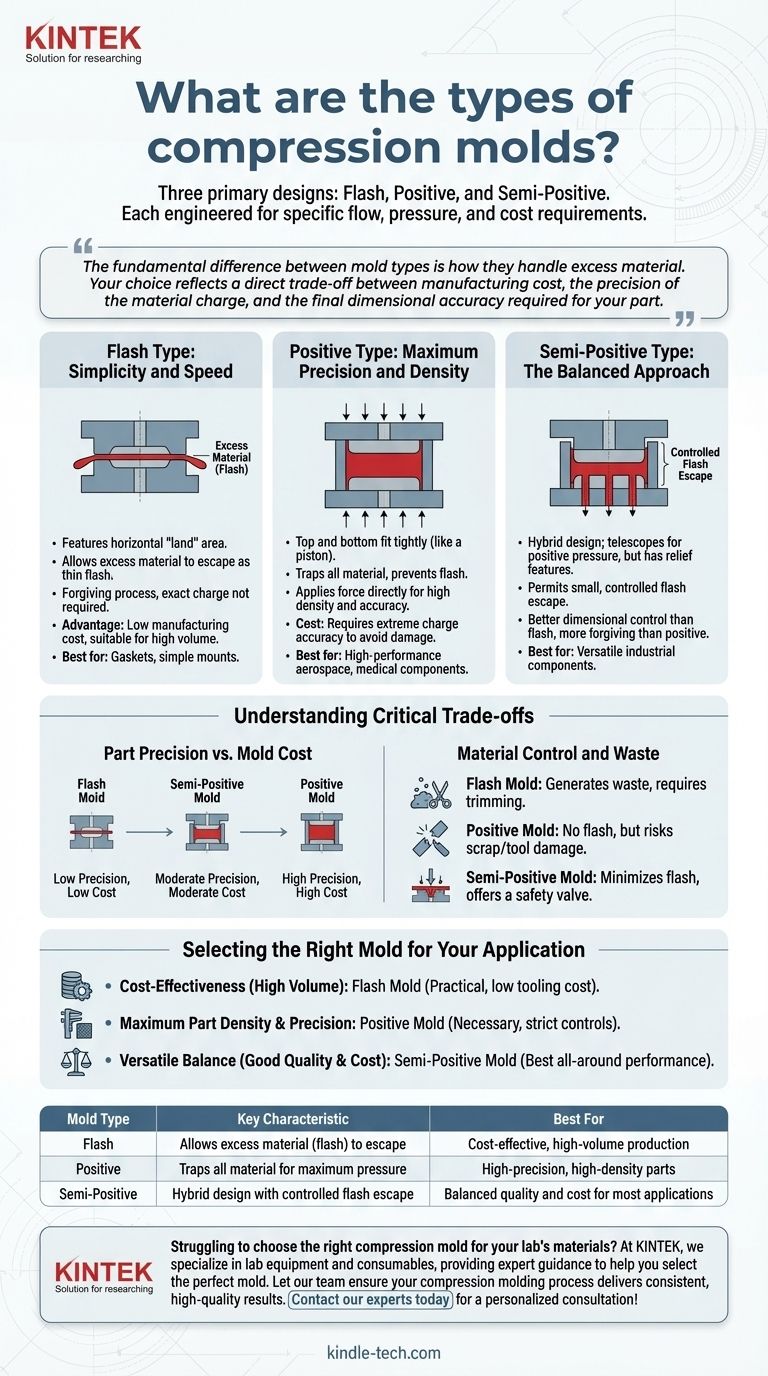
There are three primary types of compression molds: flash, positive, and semi-positive. Each design is engineered to control the flow and pressure on the molding material differently, directly impacting the final part's precision, density, and cost. The choice among them depends entirely on the specific requirements of the component being produced.

The fundamental difference between mold types is how they handle excess material. Your choice reflects a direct trade-off between manufacturing cost, the precision of the material charge, and the final dimensional accuracy required for your part.
What are the types of compression molds? Flash, Positive, and Semi-Positive Explained

The Three Core Mold Designs Explained

Understanding each design's mechanics reveals its ideal use case. The primary distinction lies in whether, and how, the mold allows excess material (known as "flash") to escape as the mold closes under pressure.

Flash Type: Simplicity and Speed

A flash mold is the simplest and most common design. It features a horizontal "land" area around the mold cavity.

As the mold closes, this land allows excess material to be squeezed out, forming a thin sheet of flash. This makes the process forgiving, as the exact amount of material (the "charge") does not need to be perfectly measured.

The primary advantage is its low manufacturing cost and suitability for high-volume production where minor imperfections are acceptable.

Positive Type: Maximum Precision and Density

A positive mold is designed for maximum pressure and material containment. The top and bottom halves of the mold fit together with a tight tolerance, almost like a piston in a cylinder.

This design traps all the material within the cavity, preventing any flash from escaping. All the force is applied directly to the material, resulting in parts with very high density and excellent dimensional accuracy.

However, this precision comes at a cost. The material charge must be weighed with extreme accuracy to avoid either under-filling the cavity or creating excessive pressure that could damage the expensive mold.

Semi-Positive Type: The Balanced Approach

The semi-positive mold is a hybrid design that captures the benefits of both flash and positive molds.

It allows the mold halves to telescope together for a short distance to apply positive pressure, but it also incorporates features like vertical lands or relief vents. This permits a small, controlled amount of flash to escape once a specific pressure is reached.

This design provides much better dimensional control and density than a flash mold while being more forgiving on material charge than a fully positive mold.

Understanding the Critical Trade-offs

Selecting a mold type is an engineering decision based on balancing three key factors: cost, material control, and the required quality of the final part.

Part Precision vs. Mold Cost

There is a direct relationship between the cost of the mold and the precision of the part it produces.

  • Flash Mold: Lowest cost, lowest precision. Ideal for parts like gaskets or simple mounts where exact dimensions are less critical.
  • Positive Mold: Highest cost, highest precision. Used for high-performance components in aerospace, medical, or electrical applications.
  • Semi-Positive Mold: A moderate cost for good-to-high precision. It is a versatile workhorse for a wide range of industrial components.

Material Control and Waste

How the mold handles the material charge is a defining factor.

Flash molds generate waste material and require a secondary trimming operation, adding labor and cost to the process. Positive molds create no flash but risk scrap parts or tool damage if the charge is incorrect.

The semi-positive design offers a compromise, minimizing flash while providing a safety valve for slight variations in the material charge.

Selecting the Right Mold for Your Application

Your final choice should be guided by the end-use requirements of your component.

  • If your primary focus is cost-effectiveness for high-volume production: The flash mold is the most practical choice due to its low tooling cost and forgiving nature.
  • If your primary focus is maximum part density and dimensional accuracy: The positive mold is necessary, despite its higher cost and strict process controls.
  • If your primary focus is a versatile balance of good quality and reasonable cost: The semi-positive mold offers the best all-around performance for most industrial applications.

Ultimately, aligning your mold design with your part's specific engineering and economic goals is the key to successful compression molding.

Summary Table:

Mold Type Key Characteristic Best For
Flash Allows excess material (flash) to escape Cost-effective, high-volume production
Positive Traps all material for maximum pressure High-precision, high-density parts
Semi-Positive Hybrid design with controlled flash escape Balanced quality and cost for most applications

Struggling to choose the right compression mold for your lab's materials? The wrong mold design can lead to imprecise parts, wasted material, and increased costs. At KINTEK, we specialize in lab equipment and consumables, providing expert guidance to help you select the perfect mold for your specific application—whether you need high-volume efficiency with a flash mold or maximum precision with a positive mold. Let our team ensure your compression molding process delivers consistent, high-quality results. Contact our experts today for a personalized consultation!

Visual Guide
What are the types of compression molds? Flash, Positive, and Semi-Positive Explained Visual Guide

Related Products

People Also Ask

Related Products

Anti-Cracking Press Mold for Lab Use

Anti-Cracking Press Mold for Lab Use

The anti-cracking press mold is a specialized equipment designed for molding various shapes and sizes of film using high pressure and electric heating.

Small Injection Molding Machine for Lab Use

Small Injection Molding Machine for Lab Use

The small injection molding machinehas fast and stable movements; good controllability and repeatability, super energy saving; the product can be automatically dropped and formed; the machine body is low, convenient for feeding, easy to maintain, and no height restrictions on the installation site.

HFCVD Machine System Equipment for Drawing Die Nano-Diamond Coating

HFCVD Machine System Equipment for Drawing Die Nano-Diamond Coating

The nano-diamond composite coating drawing die uses cemented carbide (WC-Co) as the substrate, and uses the chemical vapor phase method ( CVD method for short ) to coat the conventional diamond and nano-diamond composite coating on the surface of the inner hole of the mold.

CVD Diamond Cutting Tool Blanks for Precision Machining

CVD Diamond Cutting Tool Blanks for Precision Machining

CVD Diamond Cutting Tools: Superior Wear Resistance, Low Friction, High Thermal Conductivity for Non-Ferrous Materials, Ceramics, Composites Machining

915MHz MPCVD Diamond Machine Microwave Plasma Chemical Vapor Deposition System Reactor

915MHz MPCVD Diamond Machine Microwave Plasma Chemical Vapor Deposition System Reactor

915MHz MPCVD Diamond Machine and its multi-crystal effective growth, the maximum area can reach 8 inches, the maximum effective growth area of single crystal can reach 5 inches. This equipment is mainly used for the production of large-size polycrystalline diamond films, the growth of long single crystal diamonds, the low-temperature growth of high-quality graphene, and other materials that require energy provided by microwave plasma for growth.

Laboratory Sterilizer Lab Autoclave Vertical Pressure Steam Sterilizer for Liquid Crystal Display Automatic Type

Laboratory Sterilizer Lab Autoclave Vertical Pressure Steam Sterilizer for Liquid Crystal Display Automatic Type

Liquid crystal display automatic vertical sterilizer is a safe, reliable and automatic control sterilization equipment, which is composed of heating system, microcomputer control system and overheating and overvoltage protection system.

Benchtop Laboratory Vacuum Freeze Dryer

Benchtop Laboratory Vacuum Freeze Dryer

Benchtop laboratory freeze dryer for efficient lyophilization of biological, pharmaceutical, and food samples. Features intuitive touchscreen, high-performance refrigeration, and durable design. Preserve sample integrity—consult now!

Laboratory Test Sieves and Sieving Machines

Laboratory Test Sieves and Sieving Machines

Precision lab test sieves & sieving machines for accurate particle analysis. Stainless steel, ISO-compliant, 20μm-125mm range. Request specs now!

Benchtop Laboratory Freeze Dryer for Lab Use

Benchtop Laboratory Freeze Dryer for Lab Use

Premium benchtop laboratory freeze dryer for lyophilization, preserving samples with ≤ -60°C cooling. Ideal for pharmaceuticals & research.

Precision Machined Zirconia Ceramic Ball for Engineering Advanced Fine Ceramics

Precision Machined Zirconia Ceramic Ball for Engineering Advanced Fine Ceramics

zirconia ceramic ball have the characteristics of high strength, high hardness, PPM wear level, high fracture toughness, good wear resistance, and high specific gravity.

Laboratory Vibratory Sieve Shaker Machine Slap Vibrating Sieve

Laboratory Vibratory Sieve Shaker Machine Slap Vibrating Sieve

KT-T200TAP is a slapping and oscillating sieving instrument for laboratory desktop use, with 300 rpm horizontal circular motion and 300 vertical slapping motions to simulate manual sieving to help sample particles pass through better.

High Purity Zinc Foil for Battery Lab Applications

High Purity Zinc Foil for Battery Lab Applications

There are very few harmful impurities in the chemical composition of zinc foil, and the surface of the product is straight and smooth; it has good comprehensive properties, processability, electroplating colorability, oxidation resistance and corrosion resistance, etc.

Custom PTFE Teflon Parts Manufacturer for Centrifuge Tube Racks

Custom PTFE Teflon Parts Manufacturer for Centrifuge Tube Racks

The precision-made PTFE test tube racks are completely inert and, due to the high temperature properties of PTFE, these test tube racks can be sterilized (autoclaved) without any problems.

Hexagonal Boron Nitride HBN Ceramic Ring

Hexagonal Boron Nitride HBN Ceramic Ring

Boron nitride ceramic (BN) rings are commonly used in high temperature applications such as furnace fixtures, heat exchangers and semiconductor processing.

Vacuum Hot Press Furnace Machine for Lamination and Heating

Vacuum Hot Press Furnace Machine for Lamination and Heating

Experience clean and precise lamination with Vacuum Lamination Press. Perfect for wafer bonding, thin-film transformations, and LCP lamination. Order now!

Laboratory Sterilizer Lab Autoclave Pulse Vacuum Lifting Sterilizer

Laboratory Sterilizer Lab Autoclave Pulse Vacuum Lifting Sterilizer

The pulse vacuum lifting sterilizer is a state-of-the-art equipment for efficient and precise sterilization. It uses pulsating vacuum technology, customizable cycles, and a user-friendly design for easy operation and safety.

High-Purity Titanium Foil and Sheet for Industrial Applications

High-Purity Titanium Foil and Sheet for Industrial Applications

Titanium is chemically stable, with a density of 4.51g/cm3, which is higher than aluminum and lower than steel, copper, and nickel, but its specific strength ranks first among metals.

High Energy Vibratory Laboratory Ball Mill Grinding Mill Single Tank Type

High Energy Vibratory Laboratory Ball Mill Grinding Mill Single Tank Type

High-energy vibration ball mill is a small desktop laboratory grinding instrument.It can be ball-milled or mixed with different particle sizes and materials by dry and wet methods.

Aluminum Foil Current Collector for Lithium Battery

Aluminum Foil Current Collector for Lithium Battery

The surface of aluminum foil is extremely clean and hygienic, and no bacteria or microorganisms can grow on it. It is a non-toxic, tasteless and plastic packaging material.

Laboratory Disc Rotary Mixer for Efficient Sample Mixing and Homogenization

Laboratory Disc Rotary Mixer for Efficient Sample Mixing and Homogenization

Efficient Laboratory Disc Rotary Mixer for Precise Sample Mixing, Versatile for Various Applications, DC Motor and Microcomputer Control, Adjustable Speed and Angle.


Leave Your Message