Knowledge What catalysts are used in catalytic pyrolysis? Unlock Higher-Quality Bio-Oil with Zeolites
Author avatar

Tech Team · Kintek Solution

Updated 6 days ago

What catalysts are used in catalytic pyrolysis? Unlock Higher-Quality Bio-Oil with Zeolites


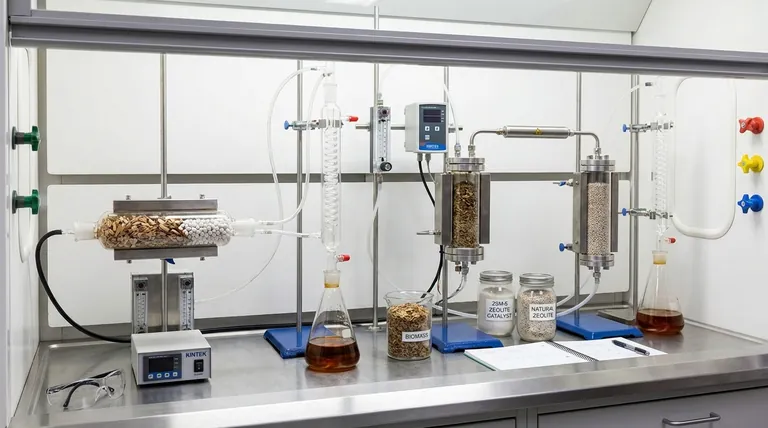
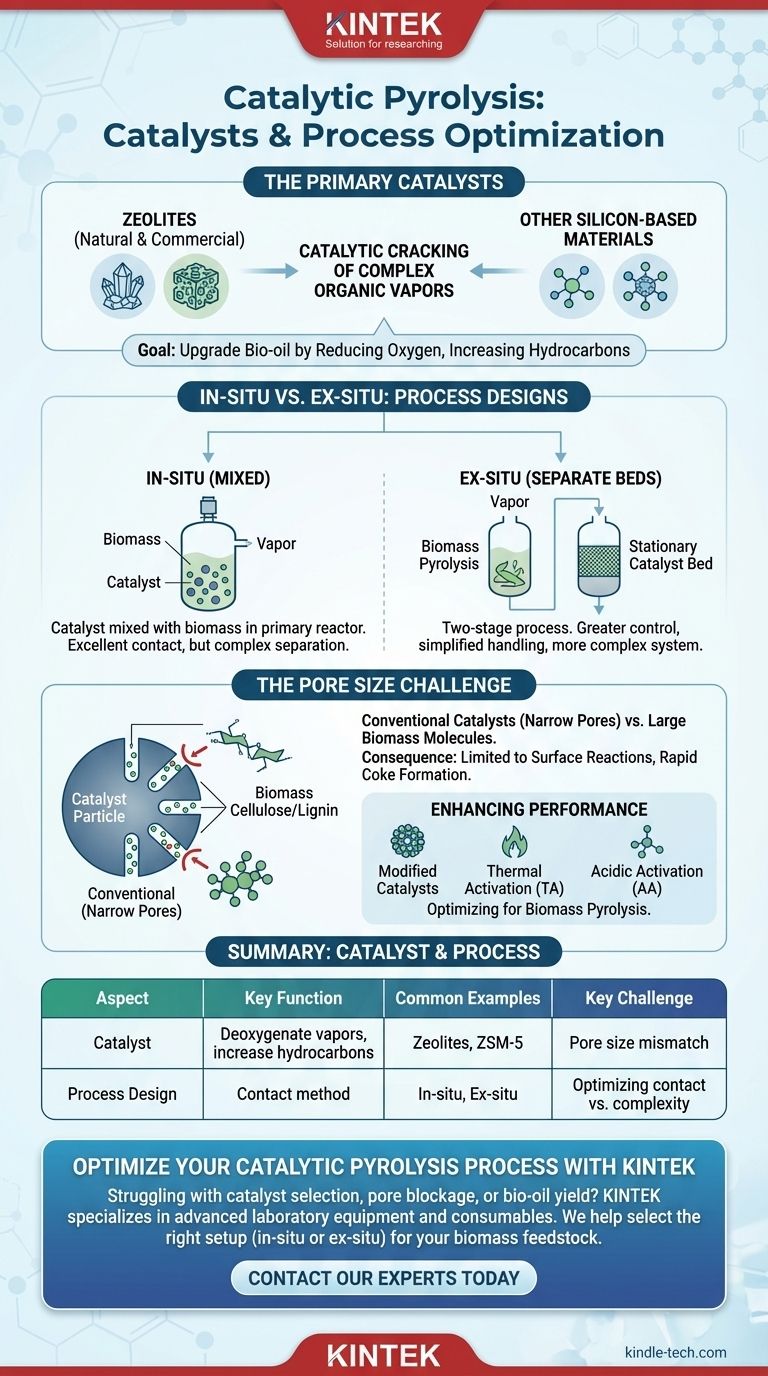
In catalytic pyrolysis, the most prevalent catalysts used are zeolites, both natural and commercial, along with other silicon-based materials. These substances are introduced into the pyrolysis process to catalytically "crack" the complex organic vapors produced from biomass, upgrading them into a more stable and valuable bio-oil by reducing oxygen content and increasing hydrocarbon yield.

While zeolites are the most common catalysts, their standard forms are often a poor fit for raw biomass. The core challenge is not just choosing a material, but overcoming the mismatch between the catalyst's narrow pores and the large, bulky molecules present in biomass polymers.
What catalysts are used in catalytic pyrolysis? Unlock Higher-Quality Bio-Oil with Zeolites

The Role of Key Catalysts

Catalysts are the critical element that transforms standard pyrolysis into a more refined upgrading process. Their primary function is to deoxygenate the pyrolysis vapors, which improves the quality and stability of the final liquid product, known as bio-oil.

The Primary Catalyst Family: Zeolites

Zeolites are crystalline, microporous aluminosilicates that are the workhorses of catalytic pyrolysis. They are favored for their high acidity and shape-selective properties.

Both natural zeolites (NZ) and commercially produced zeolites are used. However, their effectiveness can vary significantly based on their structure and the specific application.

Enhancing Catalyst Performance

Standard catalysts are often not optimized for biomass. Therefore, modification methods are frequently employed to improve their performance.

Techniques like thermal activation (TA) and acidic activation (AA) are used to alter the properties of natural zeolites, enhancing their catalytic activity for the pyrolysis of large biomass molecules.

In-situ vs. Ex-situ: Two Process Designs

The way a catalyst is introduced into the process dramatically impacts the outcome. There are two fundamental configurations for catalytic pyrolysis.

In-situ Catalysis (Mixed)

In the in-situ method, the catalyst is physically mixed with the biomass feedstock inside the primary pyrolysis reactor.

This approach ensures excellent contact between the biomass vapors and the catalyst, but it can make catalyst separation and regeneration more difficult.

Ex-situ Catalysis (Separate Beds)

In the ex-situ method, the process is separated into two stages. Biomass is first pyrolyzed in one reactor, and the resulting vapors are then passed over a stationary catalyst bed in a second reactor.

This dual-bed setup offers greater control over reaction conditions and simplifies catalyst handling, though it requires a more complex and expensive system.

Understanding the Key Trade-off: Pore Size

The central challenge in catalytic pyrolysis of biomass is a fundamental structural mismatch between the fuel and the catalyst.

The Problem with Conventional Catalysts

Most commercial catalysts, including many zeolites, were originally developed for the petrochemical industry, which deals with relatively small hydrocarbon molecules.

These catalysts have narrow pores that are simply too small for the bulky natural polymers found in biomass, such as cellulose and lignin, to enter.

The Consequence: Surface-Level Reactions

When large biomass molecules cannot access the internal active sites of the catalyst, reactions are limited to the catalyst's external surface. This severely reduces efficiency and can lead to the rapid formation of coke, which deactivates the catalyst.

This physical limitation is a primary reason why direct catalytic pyrolysis of biomass remains a significant technical challenge.

Making the Right Choice for Your Goal

Selecting a catalytic strategy depends entirely on your project's specific objectives, whether they are focused on product quality, cost, or feedstock flexibility.

  • If your primary focus is maximizing bio-oil quality: An ex-situ approach with a highly active, shape-selective zeolite offers the most control over the final product composition.
  • If your primary focus is process simplicity and lower initial cost: An in-situ method using a robust, less-expensive catalyst like modified natural zeolite is a more direct and economical starting point.
  • If your primary focus is processing raw biomass: You must prioritize catalysts with larger pores or consider an ex-situ process where initial thermal cracking can break down large molecules before they encounter the catalyst.

Ultimately, success in catalytic pyrolysis comes from matching the catalyst's properties and the process design to the unique characteristics of your biomass feedstock.

Summary Table:

Catalyst / Aspect Key Function Common Examples
Zeolites Deoxygenate vapors, increase hydrocarbons Natural Zeolites (NZ), Commercial ZSM-5
Process Design How catalyst contacts biomass vapors In-situ (mixed), Ex-situ (separate bed)
Key Challenge Overcoming pore size mismatch with biomass Use of modified catalysts (TA, AA)

Optimize Your Catalytic Pyrolysis Process with KINTEK

Struggling with catalyst selection, pore blockage, or low bio-oil yield for your biomass feedstock? KINTEK specializes in advanced laboratory equipment and consumables for pyrolysis research and development. We can help you select the right catalyst setup—whether in-situ or ex-situ—to efficiently upgrade your bio-oil and improve process efficiency.

Contact our experts today to discuss your specific biomass and goals, and let us provide the tailored solutions you need to succeed.

Visual Guide
What catalysts are used in catalytic pyrolysis? Unlock Higher-Quality Bio-Oil with Zeolites Visual Guide

Related Products

People Also Ask

Related Products

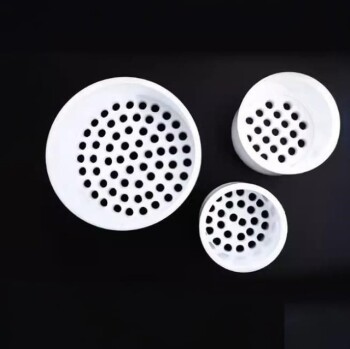
Custom PTFE Teflon Parts Manufacturer for PTFE Mesh F4 Sieve

Custom PTFE Teflon Parts Manufacturer for PTFE Mesh F4 Sieve

PTFE mesh sieve is a specialized test sieve designed for particle analysis in various industries, featuring a non-metallic mesh woven from PTFE filament. This synthetic mesh is ideal for applications where metal contamination is a concern . PTFE sieves are crucial for maintaining the integrity of samples in sensitive environments, ensuring accurate and reliable results in particle size distribution analysis.

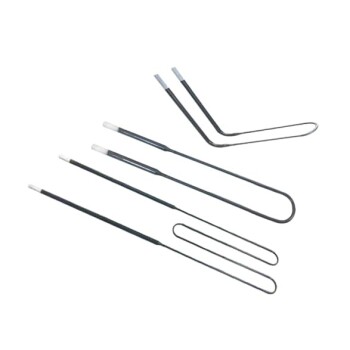
Molybdenum Disilicide (MoSi2) Thermal Elements Electric Furnace Heating Element

Molybdenum Disilicide (MoSi2) Thermal Elements Electric Furnace Heating Element

Discover the power of Molybdenum Disilicide (MoSi2) Heating Element for high-temperature resistance. Unique oxidation resistance with stable resistance value. Learn more about its benefits now!

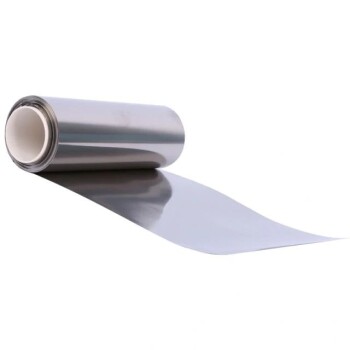
High-Purity Titanium Foil and Sheet for Industrial Applications

High-Purity Titanium Foil and Sheet for Industrial Applications

Titanium is chemically stable, with a density of 4.51g/cm3, which is higher than aluminum and lower than steel, copper, and nickel, but its specific strength ranks first among metals.

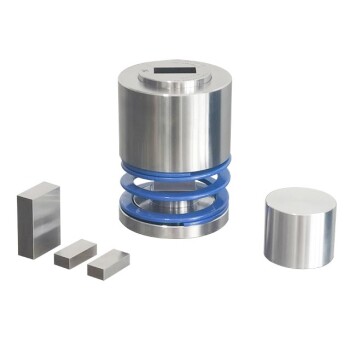
Square Bidirectional Pressure Mold for Lab Use

Square Bidirectional Pressure Mold for Lab Use

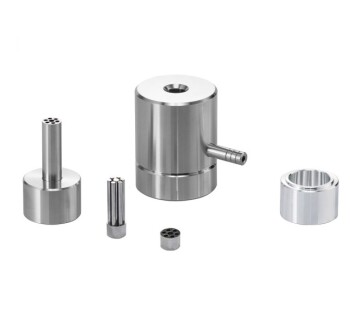
Discover precision in molding with our Square Bidirectional Pressure Mold. Ideal for creating diverse shapes and sizes, from squares to hexagons, under high pressure and uniform heating. Perfect for advanced material processing.

Custom PTFE Teflon Parts Manufacturer Adjustable Height Flower Basket

Custom PTFE Teflon Parts Manufacturer Adjustable Height Flower Basket

The flower basket is made of PTFE, which is a chemically inert material. This makes it resistant to most acids and bases, and it can be used in a wide variety of applications.

Customizable PEM Electrolysis Cells for Diverse Research Applications

Customizable PEM Electrolysis Cells for Diverse Research Applications

Custom PEM test cell for electrochemical research. Durable, versatile, for fuel cells & CO2 reduction. Fully customizable. Get a quote!

Platinum Sheet Electrode for Laboratory and Industrial Applications

Platinum Sheet Electrode for Laboratory and Industrial Applications

Elevate your experiments with our Platinum Sheet Electrode. Crafted with quality materials, our safe and durable models can be tailored to fit your needs.

Custom PTFE Teflon Parts Manufacturer for PTFE Buchner Funnel and Triangular Funnel

Custom PTFE Teflon Parts Manufacturer for PTFE Buchner Funnel and Triangular Funnel

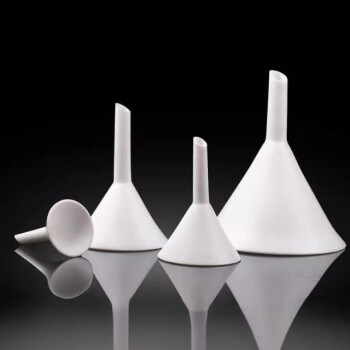
The PTFE funnel is a piece of laboratory equipment used primarily for filtration processes, particularly in the separation of solid and liquid phases in a mixture. This setup allows for efficient and rapid filtration, making it indispensable in various chemical and biological applications.

RRDE rotating disk (ring disk) electrode / compatible with PINE, Japanese ALS, Swiss Metrohm glassy carbon platinum

RRDE rotating disk (ring disk) electrode / compatible with PINE, Japanese ALS, Swiss Metrohm glassy carbon platinum

Elevate your electrochemical research with our Rotating Disk and Ring Electrodes. Corrosion resistant and customizable to your specific needs, with complete specifications.

Rotating Platinum Disk Electrode for Electrochemical Applications

Rotating Platinum Disk Electrode for Electrochemical Applications

Upgrade your electrochemical experiments with our Platinum Disc Electrode. High-quality and reliable for accurate results.

Custom PTFE Teflon Parts Manufacturer for Magnetic Stirring Bar

Custom PTFE Teflon Parts Manufacturer for Magnetic Stirring Bar

The PTFE magnetic stirring bar, made from high-quality PTFE, offers exceptional resistance to acids, alkalis, and organic solvents, coupled with high-temperature stability and low friction. Ideal for laboratory use, these stirring bars are compatible with standard flask ports, ensuring stability and safety during operations.

Customizable High Pressure Reactors for Advanced Scientific and Industrial Applications

Customizable High Pressure Reactors for Advanced Scientific and Industrial Applications

This laboratory-scale high-pressure reactor is a high-performance autoclave engineered for precision and safety in demanding research and development environments.

Lab-Scale Vacuum Induction Melting Furnace

Lab-Scale Vacuum Induction Melting Furnace

Get precise alloy composition with our Vacuum Induction Melting Furnace. Ideal for aerospace, nuclear energy, and electronic industries. Order now for effective smelting and casting of metals and alloys.

Special Shape Press Mold for Lab

Special Shape Press Mold for Lab

Discover high-pressure special shape press molds for diverse applications, from ceramics to automotive parts. Ideal for precise, efficient molding of various shapes and sizes.

Evaporation Boat for Organic Matter

Evaporation Boat for Organic Matter

The evaporation boat for organic matter is an important tool for precise and uniform heating during the deposition of organic materials.

Optical Window Glass Substrate Wafer CaF2 Substrate Window Lens

Optical Window Glass Substrate Wafer CaF2 Substrate Window Lens

A CaF2 window is an optical window made of crystalline calcium fluoride. These windows are versatile, environmentally stable and resistant to laser damage, and they exhibit a high, stable transmission from 200 nm to about 7 μm.

Automatic Laboratory Heat Press Machine

Automatic Laboratory Heat Press Machine

Precision automatic heat press machines for labs—ideal for material testing, composites, and R&D. Customizable, safe, and efficient. Contact KINTEK today!

Laboratory Disc Rotary Mixer for Efficient Sample Mixing and Homogenization

Laboratory Disc Rotary Mixer for Efficient Sample Mixing and Homogenization

Efficient Laboratory Disc Rotary Mixer for Precise Sample Mixing, Versatile for Various Applications, DC Motor and Microcomputer Control, Adjustable Speed and Angle.

Graphite Vacuum Continuous Graphitization Furnace

Graphite Vacuum Continuous Graphitization Furnace

High-temperature graphitization furnace is a professional equipment for graphitization treatment of carbon materials. It is a key equipment for the production of high-quality graphite products. It has high temperature, high efficiency and uniform heating. It is suitable for various high-temperature treatments and graphitization treatments. It is widely used in metallurgy, electronics, aerospace, etc. industry.

Precision Machined Zirconia Ceramic Ball for Engineering Advanced Fine Ceramics

Precision Machined Zirconia Ceramic Ball for Engineering Advanced Fine Ceramics

zirconia ceramic ball have the characteristics of high strength, high hardness, PPM wear level, high fracture toughness, good wear resistance, and high specific gravity.


Leave Your Message