Knowledge What causes errors in IR spectroscopy? Master Sample Prep to Avoid Common Mistakes
Author avatar

Tech Team · Kintek Solution

Updated 6 days ago

What causes errors in IR spectroscopy? Master Sample Prep to Avoid Common Mistakes


The most common errors in IR spectroscopy stem from three primary sources: incorrect sample preparation, atmospheric interference from carbon dioxide and water, and improper instrument operation, such as running a contaminated background scan. These factors are far more likely to cause a poor result than an actual malfunction of the spectrometer itself.

The core principle to understand is that a high-quality IR spectrum is less about the instrument and more about meticulous technique. Nearly all common errors are preventable by mastering how you prepare and handle your sample before you even press "scan."
What causes errors in IR spectroscopy? Master Sample Prep to Avoid Common Mistakes

The Dominant Factor: Sample Preparation Errors

The way a sample is introduced to the instrument is the single greatest source of error. An improperly prepared sample will produce a spectrum that is misleading or completely uninterpretable, regardless of how advanced the spectrometer is.

Thick Sample Films

If you are analyzing a liquid or a dissolved solid between salt plates, the sample film must be extremely thin.

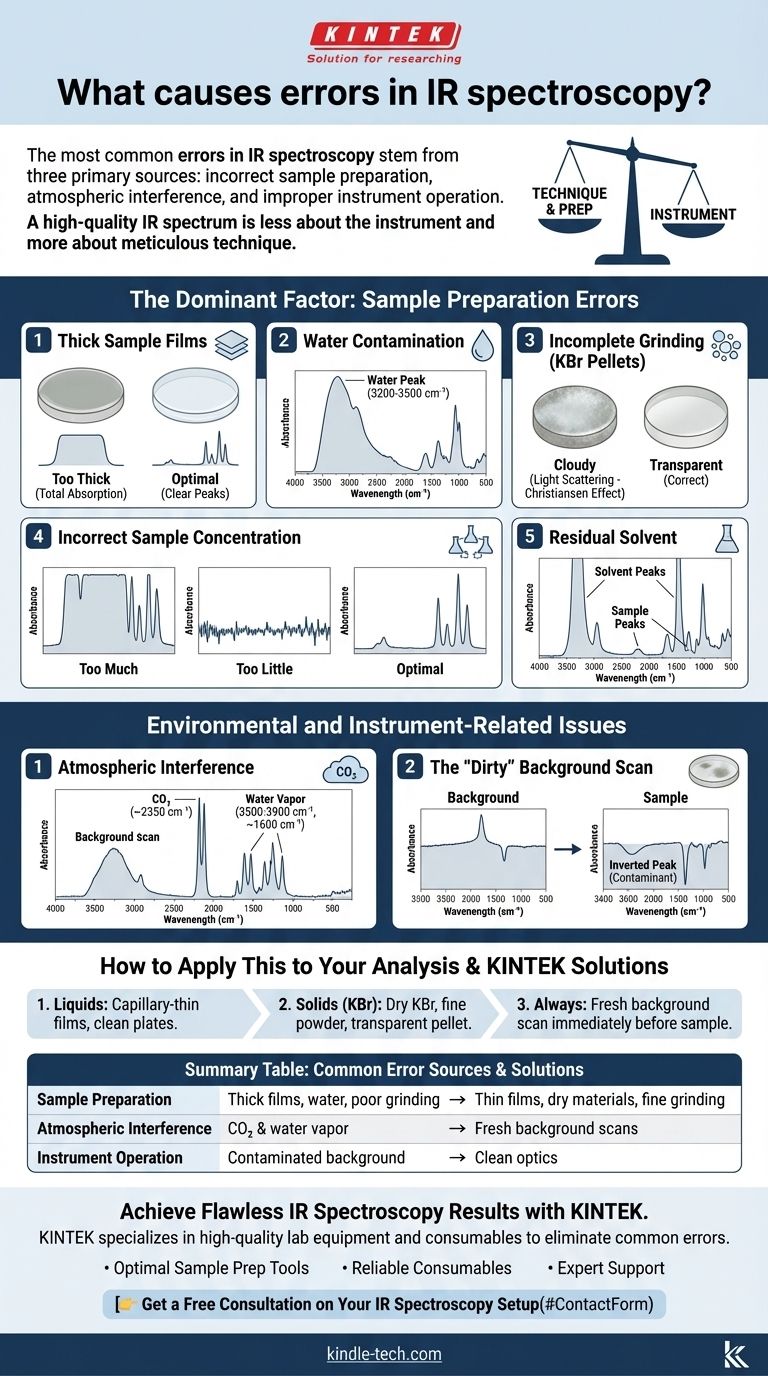
A sample that is too thick will cause total absorption of the IR beam at certain frequencies. This results in broad, flat-topped peaks that hit 0% transmittance, making it impossible to determine the true peak shape or position.

Water Contamination

Water is a very strong IR absorber and a common contaminant. It can be present in your sample, in solvents, or absorbed by hygroscopic materials like KBr.

This contamination appears as a very broad, prominent peak around 3200-3500 cm⁻¹, which can easily obscure the actual O-H or N-H stretching signals from your sample. Always use dry solvents and materials.

Incomplete Grinding (KBr Pellets)

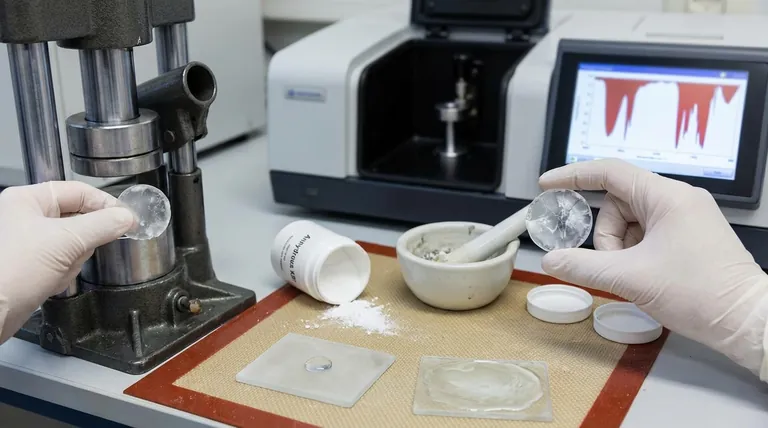
When preparing a solid sample in a potassium bromide (KBr) pellet, the sample must be ground to a fine, uniform powder.

If particles are too large, they will scatter the IR light instead of absorbing it. This phenomenon, known as the Christiansen effect, causes a distorted, sloping baseline and can make subtle peaks impossible to identify.

Incorrect Sample Concentration

Too much sample leads to the saturated, flat-topped peaks mentioned earlier.

Conversely, too little sample will produce a spectrum with very weak signals and a low signal-to-noise ratio. The resulting peaks may be difficult to distinguish from the baseline noise.

Residual Solvent

If a solid sample was dissolved in a solvent and not dried completely, the solvent will appear in the spectrum.

Strong solvent peaks (e.g., from acetone or ethanol) can easily overwhelm the peaks from your actual sample, leading to incorrect interpretations.

Environmental and Instrument-Related Issues

Even with a perfectly prepared sample, your results can be compromised by the environment in the lab or simple operational missteps.

Atmospheric Interference

The air in the sample compartment contains both carbon dioxide (CO₂) and water vapor, which absorb IR radiation.

CO₂ appears as a characteristic sharp, strong doublet peak around 2350 cm⁻¹. Water vapor appears as a series of many sharp, weak rotational lines, primarily from 3500-3900 cm⁻¹ and around 1600 cm⁻¹.

The "Dirty" Background Scan

An IR spectrometer works by comparing a sample scan to a background scan (of the empty instrument).

If your background scan was run when contaminants (like a solvent residue) were on the salt plates or ATR crystal, those contaminants will appear as inverted or negative peaks in your final sample spectrum. This is a definitive sign of a bad background.

How to Apply This to Your Analysis

Mastering IR spectroscopy is about developing a systematic and clean workflow. The instrument is precise, but it will precisely measure any errors you introduce.

  • If your primary focus is analyzing liquids: Ensure your sample forms an almost invisible, capillary-thin film between clean salt plates; too much sample is the most common failure point.
  • If your primary focus is analyzing solids with KBr: Use dry KBr, grind the sample and KBr together until they are a flour-like powder, and ensure your pellet is transparent, not cloudy.
  • For any analysis: Always run a fresh background scan immediately before your sample to accurately subtract atmospheric CO₂ and water vapor.

By treating sample preparation with the same care as the spectral interpretation, you will consistently produce clean, reliable, and accurate results.

Summary Table:

Common Error Source Key Issue How to Avoid
Sample Preparation Thick films, water contamination, poor grinding Use thin films, dry materials, fine grinding
Atmospheric Interference CO₂ (~2350 cm⁻¹) and water vapor peaks Run fresh background scans
Instrument Operation Contaminated background scan Clean optics before background measurement

Achieve Flawless IR Spectroscopy Results with KINTEK

Struggling with inconsistent IR spectra? The problem is often technique, not your instrument. KINTEK specializes in providing the high-quality lab equipment and consumables you need to eliminate common errors.

We supply:

  • Optimal Sample Prep Tools: Precision KBr presses, durable salt plates, and grinding equipment for perfect pellets and films.
  • Reliable Consumables: Anhydrous KBr, dry solvents, and cleaning materials to prevent contamination.
  • Expert Support: Guidance on best practices for sample handling and instrument operation.

Stop guessing and start producing publication-quality data. Contact our experts today to discuss your specific lab needs and let us help you optimize your IR workflow.

👉 Get a Free Consultation on Your IR Spectroscopy Setup

Visual Guide
What causes errors in IR spectroscopy? Master Sample Prep to Avoid Common Mistakes Visual Guide

Related Products

People Also Ask

Related Products

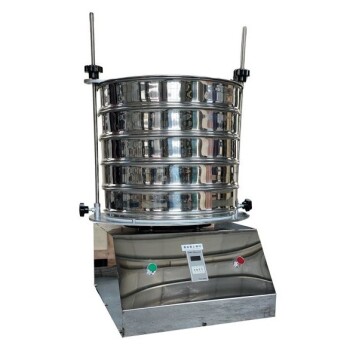
Laboratory Test Sieves and Sieving Machines

Laboratory Test Sieves and Sieving Machines

Precision lab test sieves & sieving machines for accurate particle analysis. Stainless steel, ISO-compliant, 20μm-125mm range. Request specs now!

HFCVD Machine System Equipment for Drawing Die Nano-Diamond Coating

HFCVD Machine System Equipment for Drawing Die Nano-Diamond Coating

The nano-diamond composite coating drawing die uses cemented carbide (WC-Co) as the substrate, and uses the chemical vapor phase method ( CVD method for short ) to coat the conventional diamond and nano-diamond composite coating on the surface of the inner hole of the mold.

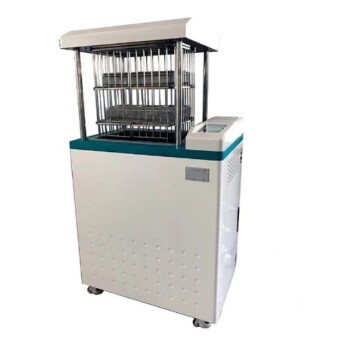
Laboratory Sterilizer Lab Autoclave Vertical Pressure Steam Sterilizer for Liquid Crystal Display Automatic Type

Laboratory Sterilizer Lab Autoclave Vertical Pressure Steam Sterilizer for Liquid Crystal Display Automatic Type

Liquid crystal display automatic vertical sterilizer is a safe, reliable and automatic control sterilization equipment, which is composed of heating system, microcomputer control system and overheating and overvoltage protection system.

Infrared Thermal Imaging Temperature Measurement Double-Sided Coated Germanium Ge Lens

Infrared Thermal Imaging Temperature Measurement Double-Sided Coated Germanium Ge Lens

Germanium lenses are durable, corrosion-resistant optical lenses suited for harsh environments and applications exposed to the elements.

Laboratory Sterilizer Lab Autoclave Pulse Vacuum Lifting Sterilizer

Laboratory Sterilizer Lab Autoclave Pulse Vacuum Lifting Sterilizer

The pulse vacuum lifting sterilizer is a state-of-the-art equipment for efficient and precise sterilization. It uses pulsating vacuum technology, customizable cycles, and a user-friendly design for easy operation and safety.

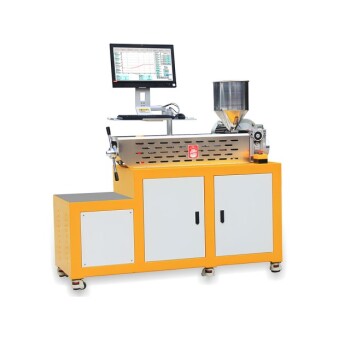
Filter Testing Machine FPV for Dispersion Properties of Polymers and Pigments

Filter Testing Machine FPV for Dispersion Properties of Polymers and Pigments

The filter testing machine (FPV) is suitable for testing the dispersion properties of polymers such as pigments, additives and masterbatches by extrusion and filtration.

915MHz MPCVD Diamond Machine Microwave Plasma Chemical Vapor Deposition System Reactor

915MHz MPCVD Diamond Machine Microwave Plasma Chemical Vapor Deposition System Reactor

915MHz MPCVD Diamond Machine and its multi-crystal effective growth, the maximum area can reach 8 inches, the maximum effective growth area of single crystal can reach 5 inches. This equipment is mainly used for the production of large-size polycrystalline diamond films, the growth of long single crystal diamonds, the low-temperature growth of high-quality graphene, and other materials that require energy provided by microwave plasma for growth.

CVD Diamond Cutting Tool Blanks for Precision Machining

CVD Diamond Cutting Tool Blanks for Precision Machining

CVD Diamond Cutting Tools: Superior Wear Resistance, Low Friction, High Thermal Conductivity for Non-Ferrous Materials, Ceramics, Composites Machining

Anti-Cracking Press Mold for Lab Use

Anti-Cracking Press Mold for Lab Use

The anti-cracking press mold is a specialized equipment designed for molding various shapes and sizes of film using high pressure and electric heating.

Benchtop Laboratory Vacuum Freeze Dryer

Benchtop Laboratory Vacuum Freeze Dryer

Benchtop laboratory freeze dryer for efficient lyophilization of biological, pharmaceutical, and food samples. Features intuitive touchscreen, high-performance refrigeration, and durable design. Preserve sample integrity—consult now!

Benchtop Laboratory Freeze Dryer for Lab Use

Benchtop Laboratory Freeze Dryer for Lab Use

Premium benchtop laboratory freeze dryer for lyophilization, preserving samples with ≤ -60°C cooling. Ideal for pharmaceuticals & research.

Laboratory Vibratory Sieve Shaker Machine Slap Vibrating Sieve

Laboratory Vibratory Sieve Shaker Machine Slap Vibrating Sieve

KT-T200TAP is a slapping and oscillating sieving instrument for laboratory desktop use, with 300 rpm horizontal circular motion and 300 vertical slapping motions to simulate manual sieving to help sample particles pass through better.

High Energy Planetary Ball Mill Milling Machine for Laboratory

High Energy Planetary Ball Mill Milling Machine for Laboratory

The biggest feature is that the high energy planetary ball mill can not only perform fast and effective grinding, but also has good crushing ability

High-Energy Omnidirectional Planetary Ball Mill Milling Machine for Laboratory

High-Energy Omnidirectional Planetary Ball Mill Milling Machine for Laboratory

The KT-P4000E is a new product derived from the vertical high-energy planetary ball mill with a 360° swivel function. Experience faster, uniform, and smaller sample output results with 4 ≤1000ml ball mill jars.

High-Energy Omnidirectional Planetary Ball Mill Machine for Laboratory

High-Energy Omnidirectional Planetary Ball Mill Machine for Laboratory

The KT-P2000E is a new product derived from the vertical high-energy planetary ball mill with a 360°rotation function. The product not only has the characteristics of the vertical high-energy ball mill, but also has a unique 360°rotation function for the planetary body.

High Energy Planetary Ball Mill Milling Machine for Laboratory

High Energy Planetary Ball Mill Milling Machine for Laboratory

Experience fast and effective sample processing with the F-P2000 high-energy planetary ball mill. This versatile equipment offers precise control and excellent grinding capabilities. Perfect for laboratories, it features multiple grinding bowls for simultaneous testing and high output. Achieve optimal results with its ergonomic design, compact structure, and advanced features. Ideal for a wide range of materials, it ensures consistent particle size reduction and low maintenance.

Button Battery Case for Battery Lab Applications

Button Battery Case for Battery Lab Applications

Button batteries are also known as micro batteries. It looks like a small button-shaped battery. Usually larger in diameter and thinner in thickness.

Precision Machined Zirconia Ceramic Ball for Engineering Advanced Fine Ceramics

Precision Machined Zirconia Ceramic Ball for Engineering Advanced Fine Ceramics

zirconia ceramic ball have the characteristics of high strength, high hardness, PPM wear level, high fracture toughness, good wear resistance, and high specific gravity.

Precision Machined Yttrium Stabilized Zirconia Ceramic Rod for Engineering Advanced Fine Ceramics

Precision Machined Yttrium Stabilized Zirconia Ceramic Rod for Engineering Advanced Fine Ceramics

Zirconia ceramic rods are prepared by isostatic pressing, and a uniform, dense and smooth ceramic layer and transition layer are formed at high temperature and high speed.

High Energy Vibratory Laboratory Ball Mill Grinding Mill Single Tank Type

High Energy Vibratory Laboratory Ball Mill Grinding Mill Single Tank Type

High-energy vibration ball mill is a small desktop laboratory grinding instrument.It can be ball-milled or mixed with different particle sizes and materials by dry and wet methods.


Leave Your Message