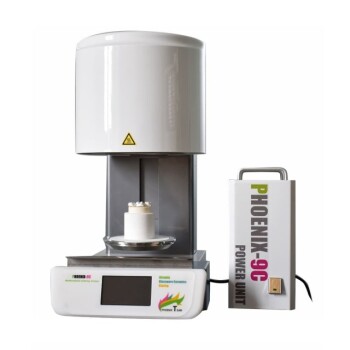
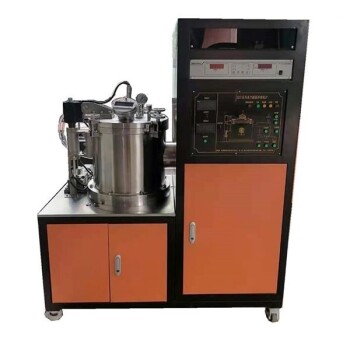
A vacuum sintering furnace establishes a specialized processing environment characterized by a high-vacuum atmosphere, precise temperature cycling, and controlled external pressure. These conditions are specifically engineered to facilitate solid-state diffusion bonding, allowing titanium alloy sheets to merge at the atomic level while preventing the oxidation and embrittlement that typically degrade reactive metals at high temperatures.
Titanium alloys are highly reactive to oxygen at the elevated temperatures required for bonding, which can lead to brittle failure. The core value of a vacuum sintering furnace is its ability to create an oxygen-free zone where heat and pressure drive atomic migration, resulting in a single, isotropic component with void-free interfaces.
The Critical Role of the Vacuum Atmosphere
Preventing Oxidation and Embrittlement
The primary condition provided by the furnace is a high-vacuum environment. Titanium has a strong affinity for oxygen; without this protective vacuum, high processing temperatures would cause rapid oxidation.
This oxidation leads to surface embrittlement, which compromises the mechanical integrity of the final laminate. The vacuum ensures the material remains pure and ductile throughout the cycle.
Surface Activation and Oxide Removal
Beyond mere protection, the vacuum environment actively aids in inhibiting or removing existing oxide layers on the titanium sheets.
For diffusion bonding to occur, raw metal must touch raw metal. By eliminating oxide barriers, the furnace prepares the surface for unobstructed atomic interaction.
Mechanisms of Atomic Bonding
Facilitating Atomic Migration
The furnace provides the precise thermal energy needed to mobilize atoms.
Under these conditions, atoms migrate across the interfacial boundaries of the stacked sheets. This movement is the essence of diffusion bonding, creating a bridge between layers that is not just a "glue" but a continuation of the material itself.
Application of External Pressure
Heat alone is often insufficient for perfect bonding. The furnace applies external pressure, often utilizing inert gas (such as argon) and flexible membrane systems.
This pressure forces the surface asperities (microscopic peaks and valleys) of the titanium sheets into intimate contact. This proximity is required for atoms to diffuse effectively from one sheet to another.
Precise Temperature Cycle Control
The process relies on exact temperature regulation. The furnace maintains specific thermal cycles that are hot enough to induce diffusion but controlled enough to preserve the original microstructure of the titanium alloy.
Achieving Isotropic Material Integrity
Elimination of Interfacial Pores
The combination of vacuum, heat, and pressure serves to eliminate voids and pores at the interface.
As atoms diffuse and pressure compresses the stack, the distinct boundary lines between layers disappear. The result is an interface that is virtually indistinguishable from the bulk material.
Creating Isotropic Properties
The ultimate condition provided is a uniform microstructure.
Because the interface creates a solid-state bond without melting, the resulting laminate exhibits isotropic mechanical properties. This means the material demonstrates consistent strength and toughness in all directions, rather than having weak points along the bond lines.
Understanding the Challenges
The Necessity of Absolute Process Control
The primary trade-off in this process is the zero tolerance for parameter deviation.
Because the process relies on solid-state diffusion rather than melting, if the pressure is uneven or the vacuum is compromised even slightly, interfacial pores will remain. This results in weak bonds that are invisible to the naked eye but catastrophic under load.
Complexity of Pressure Application
Applying uniform pressure in a vacuum is technically demanding. Systems often rely on flexible diaphragms and pressurized argon to ensure force is distributed evenly across complex geometries.
Failure in the diaphragm or pressure control system leads to "non-bonded" zones, creating hidden structural flaws within the laminate stack.
Making the Right Choice for Your Goal
To maximize the performance of titanium laminates, align your processing parameters with your specific mechanical requirements:
- If your primary focus is Impact Toughness: Prioritize pressure uniformity and pore elimination to ensure the interface is physically indistinguishable from the base layers.
- If your primary focus is Material Ductility: Focus on the integrity of the high-vacuum seal to prevent even trace oxidation that causes embrittlement.
By rigorously controlling the vacuum and pressure environment, you transform a stack of individual sheets into a unified, high-performance structural material.
Summary Table:
| Process Condition | Role in Diffusion Bonding | Benefit to Titanium Laminates |
|---|---|---|
| High-Vacuum Atmosphere | Prevents oxidation and surface embrittlement | Maintains material purity and ductility |
| Precise Temperature Cycling | Provides thermal energy for atomic migration | Ensures solid-state bonding without melting |
| External Pressure (Argon/Gas) | Collapses surface asperities and voids | Eliminates interfacial pores for full density |
| Isotropic Microstructure | Merges layers at the atomic level | Provides uniform strength in all directions |
Elevate Your Material Integrity with KINTEK
Precise control over vacuum and pressure is non-negotiable for high-performance titanium diffusion bonding. KINTEK specializes in advanced laboratory equipment designed for the most demanding thermal processes. Our comprehensive range of high-temperature vacuum furnaces, high-pressure reactors, and crushing and milling systems provides the exact environment needed to eliminate interfacial voids and prevent oxidation.
Whether you are developing complex multilayer laminates or conducting cutting-edge battery research, KINTEK offers the technical expertise and high-quality consumables—from PTFE products to ceramic crucibles—to ensure your results are isotropic and defect-free.
Ready to optimize your bonding process? Contact our specialists today to find the perfect furnace solution for your laboratory.
References
- Magdalena Podolak, Anna Bielawska. Anticancer properties of novel Thiazolidinone derivatives tested in MDA-MB-231 breast cancer cell lines.. DOI: 10.21175/rad.abstr.book.2023.10.3
This article is also based on technical information from Kintek Solution Knowledge Base .
Related Products
- Vacuum Heat Treat and Molybdenum Wire Sintering Furnace for Vacuum Sintering
- Vacuum Heat Treat and Pressure Sintering Furnace for High Temperature Applications
- Vacuum Heat Treat and Sintering Furnace with 9MPa Air Pressure
- 2200 ℃ Tungsten Vacuum Heat Treat and Sintering Furnace
- Small Vacuum Heat Treat and Tungsten Wire Sintering Furnace
People Also Ask
- What is the pressure for vacuum sintering? Achieve Optimal Material Purity and Density
- What are the critical functions of the vacuum system in a sintering furnace for Cu/Ti3SiC2/C/MWCNTs composites?
- What critical process conditions does a vacuum sintering furnace provide for titanium? Expert Diffusion Bonding Guide
- What is vacuum hardness? Unlock Superior Material Performance with Vacuum Processing
- How does a vacuum environment benefit the purification of matrix powders? Optimize Diamond Tool Sintering Efficiency