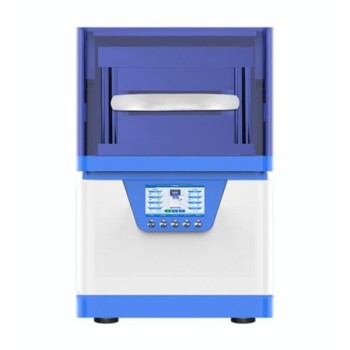
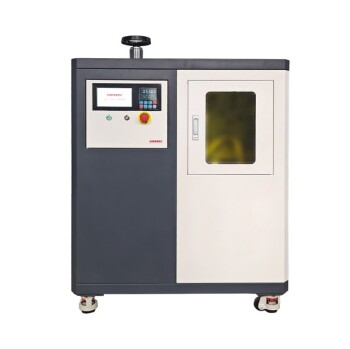
A heated hydraulic press acts as the primary catalyst for densification during the cold sintering of LLTO (Lithium Lanthanum Titanate) composite solid electrolytes. By simultaneously applying high uniaxial pressure (up to 600 MPa) and a constant, moderate temperature (typically around 125°C), the machine creates the specific thermo-mechanical environment required to trigger transient solvent-assisted particle rearrangement and dissolution-precipitation.
The core value of this equipment is its ability to substitute extreme thermal energy with mechanical force. It drives the densification of ceramic composites at temperatures drastically lower than traditional sintering, thereby preserving the material's chemical stability.
The Mechanics of Cold Sintering
The heated hydraulic press does not simply compress powder; it orchestrates a complex physical and chemical transformation.
Facilitating Particle Rearrangement
The initial function of the press is to apply massive uniaxial force. This mechanical pressure physically forces the LLTO particles into a compact arrangement, reducing the distance between them.
Crucially, this occurs in the presence of a transient liquid phase (a solvent). The pressure helps distribute this solvent, allowing it to lubricate the particles so they can slide into a tighter packing configuration efficiently.
Driving Dissolution-Precipitation
Once the particles are packed, the synergy of heat and pressure activates the dissolution-precipitation mechanism.
The pressure at the contact points between particles increases the chemical potential, causing the particle surfaces to dissolve into the transient liquid phase. As the process continues, the dissolved material precipitates into the pores, effectively "gluing" the particles together to form a dense solid.
Enabling Low-Temperature Densification
Traditional ceramic sintering requires temperatures exceeding 1000°C. The heated hydraulic press achieves similar density levels at roughly 125°C to 150°C.
By maintaining this precise thermal field, the press facilitates the necessary chemical reactions without subjecting the LLTO components to temperatures that could cause volatility or degradation.
Critical Equipment Requirements
To execute this process successfully, the hardware must meet specific engineering standards.
High-Pressure Capabilities
The press must be capable of exerting extreme force, often between 370 MPa and 600 MPa. Lower pressures may fail to trigger the creep mechanisms required to close residual porosity.
Thermal Precision
The equipment must maintain a stable temperature field (e.g., 125°C) across the platens. This ensures that the transient liquid phase (such as DMF) reacts predictably—facilitating diffusion without evaporating too quickly before densification is complete.
Rigidity and Containment
The press operates in conjunction with a high-strength steel mold. This mold is essential to restrict the lateral movement of the powder, ensuring that the vertical force translates entirely into densification rather than deformation.
Understanding the Trade-offs
While effective, the use of a heated hydraulic press for cold sintering introduces specific challenges that must be managed.
The Constraint of Geometries
Because the pressure is uniaxial (applied from one direction), the resulting components are generally limited to simple shapes, such as pellets or flat discs. Complex 3D geometries are difficult to achieve with uniform density using this method.
Mold Stress and Fatigue
The requirement for pressures up to 600 MPa places immense stress on the die and mold assembly. If the mold material is not sufficiently robust, it may deform, leading to geometric inaccuracies or safety hazards during the pressing cycle.
Making the Right Choice for Your Goal
When selecting parameters or equipment for cold sintering LLTO, align your approach with your specific technical objectives.
- If your primary focus is Maximum Density: Prioritize a press capable of sustaining the upper limits of pressure (600 MPa) to maximize the contact points for dissolution-precipitation.
- If your primary focus is Material Stability: Ensure your press features precise thermal controls to maintain the lowest effective temperature (e.g., 125°C), preventing secondary phase formation or solvent loss.
- If your primary focus is Interfacial Bonding: Utilize the press for a stepwise process, pre-pressing layers individually before co-pressing to ensure tight physical contact between electrolyte layers.
The heated hydraulic press transforms sintering from a thermal challenge into a controlled thermo-mechanical operation, enabling high-performance ceramics at a fraction of the energy cost.
Summary Table:
| Feature | Role in Cold Sintering of LLTO |
|---|---|
| Pressure (370-600 MPa) | Triggers particle rearrangement and dissolution-precipitation mechanisms. |
| Temperature (~125°C) | Activates the transient liquid phase without causing material degradation. |
| Core Mechanism | Substitutes extreme thermal energy (1000°C+) with mechanical force. |
| Key Outcome | Achieves high-density ceramic composites while preserving chemical stability. |
| Equipment Used | High-pressure hydraulic press with heated platens and high-strength steel molds. |
Elevate Your Battery Research with KINTEK Precision
Unlock the full potential of your solid-state electrolyte research with KINTEK’s advanced laboratory solutions. Whether you are performing cold sintering or complex material synthesis, our comprehensive range of equipment is engineered for precision and durability:
- High-Pressure Hydraulic Presses: Available in manual, electric, and heated configurations (pellet, hot, and isostatic) to achieve the extreme pressures required for LLTO densification.
- Thermal Processing: Explore our muffle, vacuum, and CVD furnaces for high-temperature stability.
- Milling & Grinding: Achieve perfect particle size distribution with our high-efficiency crushing and milling systems.
- Specialized Labware: High-quality ceramics, crucibles, and PTFE consumables designed to withstand rigorous chemical environments.
Ready to optimize your densification process? Contact our technical experts today to find the perfect heated hydraulic press or laboratory system tailored to your specific research goals.
Related Products
- Automatic High Temperature Heated Hydraulic Press Machine with Heated Plates for Lab
- Heated Hydraulic Press Machine with Integrated Manual Heated Plates for Lab Use
- 24T 30T 60T Heated Hydraulic Press Machine with Heated Plates for Laboratory Hot Press
- Manual High Temperature Heated Hydraulic Press Machine with Heated Plates for Lab
- Automatic Heated Hydraulic Press Machine with Heated Plates for Laboratory Hot Press
People Also Ask
- What is a heated hydraulic press used for? Essential Tool for Curing, Molding, and Laminating
- Why is a heated hydraulic press used for warm pressing NASICON green tapes? Optimize Your Solid Electrolyte Density
- Why is a heated laboratory hydraulic press necessary for composite laminates? Achieve Void-Free Structural Integrity
- What is a hot hydraulic press? Harness Heat and Pressure for Advanced Manufacturing
- What technical conditions does a heated hydraulic press provide for PEO batteries? Optimize Solid-State Interfaces