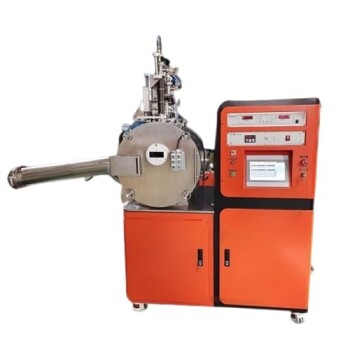
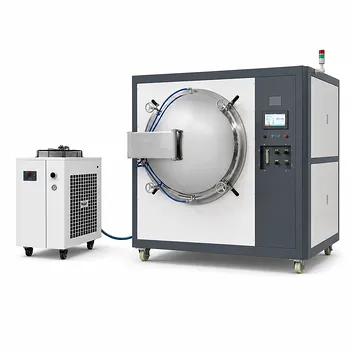
The vacuum induction melting furnace serves as the primary reaction vessel by establishing a specialized environment that combines high temperatures (around 700°C) with a high vacuum. This unique combination forces elemental magnesium within the slag to gasify and evaporate at temperatures significantly below its atmospheric boiling point, effectively separating it from solid impurities.
Core Takeaway: By manipulating pressure and temperature simultaneously, this furnace creates the thermodynamic conditions necessary to volatilize magnesium from solid slag, allowing for high-purity recovery via condensation while leaving impurities behind.
Creating the Necessary Thermodynamic Conditions
Lowering the Boiling Point
The furnace’s primary function is to alter the physical properties of the magnesium within the slag. By maintaining a high vacuum level within the sealed chamber, the boiling point of magnesium is drastically reduced.
Efficient Gasification
At atmospheric pressure, extracting magnesium would require excessive heat. However, inside the furnace, the element gasifies and evaporates at approximately 700°C. This allows for separation without melting the entire slag mass, which saves energy and improves separation efficiency.
Precision Heating via Induction
Medium Frequency Induction Principles
The furnace utilizes medium frequency induction heating to generate heat directly within the material. An induction coil surrounds a refractory-lined crucible, creating a magnetic field that rapidly heats the contents.
Uniformity through Electromagnetic Stirring
A distinct advantage of this furnace type is electromagnetic stirring. This natural byproduct of induction heating promotes a uniform temperature and chemical composition throughout the molten pool. It also assists in merging inclusions and helping them rise to the surface for easier removal.
From Evaporation to Recovery
Separation of Impurities
The vacuum environment does more than just lower boiling points; it actively prevents chemical reactions between the metal and non-metallic inclusions. This process facilitates the removal of dissolved gases (like oxygen and nitrogen) and metallic impurities with high vapor pressures, ensuring a purer end product.
Condensation and Crystallization
Once the magnesium has been successfully gasified by the furnace, the vapor migrates to a designated low-temperature zone. Here, condensation devices provide a specific degree of subcooling. This causes the magnesium vapor to rapidly undergo nucleation and crystallization, transforming it directly into solid metallic magnesium for collection.
Understanding the Operational Trade-offs
Complexity of Vacuum Systems
While the vacuum environment is essential for purity, it introduces significant complexity. The system requires air-tight integrity and high-performance pumps to maintain the necessary pressure levels, increasing the maintenance burden compared to atmospheric furnaces.
Material Restrictions
While versatile, the crucible and lining materials must be carefully selected to withstand both the thermal shock and the chemical reactivity of the slag. The induction coil itself requires a specialized manufacturing process to ensure it resists deformation over a long operational life.
Making the Right Choice for Your Goal
The vacuum induction melting furnace is a sophisticated tool that balances energy efficiency with high-purity output. To maximize its utility, consider your specific processing objectives:
- If your primary focus is High Purity: Prioritize the vacuum capabilities to ensure maximum degassing and the removal of volatile metallic impurities like zinc and lead.
- If your primary focus is Process Efficiency: Leverage the electromagnetic stirring inherent in the induction process to ensure uniform heating and faster reaction rates within the slag.
- If your primary focus is Environmental Compliance: Utilize the furnace's sealed nature to eliminate combustion products and prevent the release of harmful fumes into the facility.
By leveraging the dual powers of induction heating and vacuum pressure, you transform waste slag into a valuable resource with precision and efficiency.
Summary Table:
| Feature | Role in Magnesium Recovery | Benefit |
|---|---|---|
| High Vacuum Environment | Lowers the boiling point of magnesium | Enables gasification at lower temperatures (700°C) |
| Induction Heating | Provides precise, direct heating to the material | Increases energy efficiency and process control |
| Electromagnetic Stirring | Ensures uniform temperature and composition | Promotes inclusion removal and faster reaction rates |
| Selective Volatilization | Separates magnesium vapor from solid slag | Produces high-purity metal while removing dissolved gases |
| Direct Condensation | Facilitates nucleation and crystallization | Transforms vapor into high-quality solid metallic magnesium |
Transform your waste slag into high-purity resources with KINTEK’s advanced thermal technology. KINTEK specializes in laboratory equipment and consumables, offering a comprehensive range of high-temperature furnaces—including specialized vacuum and induction systems—alongside high-pressure reactors, crushing systems, and precision cooling solutions. Whether you are optimizing magnesium recovery or advancing battery research, our expert-engineered solutions ensure superior temperature uniformity and vacuum integrity. Contact KINTEK today to discover how our tailored laboratory equipment can enhance your process efficiency and material purity.
Related Products
- Lab-Scale Vacuum Induction Melting Furnace
- Vacuum Induction Melting Spinning System Arc Melting Furnace
- Vacuum Heat Treat Furnace and Levitation Induction Melting Furnace
- Vacuum Arc Induction Melting Furnace
- Non Consumable Vacuum Arc Induction Melting Furnace
People Also Ask
- How do vacuum induction or arc melting furnaces facilitate the synthesis of U-Al-C MAX phases? Precision Heat & Purity
- What is the primary function of a vacuum induction melting furnace in Ni-Mo-Cr-Fe master alloy prep? Ensure High Purity
- What types of metals are typically processed in a vacuum induction melting furnace? High-Purity Alloys for Critical Applications
- Why use VIM for rare earth steel? Essential Precision for Melting Reactive Lanthanum and Cerium
- What are the advantages of a vacuum induction melting furnace? Achieve High-Purity Alloys with Precision VIM