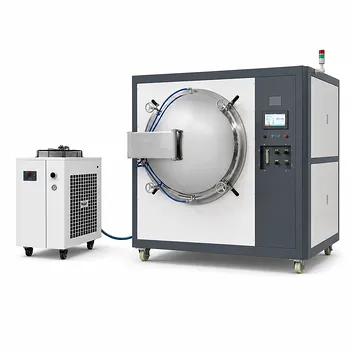
A vacuum hot pressing furnace provides the essential processing environment by applying high temperatures and axial mechanical pressure simultaneously. This dual-action approach is far more effective than thermal treatment alone, promoting the plastic flow of ceramic powders to create a solid, nearly pore-free structure.
By integrating heat and physical force in a single step, this process allows LLZTO pellets to reach a relative density exceeding 99%, effectively stabilizing the cubic phase structure required for maximum battery performance.
The Core Mechanism: Simultaneous Stress and Heat
Driving Plastic Flow
The defining feature of a vacuum hot pressing furnace is its ability to apply axial mechanical pressure while the material is heated.
Unlike standard furnaces that rely solely on thermal energy to fuse particles, hot pressing forces the ceramic powders to undergo plastic flow.
This mechanical force physically pushes particles together, closing voids that heat alone might fail to eliminate.
Achieving Near-Perfect Densification
Standard sintering methods often struggle to remove the final percentage of porosity, typically capping out at lower densities (e.g., around 93%).
The vacuum hot pressing environment overcomes this barrier, enabling LLZTO electrolytes to achieve a relative density of over 99%.
This high density is critical for creating a robust physical barrier against lithium dendrite growth in solid-state batteries.
Critical Material Outcomes
Stabilizing the Cubic Phase
For LLZTO to function effectively as an electrolyte, it must maintain a specific crystal arrangement known as the cubic phase.
The process conditions provided by the vacuum hot pressing furnace actively stabilize this structure.
Maintaining the cubic phase is the primary chemical requirement for ensuring the material allows lithium ions to move freely.
Maximizing Ionic Conductivity
Density and phase purity directly dictate how well the electrolyte conducts electricity.
Because the hot pressing process eliminates pores and stabilizes the crystal structure, the resulting pellets achieve exceptional ionic conductivity.
Specifically, this method yields an ionic conductivity of 1.1 x 10⁻³ S/cm at room temperature, significantly outperforming materials processed via standard pressureless sintering (often around 8 x 10⁻⁴ S/cm).
Understanding the Trade-offs
Process Complexity vs. Material Quality
While standard high-temperature sintering creates adequate continuous ion transport channels, it often requires complex workarounds to manage quality.
For example, standard sintering frequently results in Lithium volatilization, requiring the use of "mother powder" to prevent the material from degrading.
Vacuum hot pressing is generally a more intensive and equipment-heavy process, but it produces a superior, denser end-product in a single consolidation step.
Limitations of Cold Compaction
Using a laboratory hydraulic press (cold pressing) followed by sintering is a common alternative.
However, cold pressing relies on high pressure (up to 300 MPa) merely to pack particles tightly before heating.
This sequential approach minimizes inter-particle porosity but lacks the simultaneous heat-driven plastic flow of hot pressing, resulting in lower final densities.
Making the Right Choice for Your Goal
If you are deciding between vacuum hot pressing and conventional sintering methods, consider the following specific needs:
- If your primary focus is Maximum Conductivity: Choose vacuum hot pressing to achieve >99% density and conductivity of 1.1 x 10⁻³ S/cm by leveraging simultaneous heat and pressure.
- If your primary focus is Equipment Simplicity: Choose conventional high-temperature sintering (approx. 1150°C) with a hydraulic press, but ensure you control for lithium loss using a mother powder cover.
Select the process that aligns with your specific tolerance for porosity and your requirement for ionic speed.
Summary Table:
| Feature | Vacuum Hot Pressing | Conventional Sintering |
|---|---|---|
| Mechanism | Simultaneous Heat & Pressure | Thermal Treatment Only |
| Relative Density | > 99% | ~ 93% |
| Ionic Conductivity | 1.1 x 10⁻³ S/cm | ~ 8.0 x 10⁻⁴ S/cm |
| Phase Stability | Stabilized Cubic Phase | Risk of Lithium Volatilization |
| Primary Benefit | Near-Zero Porosity | Equipment Simplicity |
Elevate your solid-state battery research with KINTEK’s advanced thermal solutions. As specialists in laboratory equipment, we provide high-performance vacuum hot pressing furnaces, hydraulic presses, and high-temperature furnaces designed to achieve near-theoretical density and maximum ionic conductivity in LLZTO and other ceramic electrolytes. Whether you need precise crushing and milling systems or specialized battery research tools, KINTEK offers the comprehensive expertise to optimize your material synthesis. Contact KINTEK today to find the perfect furnace for your lab!
Related Products
- Vacuum Hot Press Furnace Heated Vacuum Press Machine Tube Furnace
- 600T Vacuum Induction Hot Press Furnace for Heat Treat and Sintering
- Vacuum Hot Press Furnace Machine Heated Vacuum Press
- Vacuum Hot Press Furnace Machine for Lamination and Heating
- Vacuum Heat Treat and Pressure Sintering Furnace for High Temperature Applications
People Also Ask
- What advantages does a vacuum hot press furnace provide for LSLBO ceramic electrolytes? Achieve 94% Relative Density
- What role does a Vacuum Hot Press (VHP) furnace play in the densification of austenitic stainless steel 316 composites?
- What are the advantages of using a vacuum hot pressing furnace? Superior Densification for 2024Al/Gr/SiC Composites
- What are the advantages of a vacuum hot press furnace for LTPO solid electrolytes? Boost Density and Conductivity
- What core processing conditions does a vacuum hot press furnace provide? Achieve High-Density Cu-SiC/Diamond Composites