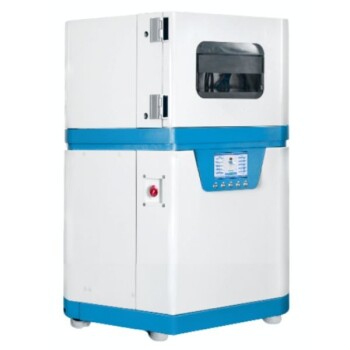
The vacuum environment acts as a critical purification agent. It actively removes adsorbed gases and volatile impurities from the surface of the powder particles before and during the sintering process. This purification is the fundamental mechanism that allows for superior bonding between the binder metal and the hard carbide particles.
Core Insight: The primary role of the vacuum is to create a chemically clean interface between particles. By stripping away surface contaminants, the vacuum ensures the liquid cobalt binder can fully "wet" the tungsten carbide, eliminating pore defects and directly enhancing the material's fracture toughness.
Optimizing Surface Chemistry for Bonding
Removal of Volatile Impurities
Raw powder materials naturally adsorb gases (such as oxygen or nitrogen) and collect volatile impurities on their surfaces.
In a vacuum hot press furnace, the low-pressure environment extracts these contaminants. Removing them is essential because trapped gases expand at high temperatures, which would otherwise create voids or "pores" within the final material.
Enhancing Liquid Phase Wettability
For cemented carbides to be strong, the binder metal (typically Cobalt) must spread evenly across the hard particles (Tungsten Carbide) when it melts.
The purification provided by the vacuum significantly enhances this wettability. Because the carbide surfaces are free of oxides and contaminants, the liquid Cobalt flows smoothly, coating the particles thoroughly rather than beading up or failing to adhere.
Prevention of Oxidation
At the high temperatures required for sintering (often exceeding 1300°C), metal powders are highly susceptible to rapid oxidation.
The vacuum environment effectively eliminates oxygen from the chamber. This prevents the formation of oxide layers on the particles, which would act as barriers to diffusion and severely degrade the mechanical properties of the final alloy.
Structural Integrity and Microstructure
Elimination of Pore Defects
The combination of gas removal and improved wettability results in a drastic reduction of structural defects.
By ensuring there are no gas pockets to trap and that the liquid phase fills all interstitial spaces, the vacuum environment drives the material toward full densification. This elimination of porosity is directly linked to improved fracture toughness.
Controlling Grain Growth
The vacuum environment works in synergy with the mechanical pressure applied by the hot press to allow for sintering at lower temperatures and faster rates.
Because the powder surfaces are clean and reactive, densification occurs rapidly—often within 10 to 15 minutes. This speed is critical because it prevents abnormal grain growth, preserving a fine microstructure that yields higher hardness and strength.
Synergistic Densification
While the mechanical pressure physically forces particles together to close gaps, the vacuum ensures those gaps are empty of resistance (gas).
This allows the applied pressure to effectively rearrange particles and force the liquid binder into even the smallest micro-pores. This synergy is what allows vacuum hot pressed carbides to achieve relative densities exceeding 98%.
Understanding the Trade-offs
Equipment Complexity
Achieving and maintaining a high vacuum (e.g., 5×10^-1 Pa) while simultaneously applying high mechanical pressure (up to 40 MPa) requires complex engineering.
The seals, pumps, and chamber integrity must be robust enough to handle thermal expansion and hydraulic force simultaneously. This increases the initial capital investment and maintenance requirements compared to standard pressureless sintering.
Batch Processing Limitations
Vacuum hot pressing is inherently a batch process.
Unlike continuous sintering furnaces, the chamber must be evacuated, heated, pressed, and cooled for each specific load. While the sintering time itself is short, the overall cycle time per unit can be higher, making it less suitable for mass production of simple, low-cost parts.
Making the Right Choice for Your Goal
The vacuum environment is not just a setting; it is a tool to manipulate the material's atomic interactions.
- If your primary focus is Fracture Toughness: Prioritize the vacuum level to ensure maximum removal of impurities, which guarantees the binder fully wets the carbide particles.
- If your primary focus is Hardness: Leverage the vacuum's ability to facilitate sintering at lower temperatures to inhibit grain growth, maintaining a fine, hard microstructure.
- If your primary focus is Part Density: Rely on the combination of vacuum (to remove gas resistance) and mechanical pressure to close all internal voids.
The vacuum environment transforms the sintering process from simple heating into a precision chemical purification, enabling the production of defect-free, high-performance cemented carbides.
Summary Table:
| Feature | Impact on Cemented Carbide Quality |
|---|---|
| Impurity Removal | Extracts adsorbed gases & volatiles to eliminate internal pores. |
| Wettability | Enables liquid Cobalt binder to fully coat carbide particles. |
| Oxidation Prevention | Eliminates oxygen to prevent brittle oxide layers at 1300°C+. |
| Grain Control | Facilitates faster densification to prevent abnormal grain growth. |
| Densification | Combines vacuum & pressure to reach >98% relative density. |
Elevate Your Material Performance with KINTEK
Precision sintering requires more than just heat; it requires a controlled chemical environment. KINTEK specializes in advanced laboratory solutions, offering industry-leading vacuum hot press furnaces, crushing and milling systems, and hydraulic presses designed to achieve full densification and superior fracture toughness in cemented carbides.
Whether you are conducting battery research, developing high-performance alloys, or refining ceramics, our comprehensive range of high-temperature furnaces and consumables provides the reliability your lab demands.
Ready to eliminate defects and optimize your microstructure? Contact KINTEK Today to Find Your Ideal Solution
Related Products
- Vacuum Hot Press Furnace Heated Vacuum Press Machine Tube Furnace
- 600T Vacuum Induction Hot Press Furnace for Heat Treat and Sintering
- Vacuum Hot Press Furnace Machine Heated Vacuum Press
- Vacuum Hot Press Furnace Machine for Lamination and Heating
- Vacuum Heat Treat and Pressure Sintering Furnace for High Temperature Applications
People Also Ask
- What advantages does a vacuum hot press furnace provide for LSLBO ceramic electrolytes? Achieve 94% Relative Density
- What role does a Vacuum Hot Press (VHP) furnace play in the densification of austenitic stainless steel 316 composites?
- What are the advantages of using a vacuum hot pressing furnace? Superior Densification for 2024Al/Gr/SiC Composites
- What are the advantages of a vacuum hot press furnace for LTPO solid electrolytes? Boost Density and Conductivity
- What core processing conditions does a vacuum hot press furnace provide? Achieve High-Density Cu-SiC/Diamond Composites