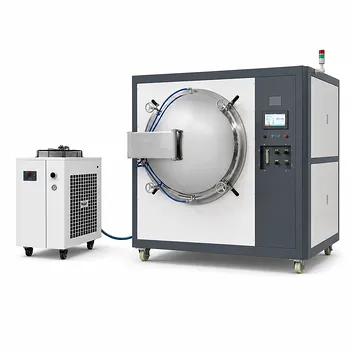
Knowledge What critical processing conditions are provided by a vacuum hot press sintering furnace? Achieve 98%+ Density.
Author avatar

Tech Team · Kintek Solution

Updated 4 days ago

What critical processing conditions are provided by a vacuum hot press sintering furnace? Achieve 98%+ Density.


The fabrication of Mo10/Cu-Al2O3 composites relies on a vacuum hot press sintering furnace to provide a critical "triple-action" environment. This equipment simultaneously delivers high temperature, high vacuum, and continuous mechanical pressure. These three conditions work in synergy to protect the metal matrix, trigger specific chemical reactions, and mechanically force the material into a dense, non-porous state.

Core Takeaway The vacuum hot press does more than just heat the material; it creates a selective environment. It protects the copper and molybdenum matrix from damage while simultaneously using heat to trigger a controlled internal oxidation reaction that creates the necessary Al2O3 reinforcement.

The Three Pillars of Processing

To understand why this furnace is essential for Mo10/Cu-Al2O3, you must understand the distinct role of each processing condition.

1. The Selective Vacuum Environment

The vacuum is the primary control mechanism for purity. Its main function is to prevent the oxidation of the matrix metals (Copper and Molybdenum) at the elevated temperatures required for sintering.

However, for this specific composite, the vacuum performs a dual role. While it shields the matrix from atmospheric oxygen, it allows the in-situ formation of the reinforcement phase. The environment is controlled such that the matrix remains pure, while the specific internal chemistry required to generate Al2O3 (aluminum oxide) proceeds without interference.

2. High Temperature as a Reaction Trigger

Heat in this process serves two distinct purposes. First, it softens the metal particles to allow for deformation.

Second, and more critically for this composite, the high thermal energy triggers an internal oxidation reaction. This reaction is responsible for generating the in-situ Al2O3 reinforcement phase. Without this specific thermal input, the composite would lack the necessary ceramic reinforcement that gives it strength and stability.

3. Axial Mechanical Pressure

Temperature and vacuum alone are often insufficient to remove all porosity. The furnace applies continuous axial pressure to force the material into a solid state.

This mechanical force drives plastic flow and particle rearrangement. It physically forces the powder particles to slide past one another and fill the voids (sintering pores) that diffusion alone cannot close. This results in exceptional relative densities, capable of reaching 98.23%.

Understanding the Trade-offs

When utilizing vacuum hot pressing, you are balancing thermodynamic protection against mechanical densification.

The "Internal Oxidation" Paradox

A common pitfall is assuming the vacuum is solely there to stop all oxidation. In the case of Mo10/Cu-Al2O3, the process is nuanced. You are preventing external oxidation of the copper matrix, but you must reach temperatures high enough to enable the internal oxidation that forms the Al2O3.

If the vacuum is compromised, the matrix degrades. If the temperature is too low to protect the matrix, the reinforcing Al2O3 phase may not form correctly.

Density vs. Particle Integrity

The application of pressure is critical for achieving high density (closing pores). However, the pressure must be synchronized with the temperature. Applying high pressure before the material has sufficiently softened (via heat) can lead to stress fracturing rather than plastic flow.

Making the Right Choice for Your Goal

How you tune these parameters depends on the specific deficiency you are trying to address in your composite material.

  • If your primary focus is Matrix Purity: Prioritize the integrity of the vacuum system to ensure no atmospheric oxygen compromises the Copper/Molybdenum conductivity.
  • If your primary focus is Mechanical Strength: Focus on the precise coupling of high heat and axial pressure to maximize plastic flow and achieve densities near 98.23%.
  • If your primary focus is Phase Formation: Ensure the temperature profile is aggressive enough to trigger the internal oxidation reaction for in-situ Al2O3 generation.

Success in fabricating Mo10/Cu-Al2O3 comes from using the vacuum to protect the host metal while using heat and pressure to force the internal structure to evolve and densify.

Summary Table:

Condition Primary Function for Mo10/Cu-Al2O3 Key Outcome
High Vacuum Prevents matrix oxidation; enables in-situ reactions Matrix purity & phase control
High Temperature Triggers internal oxidation of Al2O3 Structural reinforcement
Axial Pressure Drives plastic flow and particle rearrangement High density (up to 98.23%)
Synergy Triple-action environment Non-porous, high-strength composite

Elevate Your Material Research with KINTEK Precision

Unlock the full potential of your Mo10/Cu-Al2O3 composites and advanced materials with KINTEK’s high-performance vacuum hot press sintering furnaces. Our laboratory solutions are engineered to provide the precise triple-action environment—selective vacuum, high temperature, and synchronized axial pressure—required to achieve exceptional relative densities and controlled in-situ reinforcement.

From high-temperature furnaces (muffle, tube, rotary, and CVD) to advanced hydraulic presses and crushing systems, KINTEK specializes in the tools that drive scientific breakthroughs. Whether you are focused on matrix purity, mechanical strength, or complex phase formation, our team is ready to provide the expertise and equipment you need.

Ready to achieve 98.23% density in your next project?

Contact a KINTEK Specialist Today

Related Products

People Also Ask

Related Products

Vacuum Hot Press Furnace Machine Heated Vacuum Press

Vacuum Hot Press Furnace Machine Heated Vacuum Press

Discover the advantages of Vacuum Hot Press Furnace! Manufacture dense refractory metals & compounds, ceramics, and composites under high temp and pressure.

Vacuum Hot Press Furnace Heated Vacuum Press Machine Tube Furnace

Vacuum Hot Press Furnace Heated Vacuum Press Machine Tube Furnace

Reduce forming pressure & shorten sintering time with Vacuum Tube Hot Press Furnace for high-density, fine-grain materials. Ideal for refractory metals.

Vacuum Heat Treat and Sintering Furnace with 9MPa Air Pressure

Vacuum Heat Treat and Sintering Furnace with 9MPa Air Pressure

The air pressure sintering furnace is a high-tech equipment commonly used for the sintering of advanced ceramic materials. It combines vacuum sintering and pressure sintering techniques to achieve high-density and high-strength ceramics.

600T Vacuum Induction Hot Press Furnace for Heat Treat and Sintering

600T Vacuum Induction Hot Press Furnace for Heat Treat and Sintering

Discover the 600T Vacuum Induction Hot Press Furnace, designed for high-temperature sintering experiments in vacuum or protected atmospheres. Its precise temperature and pressure control, adjustable working pressure, and advanced safety features make it ideal for nonmetal materials, carbon composites, ceramics, and metal powders.

Vacuum Heat Treat and Molybdenum Wire Sintering Furnace for Vacuum Sintering

Vacuum Heat Treat and Molybdenum Wire Sintering Furnace for Vacuum Sintering

A vacuum molybdenum wire sintering furnace is a vertical or bedroom structure, which is suitable for withdrawal, brazing, sintering and degassing of metal materials under high vacuum and high temperature conditions. It is also suitable for dehydroxylation treatment of quartz materials.

Vacuum Heat Treat Furnace with Ceramic Fiber Liner

Vacuum Heat Treat Furnace with Ceramic Fiber Liner

Vacuum furnace with polycrystalline ceramic fiber insulation liner for excellent heat insulation and uniform temperature field. Choose from 1200℃ or 1700℃ max. working temperature with high vacuum performance and precise temperature control.

2200 ℃ Tungsten Vacuum Heat Treat and Sintering Furnace

2200 ℃ Tungsten Vacuum Heat Treat and Sintering Furnace

Experience the ultimate refractory metal furnace with our Tungsten vacuum furnace. Capable of reaching 2200℃, perfect for sintering advanced ceramics and refractory metals. Order now for high-quality results.

Vacuum Heat Treat Sintering Brazing Furnace

Vacuum Heat Treat Sintering Brazing Furnace

A vacuum brazing furnace is a type of industrial furnace used for brazing, a metalworking process that joins two pieces of metal using a filler metal that melts at a lower temperature than the base metals. Vacuum brazing furnaces are typically used for high-quality applications where a strong, clean joint is required.

2200 ℃ Graphite Vacuum Heat Treat Furnace

2200 ℃ Graphite Vacuum Heat Treat Furnace

Discover the power of the KT-VG Graphite Vacuum Furnace - with a maximum working temperature of 2200℃, it's perfect for vacuum sintering of various materials. Learn more now.

Molybdenum Vacuum Heat Treat Furnace

Molybdenum Vacuum Heat Treat Furnace

Discover the benefits of a high-configuration molybdenum vacuum furnace with heat shield insulation. Ideal for high-purity, vacuum environments like sapphire crystal growth and heat treatment.

Vacuum Dental Porcelain Sintering Furnace

Vacuum Dental Porcelain Sintering Furnace

Get precise and reliable results with KinTek's Vacuum Porcelain Furnace. Suitable for all porcelain powders, it features hyperbolic ceramic furnace function, voice prompt, and automatic temperature calibration.

Ultra-High Temperature Graphite Vacuum Graphitization Furnace

Ultra-High Temperature Graphite Vacuum Graphitization Furnace

The ultra-high temperature graphitization furnace utilizes medium frequency induction heating in a vacuum or inert gas environment. The induction coil generates an alternating magnetic field, inducing eddy currents in the graphite crucible, which heats up and radiates heat to the workpiece, bringing it to the desired temperature. This furnace is primarily used for graphitization and sintering of carbon materials, carbon fiber materials, and other composite materials.

Horizontal High Temperature Graphite Vacuum Graphitization Furnace

Horizontal High Temperature Graphite Vacuum Graphitization Furnace

Horizontal Graphitization Furnace: This type of furnace is designed with the heating elements placed horizontally, allowing for uniform heating of the sample. It's well-suited for graphitizing large or bulky samples that require precise temperature control and uniformity.

Dental Porcelain Zirconia Sintering Ceramic Vacuum Press Furnace

Dental Porcelain Zirconia Sintering Ceramic Vacuum Press Furnace

Get precise dental results with Dental Vacuum Press Furnace. Automatic temperature calibration, low noise tray, and touch screen operation. Order now!

Graphite Vacuum Furnace Bottom Discharge Graphitization Furnace for Carbon Materials

Graphite Vacuum Furnace Bottom Discharge Graphitization Furnace for Carbon Materials

Bottom-out graphitization furnace for carbon materials, ultra-high temperature furnace up to 3100°C, suitable for graphitization and sintering of carbon rods and carbon blocks. Vertical design, bottom discharging, convenient feeding and discharging, high temperature uniformity, low energy consumption, good stability, hydraulic lifting system, convenient loading and unloading.

Graphite Vacuum Furnace High Thermal Conductivity Film Graphitization Furnace

Graphite Vacuum Furnace High Thermal Conductivity Film Graphitization Furnace

The high thermal conductivity film graphitization furnace has uniform temperature, low energy consumption and can operate continuously.

Graphite Vacuum Furnace IGBT Experimental Graphitization Furnace

Graphite Vacuum Furnace IGBT Experimental Graphitization Furnace

IGBT experimental graphitization furnace, a tailored solution for universities and research institutions, with high heating efficiency, user-friendliness, and precise temperature control.

Laboratory Vacuum Tilt Rotary Tube Furnace Rotating Tube Furnace

Laboratory Vacuum Tilt Rotary Tube Furnace Rotating Tube Furnace

Discover the versatility of Laboratory Rotary Furnace: Ideal for calcination, drying, sintering, and high-temperature reactions. Adjustable rotating and tilting functions for optimal heating. Suitable for vacuum and controlled atmosphere environments. Learn more now!

Graphite Vacuum Continuous Graphitization Furnace

Graphite Vacuum Continuous Graphitization Furnace

High-temperature graphitization furnace is a professional equipment for graphitization treatment of carbon materials. It is a key equipment for the production of high-quality graphite products. It has high temperature, high efficiency and uniform heating. It is suitable for various high-temperature treatments and graphitization treatments. It is widely used in metallurgy, electronics, aerospace, etc. industry.

Mesh belt controlled atmosphere furnace

Mesh belt controlled atmosphere furnace

Discover our KT-MB mesh belt sintering furnace - perfect for high-temperature sintering of electronic components & glass insulators. Available for open air or controlled atmosphere environments.


Leave Your Message