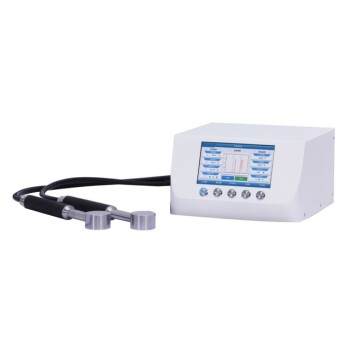
The halogen infrared heating furnace serves as the technological engine for Rapid Thermal Nitridation (RTN). By utilizing high-intensity infrared radiation under an ammonia (NH3) atmosphere, this equipment drives the chemical reduction and nitridation required to convert titanium dioxide (TiO2) sol-gel films into titanium nitride (TiN). Its primary function is to deliver precise, rapid heating cycles that ensure complete crystallization while strictly managing the thermal budget.
The core value of this furnace lies in its ability to decouple high-temperature processing from long exposure times. Unlike conventional ovens, it uses pulsed infrared energy to achieve complete film nitridation rapidly, protecting both the substrate and the heating elements from thermal degradation.
The Mechanics of Rapid Thermal Nitridation
High-Intensity Infrared Radiation
The furnace operates by emitting high-intensity infrared radiation. This allows for extremely rapid heating rates that are unattainable with standard convection or resistive heating methods.
The radiation directly targets the film, accelerating the physical and chemical changes necessary for the phase transition from oxide (TiO2) to nitride (TiN).
The Role of Chemical Atmosphere
Heat alone is insufficient for this conversion; the furnace must operate within an ammonia (NH3) atmosphere.
The halogen infrared source provides the thermal energy required to activate the reaction between the TiO2 film and the ammonia gas, facilitating the reduction and subsequent nitridation.
Cycle-Based Heating Protocols
A defining characteristic of this process is the use of multiple heating cycles rather than a continuous blast of heat.
For example, a typical protocol might involve 10 distinct cycles operating at 30% power. This cycling is critical for driving the reaction forward incrementally without overwhelming the material or the equipment.
Advantages Over Conventional Heating
Maximizing Process Efficiency
Conventional high-temperature furnaces require long durations to achieve crystallization.
In contrast, the halogen infrared furnace enables complete crystallization and nitridation in a very short time. This drastically reduces total processing time and increases throughput.
Controlling the Thermal Budget
The "thermal budget" refers to the total amount of thermal energy transferred to the workpiece.
By using rapid, controlled cycles, this furnace minimizes the total thermal load. This effectively minimizes thermal damage to the substrate, making it compatible with materials that cannot withstand prolonged high-temperature soaking.
Understanding the Operational Trade-offs
Equipment Longevity Considerations
While the process is intense, the equipment is designed to manage its own wear.
The reference specifically notes that the cyclical heating method is designed to protect the heating lamps. Continuous operation at maximum intensity could degrade the infrared sources, so adhering to the multi-cycle approach is essential for equipment durability.
Precision vs. Simplicity
This is not a "set and forget" thermal process.
Achieving high-quality TiN films requires precise control over the number of cycles and power percentages (e.g., the 30% power setting). The operator must finely tune these parameters to balance the reaction rate with the thermal limits of the system.
Making the Right Choice for Your Process
If you are evaluating whether to implement halogen infrared heating for your sol-gel applications, consider your specific constraints:
- If your primary focus is processing speed: This furnace is the superior choice, as it achieves complete crystallization significantly faster than conventional long-duration furnaces.
- If your primary focus is substrate integrity: The precise control over the thermal budget makes this ideal for minimizing thermal damage to sensitive underlying materials.
By leveraging pulsed infrared energy, you transform a slow, thermal-heavy process into a rapid, precise chemical reaction.
Summary Table:
| Feature | Halogen Infrared Heating (RTN) | Conventional Furnace Heating |
|---|---|---|
| Heating Mechanism | High-intensity infrared radiation | Convection or resistive heating |
| Process Speed | Extremely rapid; complete in minutes | Slow; requires long soak times |
| Atmosphere Control | Optimized for Ammonia (NH3) reaction | General atmosphere control |
| Thermal Budget | Low; protects substrate from damage | High; risk of substrate degradation |
| Key Outcome | Rapid crystallization & nitridation | Continuous thermal exposure |
Elevate Your Material Research with KINTEK Precision
Ready to master Rapid Thermal Nitridation? KINTEK specializes in advanced laboratory solutions, providing the high-performance high-temperature furnaces—including specialized vacuum, atmosphere, and tube systems—needed for precise sol-gel conversions.
Whether you are processing TiO2 films or developing next-generation ceramics, our comprehensive range of crushing systems, hydraulic presses, and high-purity consumables like crucibles ensures your lab achieves peak efficiency with a minimal thermal budget.
Contact our technical experts today to find the perfect thermal solution for your application.
Contact KINTEK for a Consultation
References
- Arnaud Valour, Yves Jourlin. Optical, electrical and mechanical properties of TiN thin film obtained from a TiO2 sol-gel coating and rapid thermal nitridation. DOI: 10.1016/j.surfcoat.2021.127089
This article is also based on technical information from Kintek Solution Knowledge Base .
Related Products
- 1400℃ Controlled Atmosphere Furnace with Nitrogen and Inert Atmosphere
- 1700℃ Controlled Atmosphere Furnace Nitrogen Inert Atmosphere Furnace
- 1200℃ Controlled Atmosphere Furnace Nitrogen Inert Atmosphere Furnace
- Controlled Nitrogen Inert Hydrogen Atmosphere Furnace
- 2200 ℃ Tungsten Vacuum Heat Treat and Sintering Furnace
People Also Ask
- What is the necessity of controlled atmosphere furnaces for gas corrosion? Ensure Precise Material Failure Modeling
- How is oxygen (O2) used in controlled furnace atmospheres? Mastering Surface Engineering for Metals
- What is the role of the furnace atmosphere? Master Precise Metallurgical Control for Your Heat Treatment
- What is a controlled atmosphere furnace? Achieve Purity and Precision in High-Temp Processing
- What is a controlled atmosphere furnace for heat treatment? Master Surface Chemistry and Metallurgy