Knowledge Resources What do you mean by sintering? A Guide to Solid-State Manufacturing
Author avatar

Tech Team · Kintek Solution

Updated 3 months ago

What do you mean by sintering? A Guide to Solid-State Manufacturing


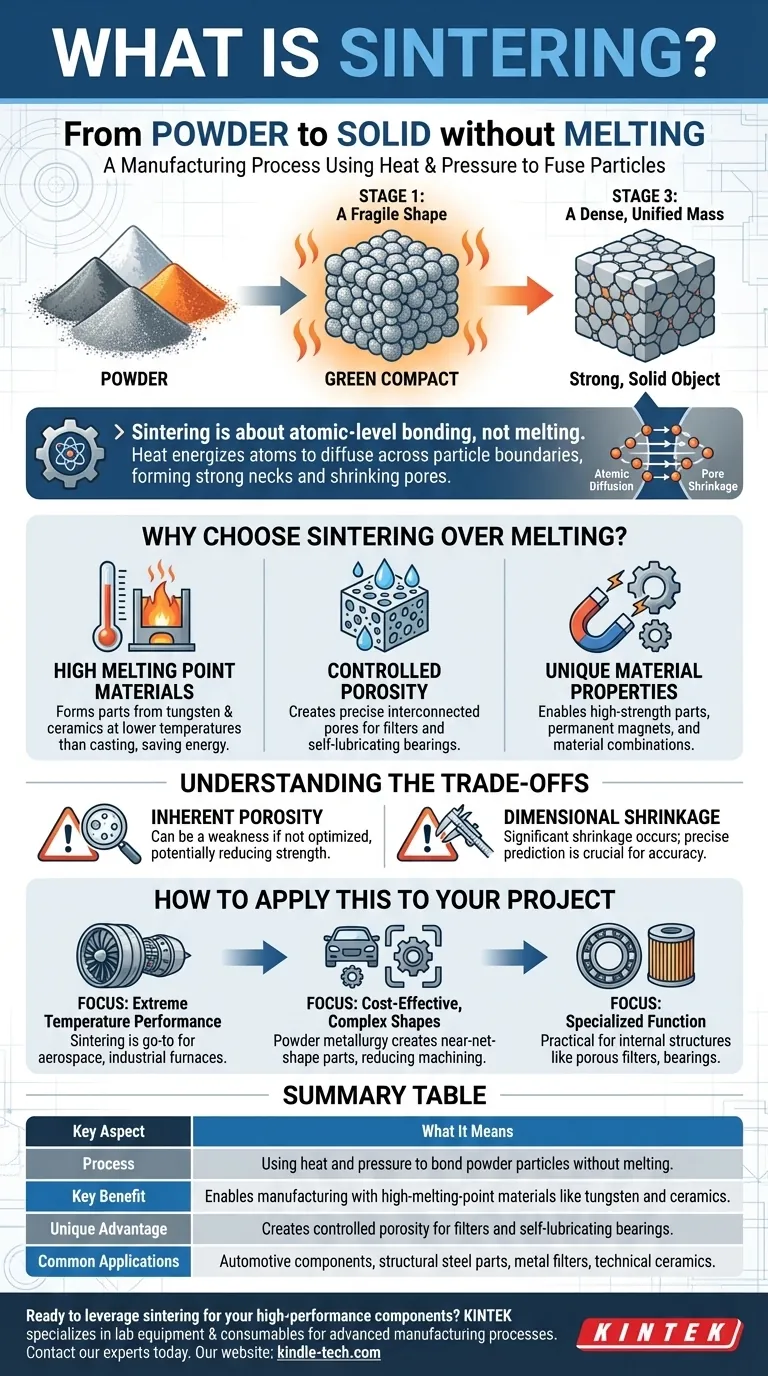
In short, sintering is a manufacturing process that uses heat and pressure to fuse particles together into a solid object without melting them into a liquid. Imagine compressing a pile of metallic or ceramic powder and heating it just enough for the individual particles to weld themselves together at their contact points. The result is a single, solid mass created directly from powder.

Sintering is fundamentally about atomic-level bonding, not melting. It leverages heat to give atoms the energy to diffuse across particle boundaries, effectively fusing a powder compact into a dense, solid component with unique properties.
What do you mean by sintering? A Guide to Solid-State Manufacturing

How Sintering Fundamentally Works

To understand sintering, it's best to think of it as a three-stage process that transforms loose powder into a solid object.

The Starting Point: A 'Green' Compact

The process begins with a powder of a specific material, such as a metal, ceramic, or plastic. This powder is typically pressed into a desired shape, often called a "green compact." At this stage, the object has shape but is fragile, with particles only held together by mechanical friction.

The Role of Heat: Atomic Diffusion

The green compact is then heated in a controlled furnace to a temperature below the material's melting point. This heat is the critical ingredient. It provides the thermal energy needed to make the atoms at the surface of each particle highly active.

These energized atoms begin to move and diffuse across the boundaries where particles touch. This atomic transport effectively closes the gaps and pores between particles, forming strong metallurgical bonds or "necks" between them.

The Result: A Dense, Unified Mass

As this diffusion process continues, the individual particles merge, the pores shrink, and the overall part becomes denser and stronger. The final result is a single, solid piece that has been fundamentally transformed from a collection of discrete particles into a unified material.

Why Choose Sintering Over Melting?

Sintering is not just an alternative to casting (melting and pouring); it enables the creation of materials and shapes that are otherwise difficult or impossible to produce.

Working with High Melting Point Materials

Many advanced materials, like tungsten and certain technical ceramics, have extremely high melting points. Melting and casting them is energy-intensive, expensive, and technically challenging. Sintering allows them to be formed into solid parts at much lower temperatures.

Creating Controlled Porosity

Sintering is unique in its ability to create parts with a precisely controlled level of porosity. This is essential for products like metal filters or self-lubricating bearings, where a network of interconnected pores is a required feature. Casting cannot achieve this.

Achieving Unique Material Properties

The process allows for the creation of structural steel parts, high-strength components, and specialized products like permanent magnets. Because it operates in the solid state, it can also be used to combine materials that would not normally mix in a liquid state.

Understanding the Trade-offs

While powerful, sintering is not a universal solution. It comes with specific considerations that must be managed.

Inherent Porosity Can Be a Weakness

Unless the process is perfectly optimized, some residual porosity often remains in the final part. These microscopic voids can act as stress concentration points, potentially reducing the material's ultimate strength compared to a fully dense, wrought equivalent.

Dimensional Shrinkage Must Be Controlled

As the particles fuse and the pores close, the entire component shrinks. This shrinkage is significant and must be precisely predicted and controlled to achieve accurate final dimensions, which adds a layer of complexity to the process design.

How to Apply This to Your Project

Your choice to use sintering depends entirely on the material and the desired outcome for your component.

  • If your primary focus is extreme temperature performance: Sintering is the go-to method for creating parts from high-melting-point materials like tungsten or advanced ceramics for aerospace or industrial furnace applications.
  • If your primary focus is cost-effective, complex shapes: For components like automotive gears and structural brackets, powder metallurgy (which uses sintering) can produce near-net-shape parts with minimal machining, saving significant cost.
  • If your primary focus is a specialized function: Sintering is the only practical way to produce components defined by their internal structure, such as porous metal filters or oil-impregnated bearings.

Ultimately, sintering empowers engineers to build materials from the particle level upwards, unlocking properties and applications that traditional melt-based processes cannot access.

Summary Table:

Key Aspect What It Means
Process Using heat and pressure to bond powder particles without melting.
Key Benefit Enables manufacturing with high-melting-point materials like tungsten and ceramics.
Unique Advantage Creates controlled porosity for filters and self-lubricating bearings.
Common Applications Automotive components, structural steel parts, metal filters, and technical ceramics.

Ready to leverage sintering for your high-performance components?

KINTEK specializes in the lab equipment and consumables that power advanced manufacturing processes like sintering. Whether you're developing new materials or optimizing production, we provide the reliable tools you need for R&D and quality control.

Contact our experts today to discuss how we can support your laboratory's specific needs in materials science and powder metallurgy.

Visual Guide
What do you mean by sintering? A Guide to Solid-State Manufacturing Visual Guide

Related Products

People Also Ask

Related Products

Vacuum Heat Treat and Sintering Furnace with 9MPa Air Pressure

Vacuum Heat Treat and Sintering Furnace with 9MPa Air Pressure

The air pressure sintering furnace is a high-tech equipment commonly used for the sintering of advanced ceramic materials. It combines vacuum sintering and pressure sintering techniques to achieve high-density and high-strength ceramics.

Spark Plasma Sintering Furnace SPS Furnace

Spark Plasma Sintering Furnace SPS Furnace

Discover the benefits of Spark Plasma Sintering Furnaces for rapid, low-temperature material preparation. Uniform heating, low cost & eco-friendly.

Vacuum Heat Treat and Molybdenum Wire Sintering Furnace for Vacuum Sintering

Vacuum Heat Treat and Molybdenum Wire Sintering Furnace for Vacuum Sintering

A vacuum molybdenum wire sintering furnace is a vertical or bedroom structure, which is suitable for withdrawal, brazing, sintering and degassing of metal materials under high vacuum and high temperature conditions. It is also suitable for dehydroxylation treatment of quartz materials.

Small Vacuum Heat Treat and Tungsten Wire Sintering Furnace

Small Vacuum Heat Treat and Tungsten Wire Sintering Furnace

The small vacuum tungsten wire sintering furnace is a compact experimental vacuum furnace specially designed for universities and scientific research institutes. The furnace features a CNC welded shell and vacuum piping to ensure leak-free operation. Quick-connect electrical connections facilitate relocation and debugging, and the standard electrical control cabinet is safe and convenient to operate.

Dental Porcelain Zirconia Sintering Ceramic Vacuum Press Furnace

Dental Porcelain Zirconia Sintering Ceramic Vacuum Press Furnace

Get precise dental results with Dental Vacuum Press Furnace. Automatic temperature calibration, low noise tray, and touch screen operation. Order now!

Vacuum Heat Treat and Pressure Sintering Furnace for High Temperature Applications

Vacuum Heat Treat and Pressure Sintering Furnace for High Temperature Applications

Vacuum pressure sintering furnaces are designed for high temperature hot pressing applications in metal and ceramic sintering. Its advanced features ensure precise temperature control, reliable pressure maintenance, and a robust design for seamless operation.

Dental Porcelain Zirconia Sintering Ceramic Furnace Chairside with Transformer

Dental Porcelain Zirconia Sintering Ceramic Furnace Chairside with Transformer

Experience top-notch sintering with Chairside Sintering Furnace with Transformer. Easy to operate, noise-free pallet, and automatic temperature calibration. Order now!

Vacuum Dental Porcelain Sintering Furnace

Vacuum Dental Porcelain Sintering Furnace

Get precise and reliable results with KinTek's Vacuum Porcelain Furnace. Suitable for all porcelain powders, it features hyperbolic ceramic furnace function, voice prompt, and automatic temperature calibration.

High Temperature Muffle Oven Furnace for Laboratory Debinding and Pre Sintering

High Temperature Muffle Oven Furnace for Laboratory Debinding and Pre Sintering

KT-MD High temperature debinding and pre-sintering furnace for ceramic materials with various molding processes. Ideal for electronic components such as MLCC and NFC.

2200 ℃ Tungsten Vacuum Heat Treat and Sintering Furnace

2200 ℃ Tungsten Vacuum Heat Treat and Sintering Furnace

Experience the ultimate refractory metal furnace with our Tungsten vacuum furnace. Capable of reaching 2200℃, perfect for sintering advanced ceramics and refractory metals. Order now for high-quality results.

Vacuum Heat Treat Sintering Brazing Furnace

Vacuum Heat Treat Sintering Brazing Furnace

A vacuum brazing furnace is a type of industrial furnace used for brazing, a metalworking process that joins two pieces of metal using a filler metal that melts at a lower temperature than the base metals. Vacuum brazing furnaces are typically used for high-quality applications where a strong, clean joint is required.

600T Vacuum Induction Hot Press Furnace for Heat Treat and Sintering

600T Vacuum Induction Hot Press Furnace for Heat Treat and Sintering

Discover the 600T Vacuum Induction Hot Press Furnace, designed for high-temperature sintering experiments in vacuum or protected atmospheres. Its precise temperature and pressure control, adjustable working pressure, and advanced safety features make it ideal for nonmetal materials, carbon composites, ceramics, and metal powders.

Mesh belt controlled atmosphere furnace

Mesh belt controlled atmosphere furnace

Discover our KT-MB mesh belt sintering furnace - perfect for high-temperature sintering of electronic components & glass insulators. Available for open air or controlled atmosphere environments.

2200 ℃ Graphite Vacuum Heat Treat Furnace

2200 ℃ Graphite Vacuum Heat Treat Furnace

Discover the power of the KT-VG Graphite Vacuum Furnace - with a maximum working temperature of 2200℃, it's perfect for vacuum sintering of various materials. Learn more now.

Ultra-High Temperature Graphite Vacuum Graphitization Furnace

Ultra-High Temperature Graphite Vacuum Graphitization Furnace

The ultra-high temperature graphitization furnace utilizes medium frequency induction heating in a vacuum or inert gas environment. The induction coil generates an alternating magnetic field, inducing eddy currents in the graphite crucible, which heats up and radiates heat to the workpiece, bringing it to the desired temperature. This furnace is primarily used for graphitization and sintering of carbon materials, carbon fiber materials, and other composite materials.

Controlled Nitrogen Inert Hydrogen Atmosphere Furnace

Controlled Nitrogen Inert Hydrogen Atmosphere Furnace

KT-AH Hydrogen atmosphere furnace - induction gas furnace for sintering/annealing with built-in safety features, dual housing design, and energy-saving efficiency. Ideal for lab and industrial use.

Vacuum Heat Treat Furnace with Ceramic Fiber Liner

Vacuum Heat Treat Furnace with Ceramic Fiber Liner

Vacuum furnace with polycrystalline ceramic fiber insulation liner for excellent heat insulation and uniform temperature field. Choose from 1200℃ or 1700℃ max. working temperature with high vacuum performance and precise temperature control.

Graphite Vacuum Furnace High Thermal Conductivity Film Graphitization Furnace

Graphite Vacuum Furnace High Thermal Conductivity Film Graphitization Furnace

The high thermal conductivity film graphitization furnace has uniform temperature, low energy consumption and can operate continuously.

Non Consumable Vacuum Arc Induction Melting Furnace

Non Consumable Vacuum Arc Induction Melting Furnace

Explore the benefits of Non-Consumable Vacuum Arc Furnace with high melting point electrodes. Small, easy to operate & eco-friendly. Ideal for laboratory research on refractory metals & carbides.

Vacuum Arc Induction Melting Furnace

Vacuum Arc Induction Melting Furnace

Discover the power of Vacuum Arc Furnace for melting active & refractory metals. High-speed, remarkable degassing effect, and free of contamination. Learn more now!


Leave Your Message